Map of France showing where the Carleo arms are recorded
The Carleo arms were recorded in Dauphine, c. 1663.
Dauphine lay in the mountains of south-eastern France, a country of small estates and scattered valleys. Its gentry were many and mostly modest, and even a small landholding was enough to justify arms.
This is where the arms were entered in the register. Families often moved to other parts of the country, so the same name can turn up in more than one region.
The body that granted and recorded arms in France in this period.
Louis XIV of France
Sovereign of the period
Louis XIV of France
1643–1715
Reigning in France when the Carleo arms are first recorded.
How Arms Worked in France
In France, a coat of arms was a mark of honor that passed down through the male line to all legitimate descendants. Families often used the same shield without changes to show their shared heritage. If a branch wanted to stand out, they could add a small mark to their shield to show their specific place in the family tree.
Granting authority
The Juge d'armes de France acted as the official authority that regulated and verified coats of arms across the country.
How they got arms
Families typically inherited their arms from ancestors, though they could also receive them through royal grants or by proving their noble status.
Where arms were recorded
Coats of arms were officially recorded in the Armorial Général de France, which began its main collection in the year 1696.
The family's standing
Recorded among the armigerous families of Dauphine.
Origin & History of the Carleo Family in France
The family name Carleo traces its roots to the mountainous region of Dauphiné in southeastern France. By the year 1663, records confirm that members of the family were well-established in this area, which served as a strategic gateway between the French kingdom and the Italian peninsula. The name itself likely evolved from local linguistic traditions that blended regional dialects with influences from neighboring territories. Families in the Dauphiné region during the seventeenth century often lived in tight-knit rural communities where they worked as landowners or skilled tradespeople. Because the region was a crossroads for trade and travel, the Carleo family was positioned in a place where cultural exchanges were common. This environment helped shape the early identity of the family as they navigated the social and economic changes occurring in provincial France during the reign of King Louis XIV.
Coat of Arms & Family Crest Details
Symbols on this shield
mountThe ground held, and steadfastness upon it
Colours
Gold (Or)Means: Generosity
Green (Vert)Means: Hope
Historical info
Source
J. B. Rietstap, Armorial Général, Gouda: G. B. van Goor Zonen, 1884–87
Blazon (the actual original written record)
“D'or à deux C affr. et entrelacés de sa., surmontant un tertre de trois coupeaux de sin. C.: un homme iss., hab. de sa., au rabat d'or, tenant de sa main dextre un chardon tigé et feuillé de sin., fleuri au nat. L. d'or et de sa.”
SwitzerlandBäle, c. 1745
Digital archive packCoat of arms PNG, gold border print PDF, vector SVG and the certificate of authenticity. Sent to your email in minutes.
Map of Switzerland showing where the Carleo arms are recorded
The Carleo arms were recorded in Bäle, c. 1745.
This is where the arms were entered in the register. Families often moved to other parts of the country, so the same name can turn up in more than one region.
The body that granted and recorded arms in Switzerland in this period.
How Arms Worked in Switzerland
In Switzerland, coats of arms were not restricted to the nobility and were often adopted by common citizens and families. These symbols were passed down through generations to show family identity. When branches of a family grew, they often changed small details of the design to distinguish their own line from the original group.
Granting authority
Cantonal and civic authorities managed the use of coats of arms within their specific regions and local jurisdictions.
How they got arms
Families typically assumed their own coats of arms based on local custom rather than receiving them from a central monarch.
Where arms were recorded
Arms were recorded in various cantonal and civic registers starting from the fourteenth century throughout the Swiss region.
The family's standing
Recorded among the armigerous families of Switzerland.
Origin & History of the Carleo Family in Switzerland
The history of the Carleo family in Switzerland is rooted in the vibrant urban environment of Basel during the mid-eighteenth century. By 1745, records confirm that members of the family were already established residents within this important trade hub. At that time, Basel was a center for commerce and craftsmanship, drawing people from across Europe to participate in its growing economy. Families like the Carleos often integrated into the local guild systems or merchant networks that defined the city’s social structure. While the name suggests a potential connection to southern European origins, the family’s presence in Basel highlights how individuals moved across borders to seek new opportunities in the Swiss cantons. Their early life in the city likely involved navigating the strict citizenship and residency laws that governed life in the Swiss Confederation during the Enlightenment. This period of settlement laid the foundation for the family's long-term integration into the local culture of the region.
Coat of Arms & Family Crest Details
Symbols on this shield
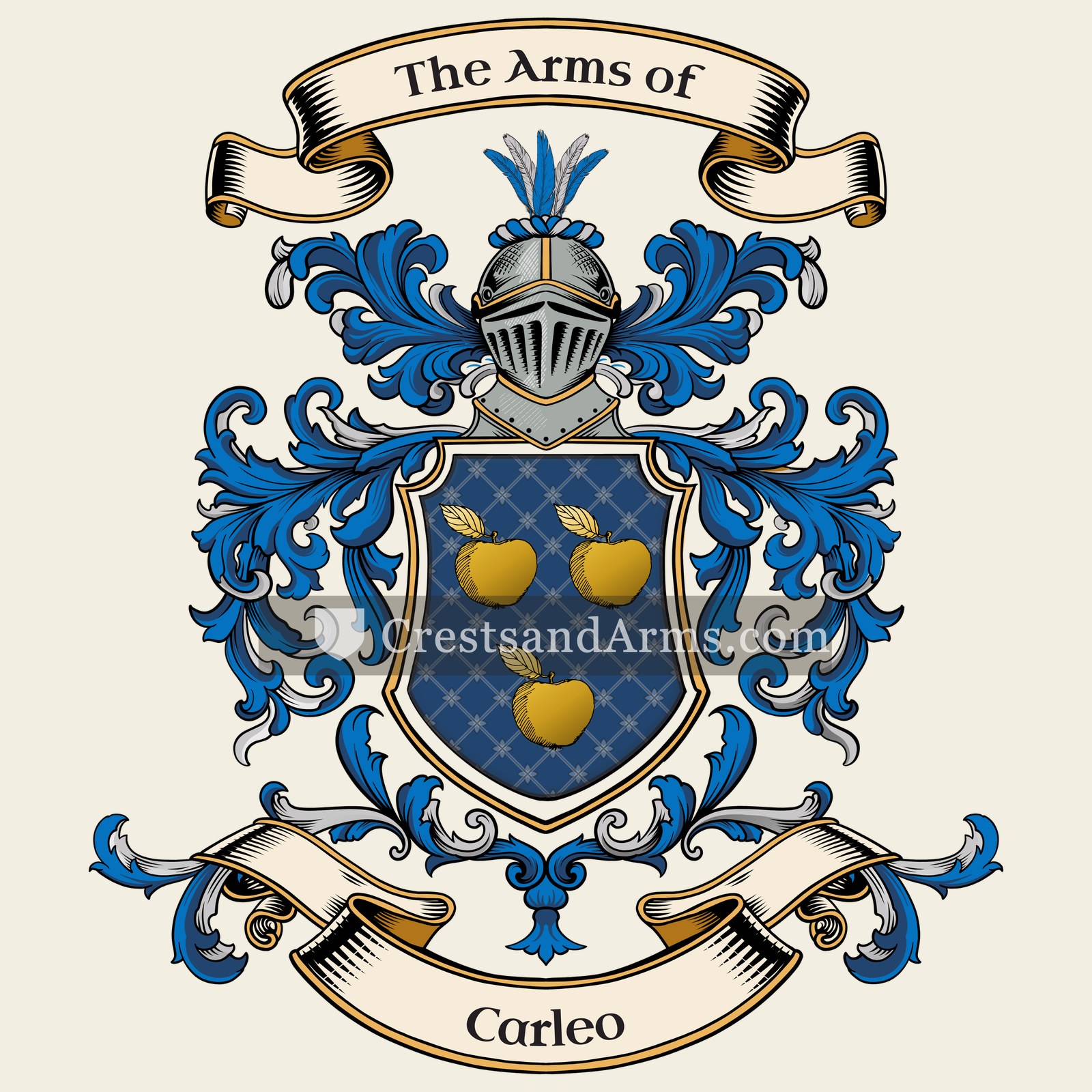
applePeace, plenty and long-standing settlement
Colours
Blue (Azure)Means: Loyalty and truth
Gold (Or)Means: Generosity
Historical info
Source
Sir Bernard Burke, The General Armory of England, Scotland, Ireland and Wales, London: Harrison & Sons, 1884
Blazon (the actual original written record)
“Az. three pomegranates or, seeded gu”
Englandc. 1620
Digital archive packCoat of arms PNG, gold border print PDF, vector SVG and the certificate of authenticity. Sent to your email in minutes.
Map of England showing where the Carleo arms are recorded
The Carleo arms were recorded in England, c. 1620.
Arms such as these were typically recorded in York.
Yorkshire is the largest of the English counties, and it held more gentry families than any other. Land there was split among a great many households rather than a few, so a great many of them carried arms.
This is where the arms were entered in the register. Families often moved to other parts of the country, so the same name can turn up in more than one region.
The body that granted and recorded arms in England in this period.
James VI and I
Sovereign of the period
James VI and I
1603–1625
Reigning in France when the Carleo arms are first recorded.
How Arms Worked in England
English heraldry allowed arms to be shared by all legitimate descendants of the original owner. These symbols were treated as personal property that moved through the generations to all children. While the eldest son kept the original design, other family members could use the same shield without needing to change it or register their own unique versions.
Granting authority
The College of Arms in London has regulated the use of coats of arms throughout England and Wales since 1484.
How they got arms
Families typically obtained their coats of arms through a formal grant from the Crown or by proving their ancient right to them.
Where arms were recorded
All official coats of arms are recorded in the registers kept at the College of Arms, which date back to the fifteenth century.
The family's standing
Recorded among the armigerous families of England.
Origin & History of the Carleo Family in England
The history of the Carleo family in England begins to emerge clearly in the early seventeenth century, specifically with documented records of the family residing in the historic city of York by 1620. During this period, York served as a vital northern hub for trade and administration, placing the family in a region characterized by deep religious transitions and shifting social structures. While the name itself suggests potential roots in Mediterranean or continental European naming traditions, its presence in a major English ecclesiastical center indicates that these early ancestors were likely integrated into the urban economy of the North. By establishing themselves in York, the Carleo family became part of a community defined by its ancient walls and bustling market life, navigating the complexities of life in Stuart-era England. Their presence in the city records provides a tangible link to a time when families were increasingly documented through parish registers and local administrative rolls, marking the beginning of their documented journey within the English landscape.
Related Branches & Arms
Root word
Carolus
A Latin name derived from the Germanic word for free man.
This name
CarleoA diminutive form indicating a descendant or follower of Charles.
also spelled
Carlee
Carley
Karle
Karley
Carll
Documented Sources
J. B. Rietstap, Armorial Général, Gouda: G. B. van Goor Zonen, 1884–87
Archives Départementales de l'Isère, Registres paroissiaux et d'état civil de la province du Dauphiné, 1663
Borel d'Hauterive, André, Annuaire de la noblesse de France et des maisons souveraines de l'Europe, 1855
Chorier, Nicolas, Histoire générale de Dauphiné, 1661
Digital archive packCoat of arms PNG, gold border print PDF, vector SVG and the certificate of authenticity. Sent to your email in minutes.




 mountThe ground held, and steadfastness upon it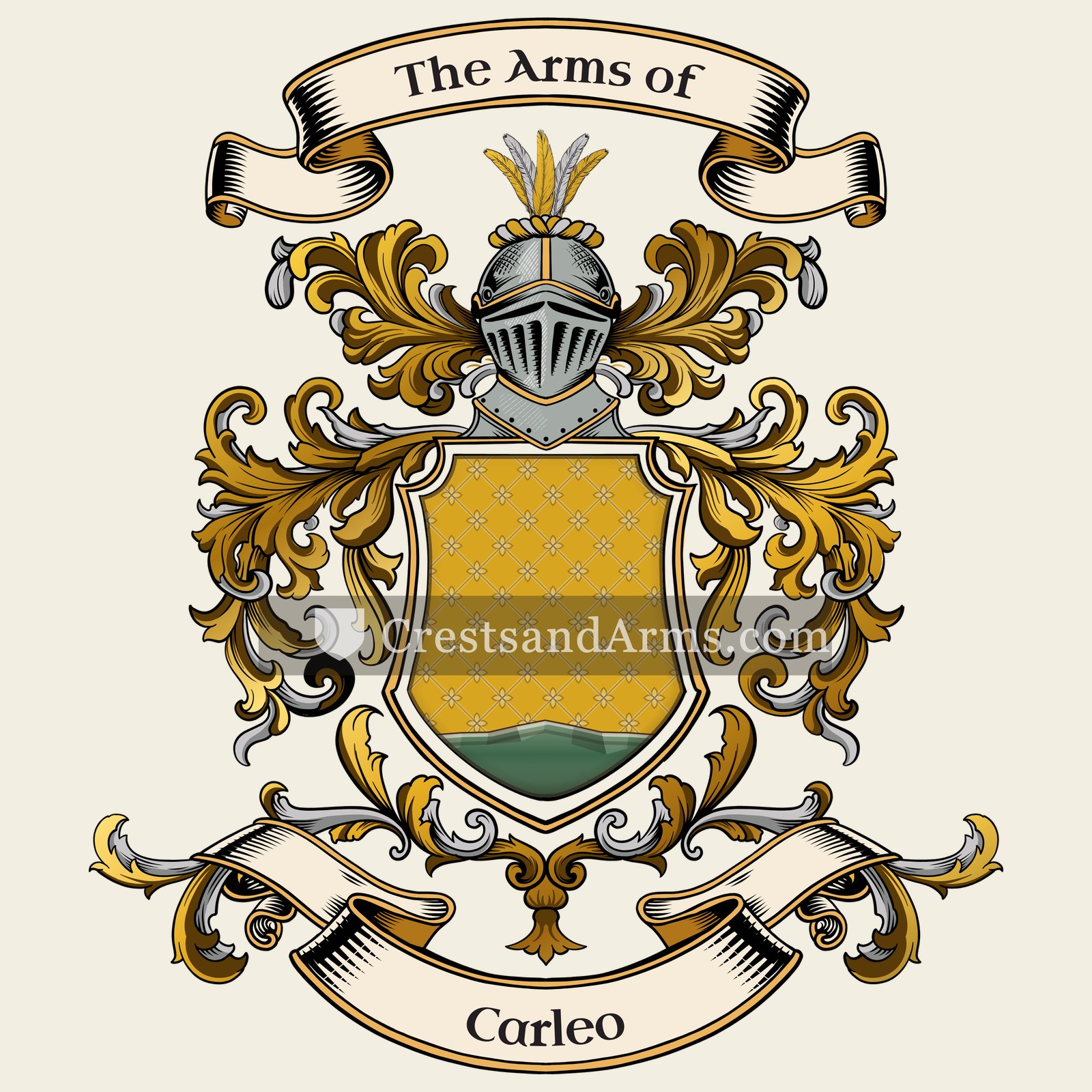

 applePeace, plenty and long-standing settlement