Map of Denmark showing where the Carlson arms are recorded
The Carlson arms were recorded in Denmark, c. 1722.
Arms such as these were typically recorded in Sjaælland.
Zealand held the Danish court, the crown's offices and Copenhagen itself. Families who served the king kept estates within reach of it, and royal service was the ordinary route to a coat of arms.
This is where the arms were entered in the register. Families often moved to other parts of the country, so the same name can turn up in more than one region.
The body that granted and recorded arms in Denmark in this period.
Frederik IV of Denmark
Sovereign of the period
Frederik IV of Denmark
1699–1730
Reigning in Denmark when the Carlson arms are first recorded.
How Arms Worked in Denmark
Danish heraldry during this period was closely tied to noble status and royal favor rather than being open to all citizens. Arms were typically granted by the monarch to individuals, and these symbols were then shared by all members of the noble house. If a family line died out, the right to use those specific arms ended with them.
Granting authority
The Danish royal chancery held the power to issue and regulate official coats of arms for the kingdom.
How they got arms
Families usually received their arms through a formal royal grant that confirmed their noble status and rights.
Where arms were recorded
These grants were officially recorded in the Danish Royal Chancery records starting in the sixteenth century.
The family's standing
Recorded among the armigerous families of Denmark.
Origin & History of the Carlson Family in Denmark
The name Carlson is a classic example of a patronymic surname, which means it was originally created to identify a person as the son of a man named Carl. In Denmark, this naming tradition was common for centuries before the government eventually required families to adopt permanent, hereditary surnames. By the year 1722, records confirm that members of the Carlson family were well-established on the island of Sjaælland. During this period, life for families in rural Denmark revolved heavily around the local parish church and the seasonal rhythms of agriculture. Because the name was tied to a specific father rather than a fixed family line, it was common for the spelling to shift slightly based on how a local clerk heard the name spoken. This fluidity reflects a time when identity was deeply rooted in one’s immediate community and local lineage rather than formal documentation. As the family moved through the eighteenth century, they remained part of the foundational social fabric of the Danish countryside, contributing to the agricultural and local development of the Sjaælland region.
Coat of Arms & Family Crest Details
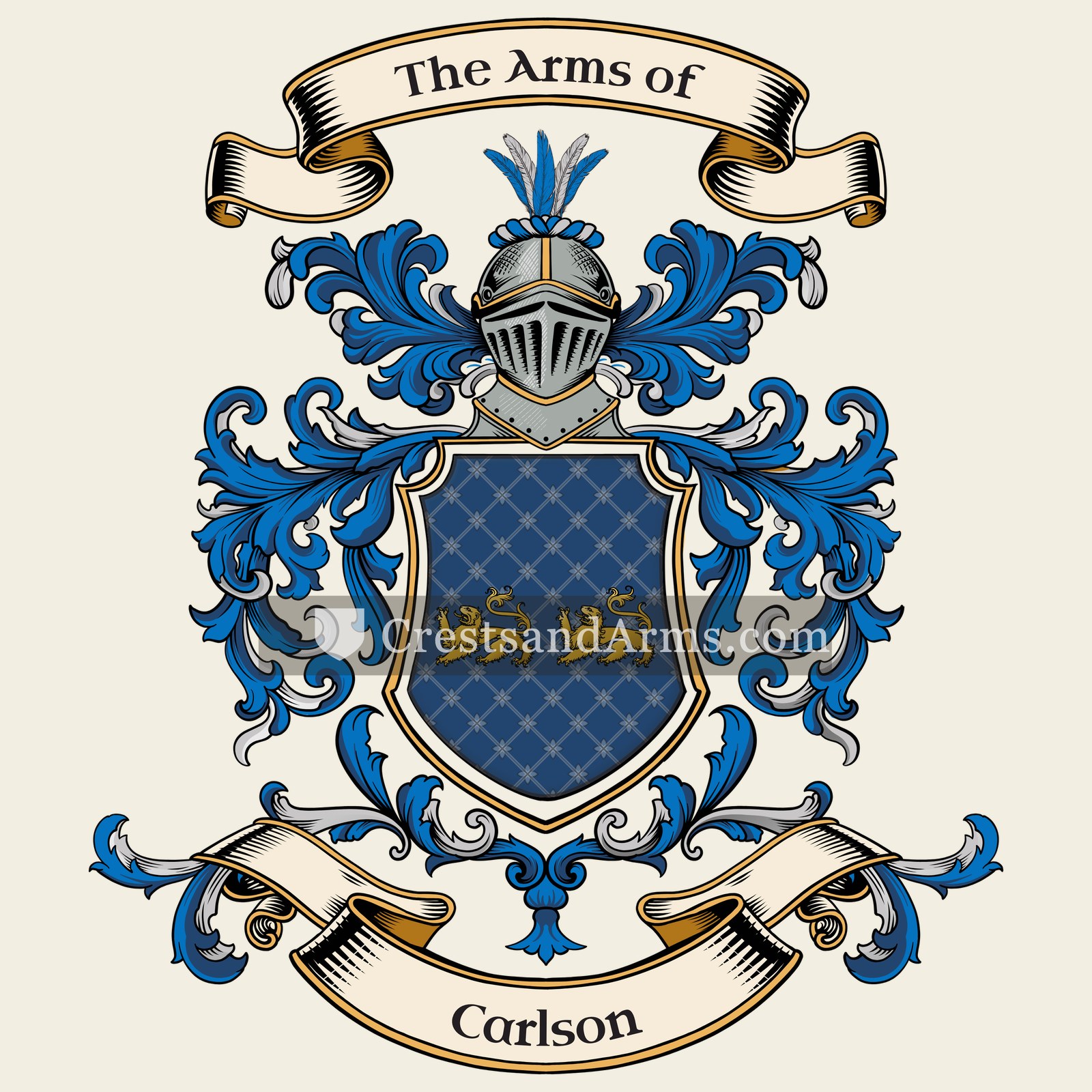
Symbols on this shield
lionCourage, strength and royalty
Colours
Blue (Azure)Means: Loyalty and truth
Gold (Or)Means: Generosity
Historical info
Source
J. B. Rietstap, Armorial Général, Gouda: G. B. van Goor Zonen, 1884–87
Blazon (the actual original written record)
“D'azur à deux lions affr. d'or. Cq. cour. C.: trois pl. d'aut., une d'or entre deux d'azur.”
Germanyc. 1827
Digital archive packCoat of arms PNG, gold border print PDF, vector SVG and the certificate of authenticity. Sent to your email in minutes.
Map of Germany showing where the Carlson arms are recorded
The Carlson arms were recorded in Germany, c. 1827.
Arms such as these were typically recorded in Bavaria.
Bavaria was a country of old landed families and walled market towns. Estates passed down the same line for centuries, and both the landowners and the leading townsmen kept arms, which is why so many Bavarian names sit in the registers.
This is where the arms were entered in the register. Families often moved to other parts of the country, so the same name can turn up in more than one region.
The body that granted and recorded arms in Germany in this period.
Frederick William III of Prussia
Sovereign of the period
Frederick William III of Prussia
1797–1840
Reigning in Denmark when the Carlson arms are first recorded.
How Arms Worked in Germany
Prussian heraldry was strictly tied to social rank and noble status rather than being a free choice for every citizen. These symbols were treated as permanent family property that moved through the generations to all legitimate heirs. If a family branch wanted to change their design to stand out, they had to apply for official permission to alter their specific version of the shield.
Granting authority
The Prussian Heroldsamt acted as the central state office that managed and strictly controlled all noble titles and coats of arms.
How they got arms
Families usually obtained their arms through formal royal grants or by proving their long-standing noble status to the state authorities.
Where arms were recorded
All official coats of arms were kept in the rolls of the Prussian Heroldsamt, which functioned from 1706 until 1918.
The family's standing
Recorded among the armigerous families of Germany.
Origin & History of the Carlson Family in Germany
The surname Carlson is a patronymic name, which means it was originally created to identify a person as the son of a man named Carl. While the name is often associated with Scandinavian roots, its presence in the German region of Bavaria by 1827 reflects the movement of families across Central Europe during the nineteenth century. In the German context, the name likely emerged as families sought to formalize their identities through stable surnames during a time of increasing government record-keeping. Many families living in Bavaria at this time were part of a growing class of farmers and craftsmen who were becoming more mobile as the Industrial Revolution began to change the landscape of the region. By settling in Bavaria, these early ancestors contributed to the local community while maintaining a name that honored their paternal lineage. This transition from a simple descriptive title to a permanent family name highlights the way individuals defined their place in society during a period of significant social and political change in Germany.
Carlson Meaning & Related Branches
Root word
Karl
A Germanic word meaning free man or freeman.
This name
CarlsonPatronymic surname meaning son of Karl.
also spelled
Karlsen
Carlson
Documented Sources
J. B. Rietstap, Armorial Général, Gouda: G. B. van Goor Zonen, 1884–87
Sørensen, John Kousgård. Danske Surnavne. 1991
Stigum, Hilmar. Vår gamle bondekultur. 1966
Rigsarkivet (Danish National Archives), Kirkebøger for Sjaælland (Parish registers for Sjaælland)
Rigsarkivet (Danish National Archives), Folketællinger (Census records)
Digital archive packCoat of arms PNG, gold border print PDF, vector SVG and the certificate of authenticity. Sent to your email in minutes.


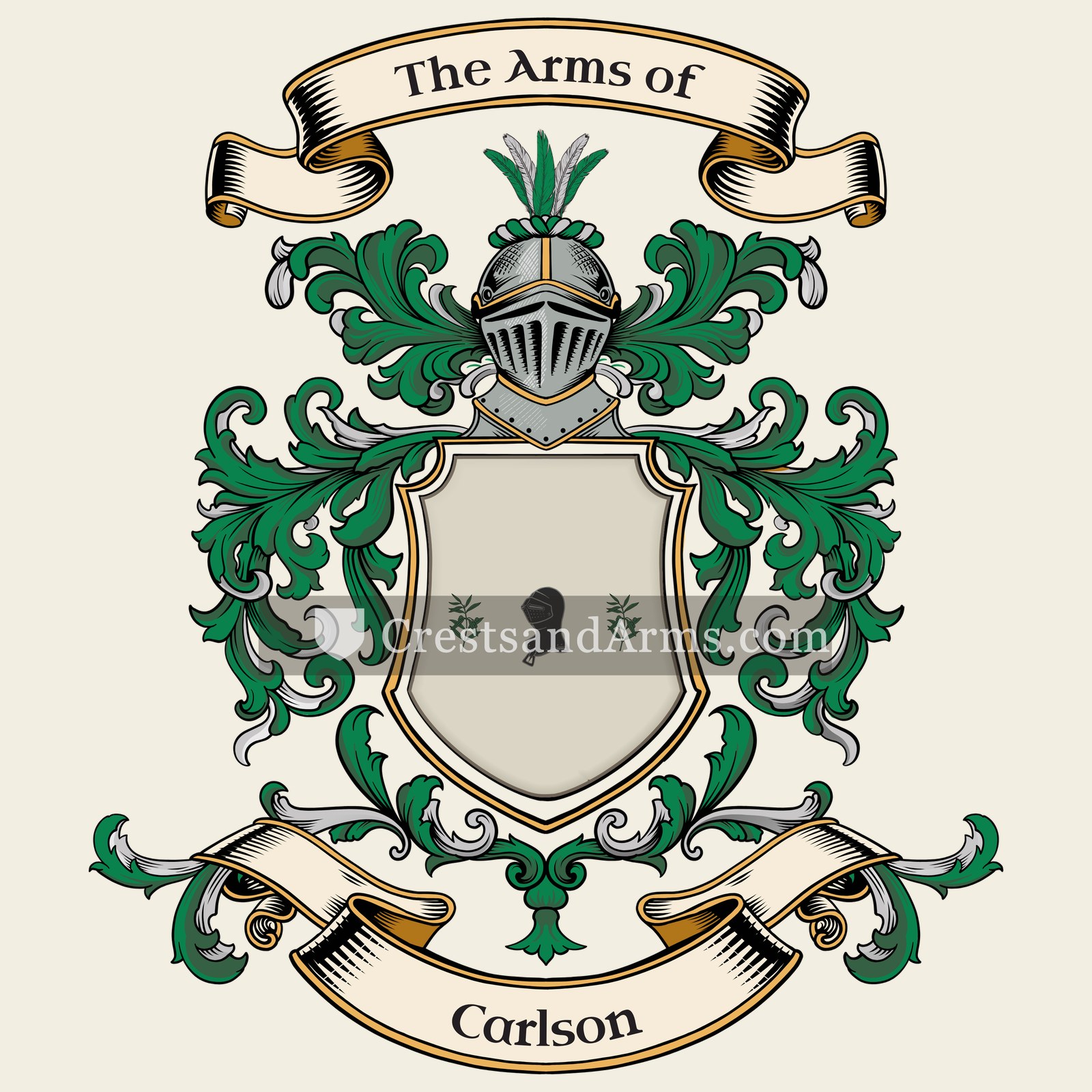
 helmetWisdom and security in defence
 branchPeace, and new growth
 helmetWisdom and security in defence
 branchPeace, and new growth


 lionCourage, strength and royalty