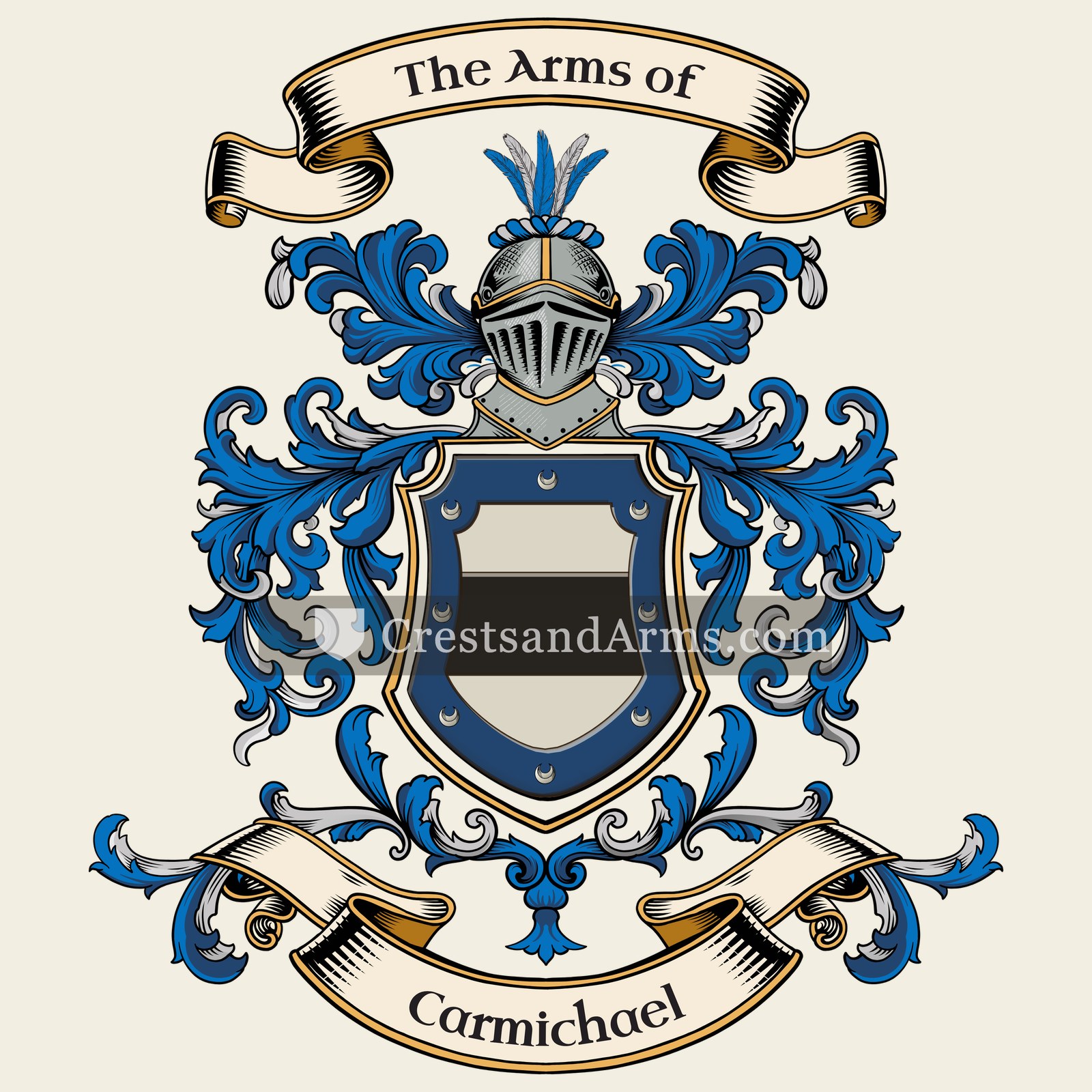
A record of documented arms, meaning and origin, researched for the Carmichael family lines. Documented in 3 countries.
Reg. 4988 · French, A–C
Coat of Arms & Family Crest Details
Symbols on this shield
fessThe military belt, and readiness to serve
Colours
Silver (Argent)Means: Peace and sincerity
Blue (Azure)Means: Loyalty and truth
Historical info
Source
J. B. Rietstap, Armorial Général, Gouda: G. B. van Goor Zonen, 1884–87
Blazon (the actual original written record)
“D'arg. à une fasce câblée d'azur et de gu. C.: un avant-bras arm., posé en pal, la main tenant une lance rompue. T.: à dextre un chevalier, arm. de toutes pièces, la visière levée, le casque panaché de trois pl. d'aut. d'arg., tenant de sa main dextre un bâton de commandement, la sen. appuyée sur sa hanche; à sen. un cheval d'arg., bridé, houssé et sanglé de gu. D.: TOUJOURS PREST.”
Francec. 1627
Digital archive packCoat of arms PNG, gold border print PDF, vector SVG and the certificate of authenticity. Sent to your email in minutes.
Map of France showing where the Carmichael arms are recorded
The Carmichael arms were recorded in France, c. 1627.
Arms such as these were typically recorded in Bretagne.
More families held coats of arms in Bretagne than anywhere else in France. The land was divided into many small estates rather than a few large ones, so far more households counted as gentry, and each needed a shield of its own to be told apart.
This is where the arms were entered in the register. Families often moved to other parts of the country, so the same name can turn up in more than one region.
The body that granted and recorded arms in France in this period.
Louis XIII of France
Sovereign of the period
Louis XIII of France
1617–1643
Reigning in France when the Carmichael arms are first recorded.
How Arms Worked in France
In France, a coat of arms was a mark of honor that passed down through the male line to all legitimate descendants. Families often used the same shield without changes to show their shared heritage. If a branch wanted to stand out, they could add a small mark to their shield to show their specific place in the family tree.
Granting authority
The Juge d'armes de France acted as the official authority that regulated and verified coats of arms across the country.
How they got arms
Families typically inherited their arms from ancestors, though they could also receive them through royal grants or by proving their noble status.
Where arms were recorded
Coats of arms were officially recorded in the Armorial Général de France, which began its main collection in the year 1696.
The family's standing
Recorded among the armigerous families of France.
Origin & History of the Carmichael Family in France
The history of the Carmichael name in France is deeply tied to the region of Bretagne, where records confirm the family presence by 1627. During this era, the name likely arrived in France through the close historical alliance between the Scottish and French crowns known as the Auld Alliance. Many Scottish families moved to the French coast to serve as soldiers, diplomats, or merchants, eventually settling into the local culture of the Breton ports. Over time, these families integrated into the social fabric of the region, often adopting local naming conventions while maintaining their distinct ancestral identity. By the early seventeenth century, the Carmichaels in Bretagne had become established members of their communities, participating in the local economy and administrative life of the province. This transition from foreign visitors to settled residents highlights the long-standing connections between the Celtic regions of Europe during the early modern period.
Coat of Arms & Family Crest Details
Symbols on this shield
fessThe military belt, and readiness to serve
Colours
Silver (Argent)Means: Peace and sincerity
Historical info
Source
Sir Bernard Burke, The General Armory of England, Scotland, Ireland and Wales, London: Harrison & Sons, 1884
Blazon (the actual original written record)
“Ar. a fess wreathed az. and gu”
LanarkHyndford · Lanark, c. 1787
Digital archive packCoat of arms PNG, gold border print PDF, vector SVG and the certificate of authenticity. Sent to your email in minutes.
Map of Scotland showing where the Carmichael arms are recorded
The Carmichael arms were recorded in Lanark, c. 1787.
Lanarkshire ran along the upper Clyde, farming country with coal beneath it. Its landed families were long-established, and long establishment is what brought them into the register.
This is where the arms were entered in the register. Families often moved to other parts of the country, so the same name can turn up in more than one region.
The body that granted and recorded arms in Scotland in this period.
George III of Great Britain
Sovereign of the period
George III of Great Britain
1760–1801
Reigning in France when the Carmichael arms are first recorded.
How Arms Worked in Scotland
Scottish heraldry is unique because it treats a coat of arms as a piece of personal property protected by law. Only one person can own a specific design at any given time. When a family grows, the head keeps the original shield while other relatives must apply for their own distinct version with slight changes to prove their specific identity.
Granting authority
The Court of the Lord Lyon acts as the official body that regulates and controls all heraldic matters throughout Scotland.
How they got arms
Individuals obtain a legal right to their arms through a formal petition process that confirms their identity and family connection.
Where arms were recorded
All valid coats of arms are officially entered into the Public Register of All Arms and Bearings starting from 1672.
The family's standing
Recorded among the armigerous families of Lanark.
Origin & History of the Carmichael Family in Scotland
The surname Carmichael originates from a specific place in the Southern Uplands of Scotland known as Carmichael in Lanarkshire. The name is locational, meaning the first people to use it were likely those who lived on or managed the lands surrounding the hill now known as Tinto. By the 13th century, the family had established a firm presence in the region, and they were recorded as holding these lands under the protection of the Douglas family. Over the centuries, the family became deeply integrated into the local government and social structure of Lanark. By the time the name appears in records from 1787, the Carmichaels had been part of the local community for hundreds of years, serving as landowners, administrators, and neighbors in the bustling market town of Lanark. Their history is tied closely to the landscape of the Clyde Valley, reflecting a long tradition of Scottish families who took their identity directly from the soil they cultivated.
Coat of Arms & Family Crest Details
Symbols on this shield
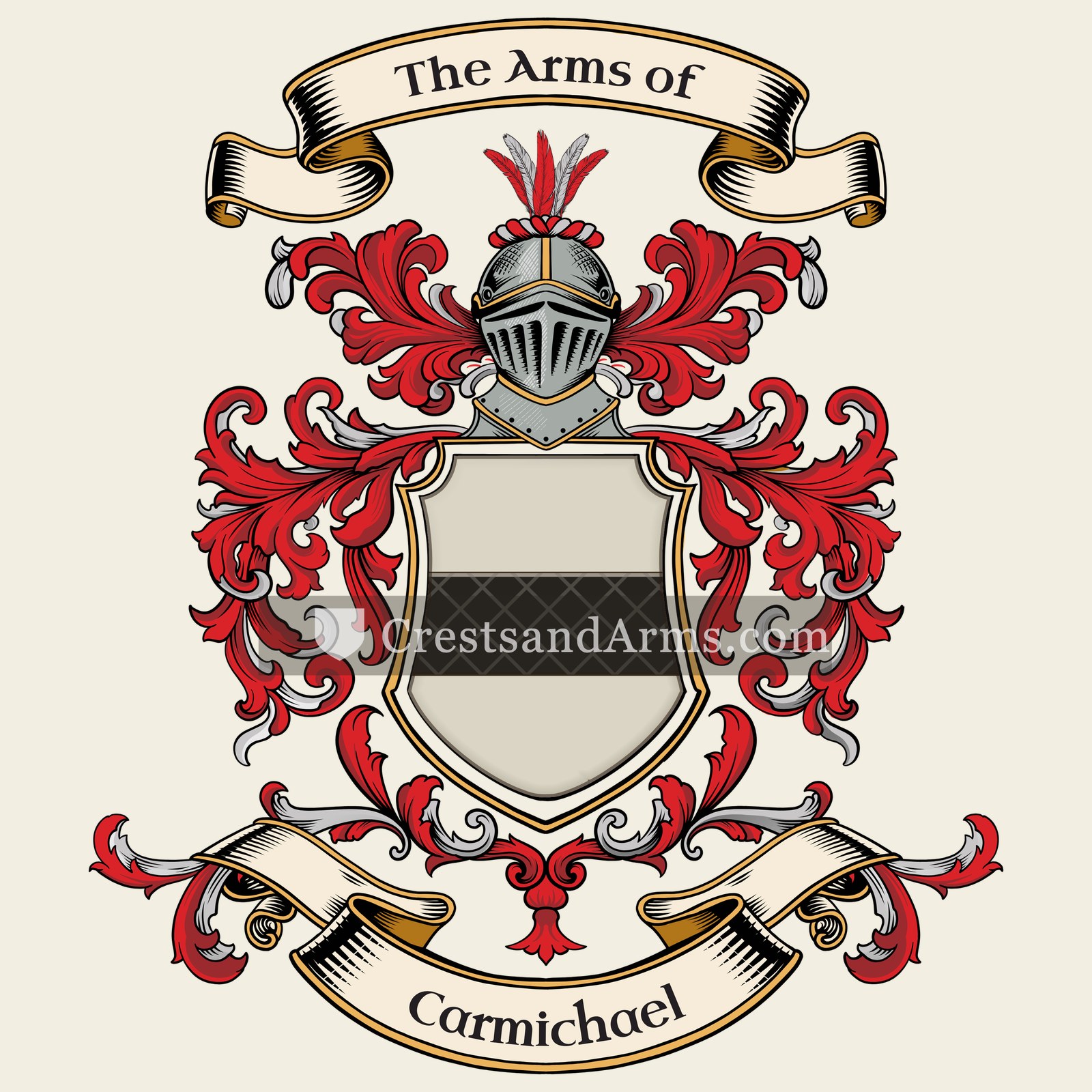
fessThe military belt, and readiness to serve
bordureA difference between branches of one family
crescentHonour by the sovereign, and the second son
Colours
Silver (Argent)Means: Peace and sincerity
Blue (Azure)Means: Loyalty and truth
Historical info
Source
Sir Bernard Burke, The General Armory of England, Scotland, Ireland and Wales, London: Harrison & Sons, 1884
Blazon (the actual original written record)
“Ar. a fess wreathed az. and gu. a bordure the second charged with eight crescents of the first”
Irelandc. 1672
Digital archive packCoat of arms PNG, gold border print PDF, vector SVG and the certificate of authenticity. Sent to your email in minutes.
Map of Ireland showing where the Carmichael arms are recorded
The Carmichael arms were recorded in Ireland, c. 1672.
Arms such as these were typically recorded in Dublin.
Dublin was the seat of government in Ireland and the place where grants were sought and recorded. Families with business at the castle or the courts settled nearby, and settling there put their arms on record.
This is where the arms were entered in the register. Families often moved to other parts of the country, so the same name can turn up in more than one region.
The body that granted and recorded arms in Ireland in this period.
Charles II of England
Sovereign of the period
Charles II of England
1660–1685
Reigning in France when the Carmichael arms are first recorded.
How Arms Worked in Ireland
The Ulster King of Arms granted coats of arms to individuals who proved their social standing and good character. These symbols were typically inherited by all legitimate descendants of the original holder. If a family branch wanted a unique look, they could apply for a specific change to their design through the office to ensure their identity remained distinct.
Granting authority
The Ulster King of Arms acted as the official body that regulated and issued all coats of arms throughout Ireland.
How they got arms
Families obtained their arms through formal grants issued by the office after proving their eligibility and paying the required fees.
Where arms were recorded
All official grants were recorded in the registers held by the Ulster King of Arms starting from the year 1552.
The family's standing
Recorded among the armigerous families of Ireland.
Origin & History of the Carmichael Family in Ireland
The Carmichael name has a long history that stretches across the Irish Sea, eventually establishing a firm presence in Dublin by the late seventeenth century. While the name originated in the Scottish Lowlands, members of the family migrated to Ireland during a period of significant movement between the two countries. By 1672, records confirm that individuals bearing the name were living and working in the city of Dublin. During this era, Dublin served as a bustling center for trade and administration, which attracted many families seeking new opportunities. These early settlers often integrated into the local economy as merchants or skilled craftsmen. Their presence in the city reflects the broader patterns of migration that shaped the social and professional landscape of Ireland during the seventeenth century.
Carmichael Meaning & Related Branches
Root word
Caer Myged
Derived from the Cumbric words for fort and beloved or dear.
This name
CarmichaelA locational surname referring to a fortified place or castle that is cherished.
also spelled
Karmichael
Carmichel
Karmikel
Carmichell
Carmychael
Related arms
Cockburnrecorded with Carmichael, same area
Documented Sources
J. B. Rietstap, Armorial Général, Gouda: G. B. van Goor Zonen, 1884–87
Archives départementales d’Ille-et-Vilaine, Série B: Cours et juridictions
Ogée, Jean, Dictionnaire historique et géographique de la province de Bretagne, 1778
Poterie, Henri de la, Histoire de la Bretagne, 1922
Digital archive packCoat of arms PNG, gold border print PDF, vector SVG and the certificate of authenticity. Sent to your email in minutes.


 fessThe military belt, and readiness to serve
 fessThe military belt, and readiness to serve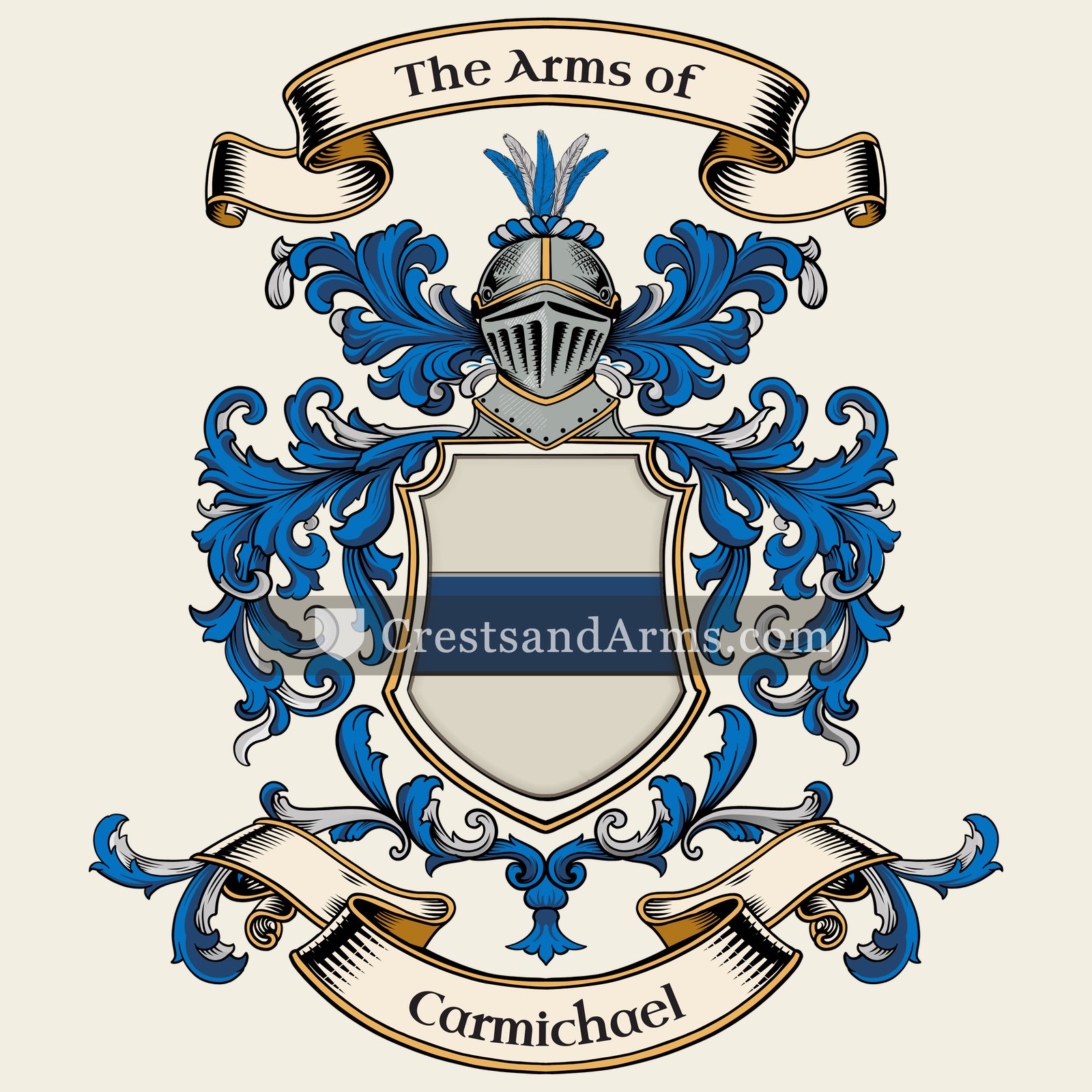




 bordureA difference between branches of one family
 crescentHonour by the sovereign, and the second son