Map of Netherlands showing where the Carpentier arms are recorded
The Carpentier arms were recorded in Netherlands, c. 1815.
Arms such as these were typically recorded in Friesland.
Friesland was low, wet country on the northern coast of the Netherlands, farmed by families who had held the same land for centuries. Free landholders were unusually common there, and a free landholder could carry arms.
This is where the arms were entered in the register. Families often moved to other parts of the country, so the same name can turn up in more than one region.
Region
Friesland
First recorded
1815
Granting Authority for the Carpentier Arms
Hoge Raad van Adel
Photograph made by me · CC BY-SA 3.0
The body that granted and recorded arms in Netherlands in this period.
William I of the Netherlands
Sovereign of the period
William I of the Netherlands
1815–1840
Reigning in Netherlands when the Carpentier arms are first recorded.
How Arms Worked in Netherlands
In the Netherlands, coats of arms were often used by noble families and those who held specific public offices. These arms were passed down through the generations to legitimate descendants. Younger branches of a family usually kept the original design without needing to add special marks. This system ensured that the family identity remained clear and consistent over many years.
Granting authority
The Hoge Raad van Adel is the official body that regulates and manages noble titles and coats of arms in the Netherlands.
How they got arms
Families typically obtained their coats of arms through official royal grants or by proving their long-standing historical use of the symbols.
Where arms were recorded
Coats of arms are officially recorded in the registers held by the Hoge Raad van Adel, which began its work in 1814.
The family's standing
Recorded among the armigerous families of Netherlands.
Origin & History of the Carpentier Family in Netherlands
The surname Carpentier is a classic occupational name that originated from the Old French word for a carpenter. While the name has deep roots in France and Belgium, it became established in the Netherlands through trade, migration, and the movement of skilled craftsmen across European borders. By the early 19th century, records confirm that members of the Carpentier family were living in the northern province of Friesland. This presence in Friesland is particularly interesting because the region has a distinct cultural and linguistic history compared to the rest of the country. Families with this name in the Netherlands often integrated into local communities by working in construction or woodworking trades, which allowed them to maintain their livelihood while adapting to Dutch society. Over time, the name evolved from a simple description of a person's job into a permanent family identity that was passed down through generations in the Dutch provinces.
Coat of Arms & Family Crest Details
Symbols on this shield
batonAuthority and office held under the crown
Colours
Blue (Azure)Means: Loyalty and truth
Green (Vert)Means: Hope
Gold (Or)Means: Generosity
Historical info
Source
J. B. Rietstap, Armorial Général, Gouda: G. B. van Goor Zonen, 1884–87
Blazon (the actual original written record)
“Coupé d'azur sur sin.; à un caducée d'or, ailé d'arg., br. sur le tout. Brl. d'or, d'azur et de sin. C.: le caducée, entre deux pl. d'aut., d'azur et de sin. L.: à dextre d'azur et d'or, à sen. de sin. et d'arg. [Une branche, dont la nob. a été reconnue le 14 avril 1822, porte la D.: DIOS Y EL REY.]”
BelgiumAnvers, c. 1717
Digital archive packCoat of arms PNG, gold border print PDF, vector SVG and the certificate of authenticity. Sent to your email in minutes.
Map of Belgium showing where the Carpentier arms are recorded
The Carpentier arms were recorded in Anvers, c. 1717.
This is where the arms were entered in the register. Families often moved to other parts of the country, so the same name can turn up in more than one region.
The body that granted and recorded arms in Belgium in this period.
Charles VI, Holy Roman Emperor
Sovereign of the period
Charles VI, Holy Roman Emperor
1711–1740
Reigning in Netherlands when the Carpentier arms are first recorded.
How Arms Worked in Belgium
In Belgium, a coat of arms is considered personal property that is passed down through the male line to legitimate descendants. Families often use the same shield design across generations to show their shared heritage. If a branch of the family wants to change the design, they must apply for an official update to their specific version of the arms.
Granting authority
The Conseil héraldique is the official body that regulates and approves all coats of arms in Belgium.
How they got arms
Families obtain their coats of arms through formal royal grants or by confirming their historical right to use existing designs.
Where arms were recorded
All approved coats of arms are officially recorded in the public registers of the Conseil héraldique since 1844.
The family's standing
Recorded among the armigerous families of Belgium.
Origin & History of the Carpentier Family in Belgium
The family name Carpentier is a classic occupational surname that identifies the original bearers as woodworkers or carpenters. In the context of Belgium, the name reflects the vital role these craftsmen played in the development of urban centers during the early modern period. By 1717, records confirm that members of the Carpentier family were well-established in the city of Anvers, which was a major hub for trade and construction in the Low Countries. At this time, the family likely participated in the local guild system, which organized skilled laborers and ensured the quality of woodwork used in the city’s homes and ships. As the name spread across the region, it became a marker of a lineage rooted in the practical and essential skills required to build the infrastructure of Belgian society. The presence of the family in Anvers suggests they were part of a growing middle class that helped sustain the city’s economic life during the eighteenth century.
Coat of Arms & Family Crest Details
Symbols on this shield
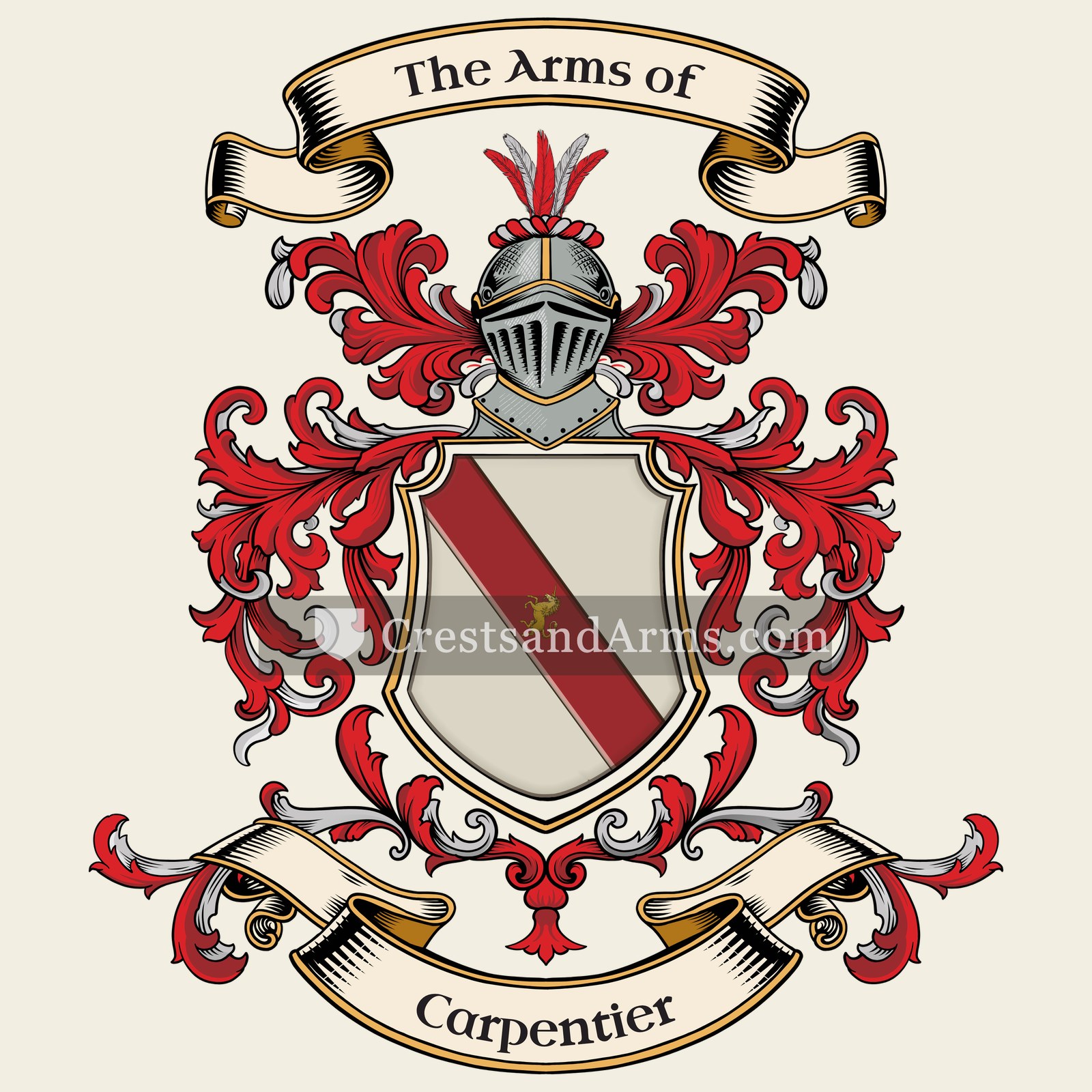
bendDefence, and the scarf of a commander
unicornPurity, and extreme courage in defence of honour
Colours
Silver (Argent)Means: Peace and sincerity
Red (Gules)Means: Military strength
Gold (Or)Means: Generosity
Historical info
Source
J. B. Rietstap, Armorial Général, Gouda: G. B. van Goor Zonen, 1884–87
Blazon (the actual original written record)
“D'arg. à la bande de gu., ch. d'une tête de licorne d'or. Cri: BAILLEUL!”
ArtoisArtois, c. 1663
Digital archive packCoat of arms PNG, gold border print PDF, vector SVG and the certificate of authenticity. Sent to your email in minutes.
Map of France showing where the Carpentier arms are recorded
The Carpentier arms were recorded in Artois, c. 1663.
Artois lay on the disputed ground between France and the Low Countries and was fought over for centuries. Families there held their land under arms, and a shield was how a fighting household was known.
This is where the arms were entered in the register. Families often moved to other parts of the country, so the same name can turn up in more than one region.
The body that granted and recorded arms in France in this period.
Louis XIV of France
Sovereign of the period
Louis XIV of France
1643–1715
Reigning in Netherlands when the Carpentier arms are first recorded.
How Arms Worked in France
In France, a coat of arms was a mark of honor that passed down through the male line to all legitimate descendants. Families often used the same shield without changes to show their shared heritage. If a branch wanted to stand out, they could add a small mark to their shield to show their specific place in the family tree.
Granting authority
The Juge d'armes de France acted as the official authority that regulated and verified coats of arms across the country.
How they got arms
Families typically inherited their arms from ancestors, though they could also receive them through royal grants or by proving their noble status.
Where arms were recorded
Coats of arms were officially recorded in the Armorial Général de France, which began its main collection in the year 1696.
The family's standing
Recorded among the armigerous families of Artois.
Origin & History of the Carpentier Family in France
The family name Carpentier is a classic occupational surname that emerged in medieval France to identify those who worked as carpenters. Because wood was the primary material for building homes, tools, and furniture, the craft was essential to every village and town. By the time records place the family in the northern region of Artois in 1663, the name had been established for generations as a marker of skilled labor and community standing. During this period, Artois was a region defined by its complex history of shifting borders between France and the Spanish Netherlands. Families living there often navigated a unique cultural landscape that blended local traditions with broader French influences. As the Carpentier family settled into the social fabric of Artois, they became part of a long lineage of craftsmen whose work provided the literal structure for the growth of French society.
Carpentier Meaning & Related Branches
Root word
Carpentarius
A Latin term referring to a maker of carriages or wagons.
This name
CarpentierAn occupational surname for a carpenter or a worker who builds with wood.
also spelled
Carpentierr
Karpentier
Carpenter
Related arms
Carpentervariant spelling
Documented Sources
J. B. Rietstap, Armorial Général, Gouda: G. B. van Goor Zonen, 1884–87
Tresoar (Fries Historisch en Letterkundig Centrum), Burgerlijke Stand van Friesland (1811-1950)
Van der Schaar, J., Woordenboek van familienamen: herkomst en betekenis van Nederlandse achternamen, 1988
Centraal Bureau voor Genealogie, Nederlandse Familienamen Databank, 2010
Digital archive packCoat of arms PNG, gold border print PDF, vector SVG and the certificate of authenticity. Sent to your email in minutes.


 chevronProtection, and faithful service completed
 ringFidelity, and a promise kept
 chevronProtection, and faithful service completed
 ringFidelity, and a promise kept


 batonAuthority and office held under the crown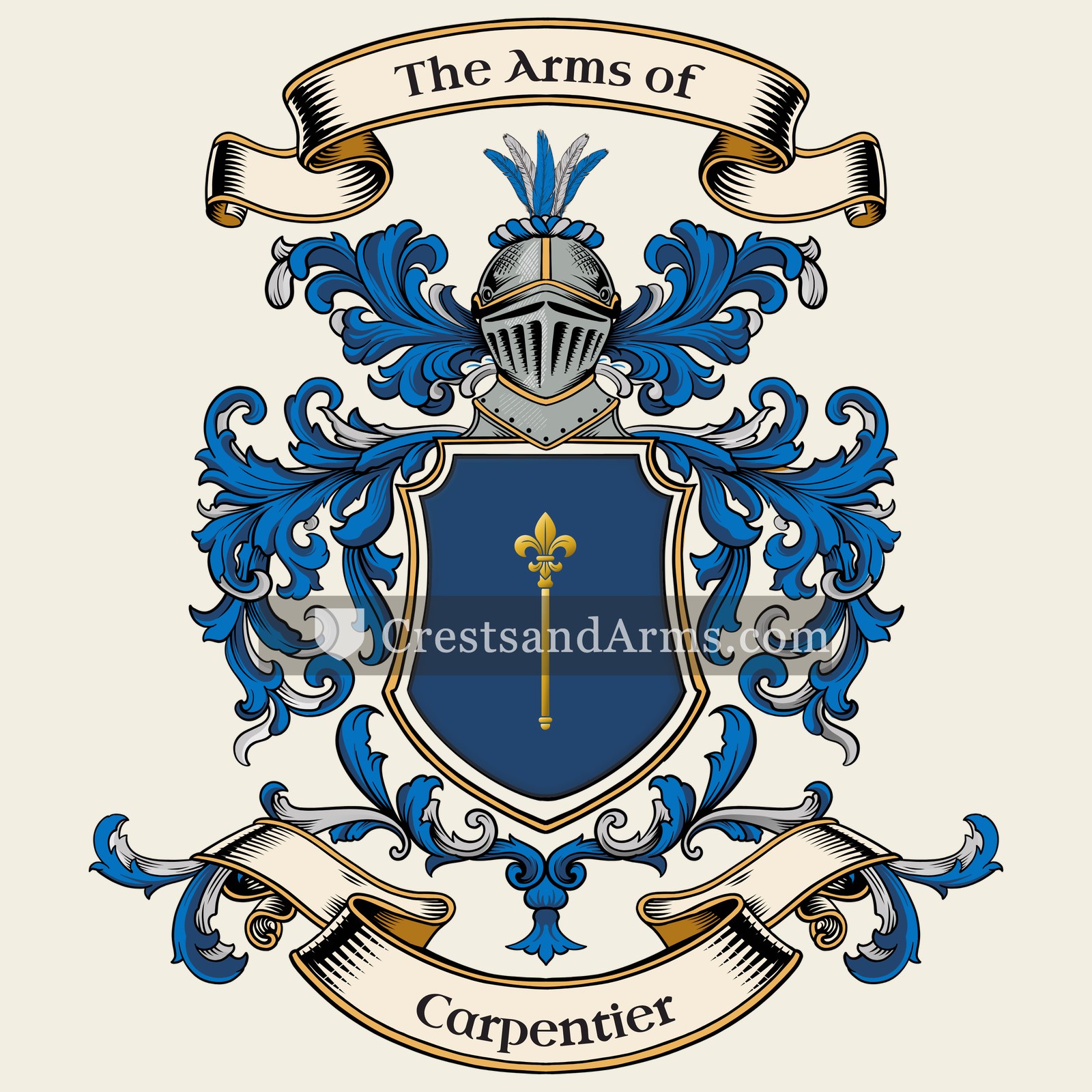


 bendDefence, and the scarf of a commander
 unicornPurity, and extreme courage in defence of honour