Map of Spain showing where the Carranza arms are recorded
The Carranza arms were recorded in Andalusia, c. 1722.
Andalusia was the last part of Spain taken back from the Moors, and the land was shared out among the men who took it. A grant of land came with a grant of arms, so the region produced a great many.
This is where the arms were entered in the register. Families often moved to other parts of the country, so the same name can turn up in more than one region.
The body that granted and recorded arms in Spain in this period.
Philip V of Spain
Sovereign of the period
Philip V of Spain
1714–1724
Reigning in Spain when the Carranza arms are first recorded.
How Arms Worked in Spain
In Spain, a coat of arms was considered a form of property that belonged to the entire family line. These arms were passed down from a father to all his children equally. Younger branches of the family usually kept the original design without needing to add any special marks to distinguish their specific line.
Granting authority
The Cronista Rey de Armas was the official body that regulated and granted coats of arms throughout Spain.
How they got arms
Families often obtained their arms through royal grants or by proving their noble status to the official heraldic authority.
Where arms were recorded
Coats of arms were officially recorded in the registers of the Cronista Rey de Armas starting in 1496.
The family's standing
Recorded among the armigerous families of Andalusia.
Origin & History of the Carranza Family in Spain
The surname Carranza originates from the Basque region of northern Spain, specifically taking its name from the town of Karrantza in the province of Biscay. The name itself is derived from the Basque words for gorse, a prickly yellow shrub that grows abundantly in the local landscape. Over many centuries, families from this region migrated southward across the Iberian Peninsula as part of the broader movements of people during the Reconquista and the subsequent expansion of the Spanish administration. By 1722, records confirm that members of the Carranza family were firmly established in Andalusia, a region known for its rich cultural history and agricultural importance. This migration reflects the typical pattern of families moving from the northern highlands toward the southern territories to seek new opportunities in trade, farming, and local governance during the eighteenth century.
Carranza Meaning & Related Branches
Root word
Carrantia
A pre-Roman or Celtic term referring to a rocky or stony place.
This name
CarranzaA topographic surname denoting someone who lived near a rocky or stony area.
also spelled
Carranzah
Carranze
Karanza
Documented Sources
J. B. Rietstap, Armorial Général, Gouda: G. B. van Goor Zonen, 1884–87
Mikel Gorrotxategi Nieto, Biscay Surnames, 2010
Archivo General de Simancas, Registro del Sello de Corte, 1722
Endika de Mogrobejo, Diccionario hispano de apellidos y blasones, 1995
Digital archive packCoat of arms PNG, gold border print PDF, vector SVG and the certificate of authenticity. Sent to your email in minutes.


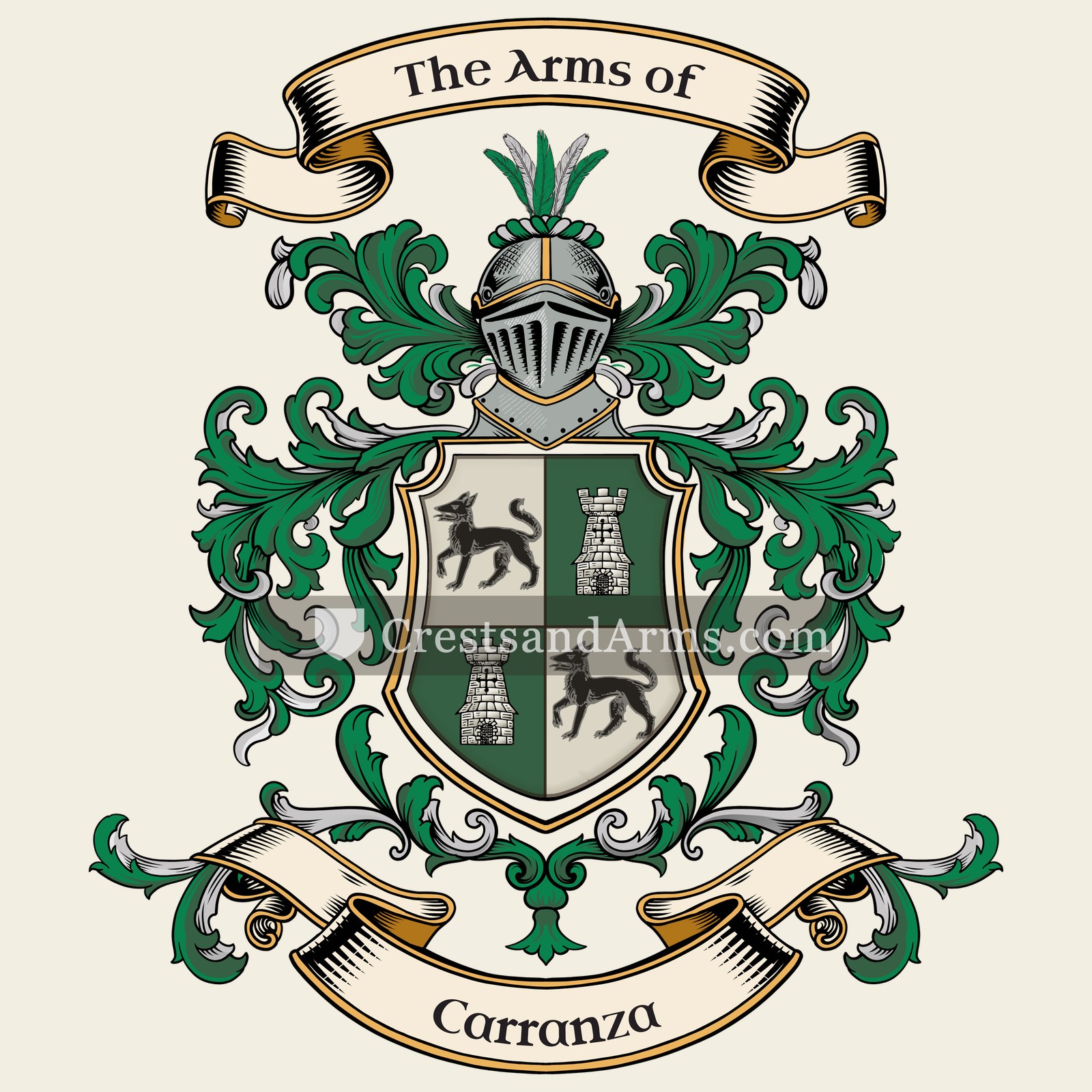
 wolfReward from long service and hard work
 towerGrandeur and solidity, and a stronghold defended
 wolfReward from long service and hard work
 towerGrandeur and solidity, and a stronghold defended