Map of Belgium showing where the Carre arms are recorded
The Carre arms were recorded in Brabant, c. 1737.
Brabant lay at the heart of the Low Countries, where the trade routes met. Its towns were wealthy and its landowners many, and both kinds of family kept arms, which is why the region is so heavily represented.
This is where the arms were entered in the register. Families often moved to other parts of the country, so the same name can turn up in more than one region.
The body that granted and recorded arms in Belgium in this period.
Charles VI, Holy Roman Emperor
Sovereign of the period
Charles VI, Holy Roman Emperor
1711–1740
Reigning in Belgium when the Carre arms are first recorded.
How Arms Worked in Belgium
In Belgium, a coat of arms is considered personal property that is passed down through the male line to legitimate descendants. Families often use the same shield design across generations to show their shared heritage. If a branch of the family wants to change the design, they must apply for an official update to their specific version of the arms.
Granting authority
The Conseil héraldique is the official body that regulates and approves all coats of arms in Belgium.
How they got arms
Families obtain their coats of arms through formal royal grants or by confirming their historical right to use existing designs.
Where arms were recorded
All approved coats of arms are officially recorded in the public registers of the Conseil héraldique since 1844.
The family's standing
Recorded among the armigerous families of Brabant.
Origin & History of the Carre Family in Belgium
The history of the Carre family in Belgium is deeply rooted in the historical region of Brabant, where records confirm their presence as early as 1737. During this period, the name was closely associated with the social and economic fabric of the Low Countries, a region defined by its bustling trade routes and complex administrative systems. Families like the Carres often lived in areas where local governance was transitioning under the influence of the Austrian Netherlands. Because the name is linked to the French word for square, it likely originated as a descriptive term for someone who lived near a town square or held a plot of land with distinct boundaries. By the mid-eighteenth century, members of the family were integrated into the local community, likely participating in the agricultural or merchant activities that sustained the Brabant economy. Their presence in these official documents from the 1730s suggests they were established residents who contributed to the stability of their local parishes and towns during a time of significant regional change.
Coat of Arms & Family Crest Details
Symbols on this shield
palm treeVictory, and righteousness that flourishes
columnFortitude and constancy
Colours
Gold (Or)Means: Generosity
Historical info
Source
J. B. Rietstap, Armorial Général, Gouda: G. B. van Goor Zonen, 1884–87
Blazon (the actual original written record)
“D'or à un palmier de sin., accosté de deux colonnes du même et surm. d'un coeur enflammé de gu.”
OrleanaisOrleanais, c. 1663
Digital archive packCoat of arms PNG, gold border print PDF, vector SVG and the certificate of authenticity. Sent to your email in minutes.
Map of France showing where the Carre arms are recorded
The Carre arms were recorded in Orleanais, c. 1663.
Orleanais lay on the Loire around Orleans, close enough to Paris for court money to reach it. Officials and lawyers who did well bought estates there, and an estate brought a coat of arms with it.
This is where the arms were entered in the register. Families often moved to other parts of the country, so the same name can turn up in more than one region.
The body that granted and recorded arms in France in this period.
Louis XIV of France
Sovereign of the period
Louis XIV of France
1643–1715
Reigning in Belgium when the Carre arms are first recorded.
How Arms Worked in France
In France, a coat of arms was a mark of honor that passed down through the male line to all legitimate descendants. Families often used the same shield without changes to show their shared heritage. If a branch wanted to stand out, they could add a small mark to their shield to show their specific place in the family tree.
Granting authority
The Juge d'armes de France acted as the official authority that regulated and verified coats of arms across the country.
How they got arms
Families typically inherited their arms from ancestors, though they could also receive them through royal grants or by proving their noble status.
Where arms were recorded
Coats of arms were officially recorded in the Armorial Général de France, which began its main collection in the year 1696.
The family's standing
Recorded among the armigerous families of Orleanais.
Origin & History of the Carre Family in France
The surname Carré finds its deep roots in the French language, where it literally translates to the word square. In the medieval period, this name was often used as a descriptive nickname for a person with a sturdy, broad, or stocky physical build. By the seventeenth century, the family had established a notable presence in the Orléanais region, a historically significant area located along the Loire River in north-central France. Records from 1663 confirm that members of the family were living and working within this fertile landscape, which was known for its proximity to the royal court and its importance in trade. During this era, families like the Carrés were often tied to the land or local crafts, contributing to the development of the rural economy in the heart of the French kingdom. As the family grew, they became part of the social fabric of the region, reflecting the common naming patterns and migration trends that defined life in provincial France before the modern era.
Coat of Arms & Family Crest Details
Symbols on this shield
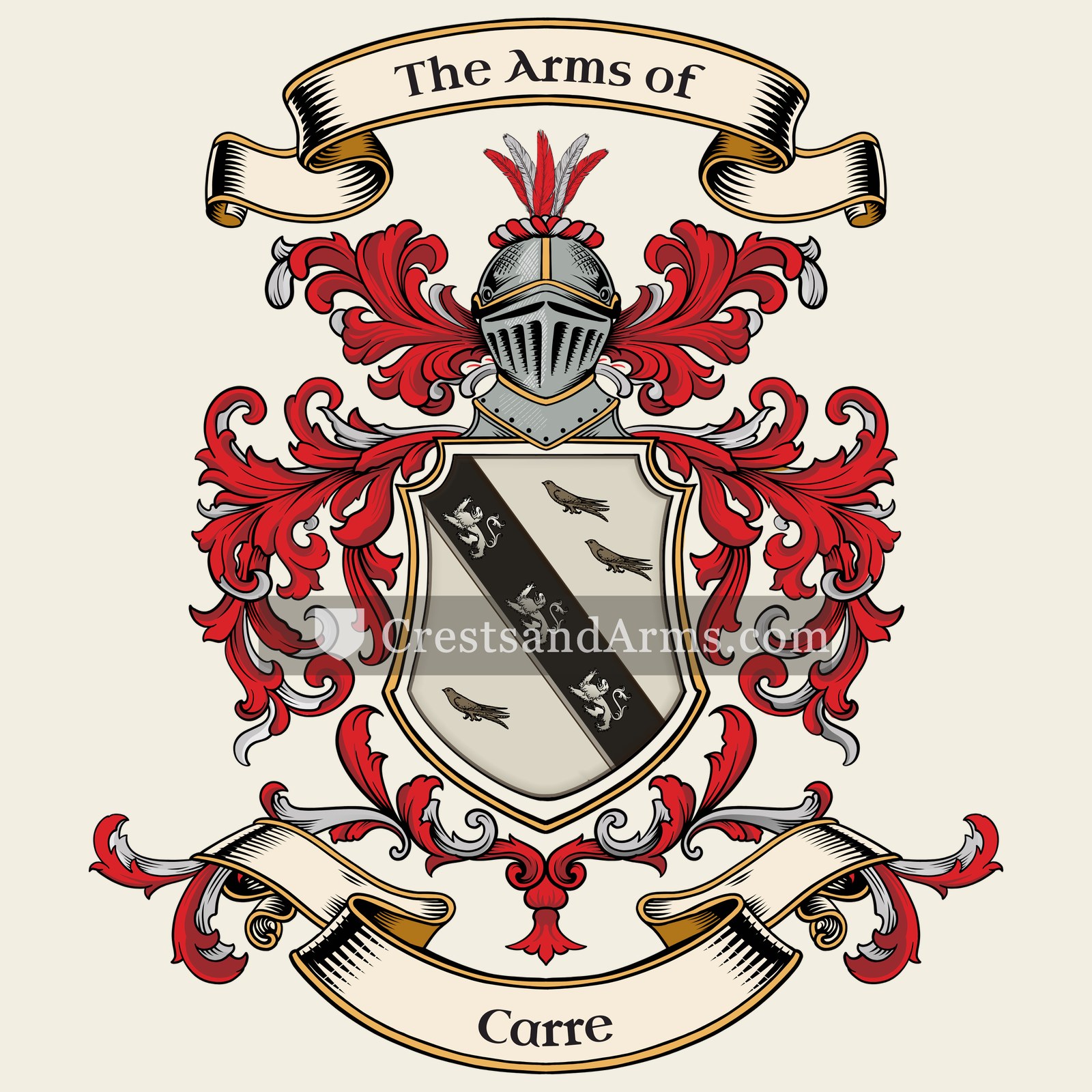
bendDefence, and the scarf of a commander
martletA younger son, who must win his own land
lionCourage, strength and royalty
Colours
Silver (Argent)Means: Peace and sincerity
Black (Sable)Means: Constancy
Historical info
Source
Sir Bernard Burke, The General Armory of England, Scotland, Ireland and Wales, London: Harrison & Sons, 1884
Blazon (the actual original written record)
“Ar. on a bend sa. betw. three Cornish choughs ppr. as many leopards' faces of the field”
WorcesterWorcester, c. 1620
Digital archive packCoat of arms PNG, gold border print PDF, vector SVG and the certificate of authenticity. Sent to your email in minutes.
Map of England showing where the Carre arms are recorded
The Carre arms were recorded in Worcester, c. 1620.
Worcestershire was orchard and farming country with a scattering of old manors. Its gentry were middling rather than great, but a manor was a manor, and holding one was what brought arms.
This is where the arms were entered in the register. Families often moved to other parts of the country, so the same name can turn up in more than one region.
The body that granted and recorded arms in England in this period.
James VI and I
Sovereign of the period
James VI and I
1603–1625
Reigning in Belgium when the Carre arms are first recorded.
How Arms Worked in England
English heraldry allowed arms to be shared by all legitimate descendants of the original owner. These symbols were treated as personal property that moved through the generations to all children. While the eldest son kept the original design, other family members could use the same shield without needing to change it or register their own unique versions.
Granting authority
The College of Arms in London has regulated the use of coats of arms throughout England and Wales since 1484.
How they got arms
Families typically obtained their coats of arms through a formal grant from the Crown or by proving their ancient right to them.
Where arms were recorded
All official coats of arms are recorded in the registers kept at the College of Arms, which date back to the fifteenth century.
The family's standing
Recorded among the armigerous families of Worcester.
Origin & History of the Carre Family in England
The surname Carre has deep roots in the English landscape, often appearing in historical documents as a descriptive term for someone who lived near a marsh or a boggy area. By the early seventeenth century, the family had established a notable presence in the city of Worcester. Records from 1620 show members of the family living in this historic cathedral city, which was a vital center for trade and cloth manufacturing at the time. During this period, families like the Carres were often involved in the local merchant guilds or the agricultural life of the surrounding Severn Valley. Their presence in Worcester suggests they were part of the growing middle class that helped shape the social and economic character of English provincial towns before the upheaval of the Civil War. As the family settled into urban life, they became part of the long tradition of English surnames that reflect both the geography of the land and the history of the communities where they chose to build their homes.
Carre Meaning & Related Branches
Root word
quadrus
Latin term meaning square or four-sided shape.
This name
CarreA topographic name for someone who lived near a square-shaped plot of land or a marketplace.
also spelled
Carrey
Carra
Karay
Carey
Karr
Related arms
Veensimilar arms
Carevariant spelling
Carrvariant spelling
Carravariant spelling
Documented Sources
J. B. Rietstap, Armorial Général, Gouda: G. B. van Goor Zonen, 1884–87
Archives: State Archives in Belgium (Rijksarchief in België), Parochieregisters van Brabant
Wauters, Alphonse, Histoire des environs de Bruxelles, 1855
Verbeemen, Joseph, De demografische evolutie van de Brabantse steden in de 18e eeuw, 1964
Digital archive packCoat of arms PNG, gold border print PDF, vector SVG and the certificate of authenticity. Sent to your email in minutes.




 palm treeVictory, and righteousness that flourishes
 columnFortitude and constancy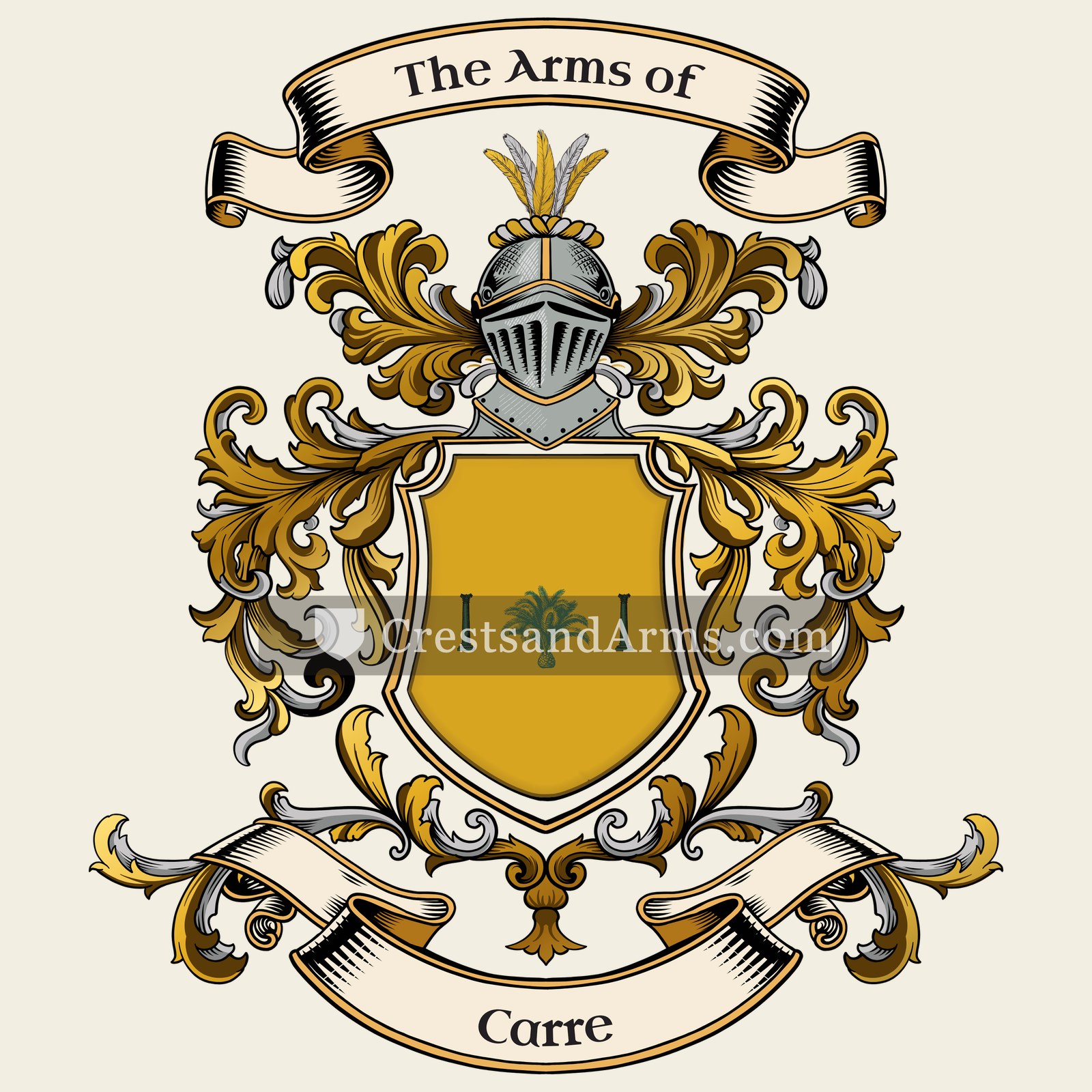


 bendDefence, and the scarf of a commander
 martletA younger son, who must win his own land
 lionCourage, strength and royalty