Map of France showing where the Carrel arms are recorded
The Carrel arms were recorded in Paris, c. 1663.
This is where the arms were entered in the register. Families often moved to other parts of the country, so the same name can turn up in more than one region.
The body that granted and recorded arms in France in this period.
Louis XIV of France
Sovereign of the period
Louis XIV of France
1643–1715
Reigning in France when the Carrel arms are first recorded.
How Arms Worked in France
In France, a coat of arms was a mark of honor that passed down through the male line to all legitimate descendants. Families often used the same shield without changes to show their shared heritage. If a branch wanted to stand out, they could add a small mark to their shield to show their specific place in the family tree.
Granting authority
The Juge d'armes de France acted as the official authority that regulated and verified coats of arms across the country.
How they got arms
Families typically inherited their arms from ancestors, though they could also receive them through royal grants or by proving their noble status.
Where arms were recorded
Coats of arms were officially recorded in the Armorial Général de France, which began its main collection in the year 1696.
The family's standing
Recorded among the armigerous families of France.
Origin & History of the Carrel Family in France
The surname Carrel traces its roots to the French language, likely originating as a descriptive name for someone who worked with stone or lived near a square. By the time the family was documented in Paris in 1663, the name was already well-established within the social fabric of the capital. During this era, families with this name were often integrated into the urban life of France, participating in the trades and administrative roles that defined the seventeenth century. As the family grew, they moved through various regions of the country, adapting to the shifts in French society while maintaining their identity. Their presence in Paris during the mid-1600s suggests they were part of the bustling middle class that helped shape the city during the reign of King Louis XIV. Through these early generations, the Carrel name became a quiet but persistent thread in the long history of the French people.
Coat of Arms & Family Crest Details
Symbols on this shield
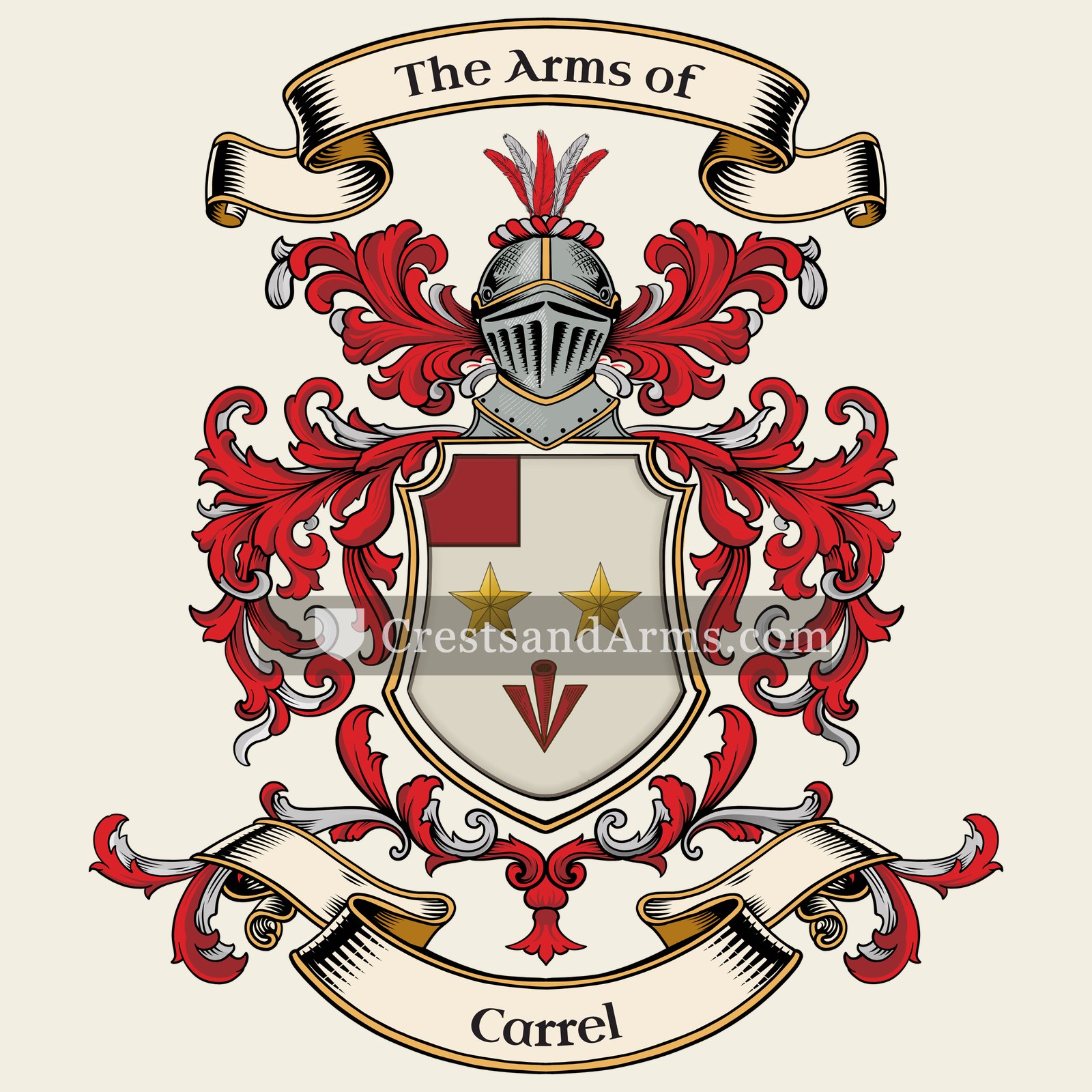
cantonA mark of honour granted by the sovereign
arrowReadiness for battle, and affliction endured
mulletThe third son, and a divine quality from above
Colours
Silver (Argent)Means: Peace and sincerity
Red (Gules)Means: Military strength
Gold (Or)Means: Generosity
Historical info
Source
J. B. Rietstap, Armorial Général, Gouda: G. B. van Goor Zonen, 1884–87
Blazon (the actual original written record)
“D'arg à une flèche de gu., posée en barre, acc. de deux étoiles (5) d'or, l'une posée au canton dextre du chef et l'autre au canton sen. de la p.”
SwitzerlandFribourg, c. 1745
Digital archive packCoat of arms PNG, gold border print PDF, vector SVG and the certificate of authenticity. Sent to your email in minutes.
Map of Switzerland showing where the Carrel arms are recorded
The Carrel arms were recorded in Fribourg, c. 1745.
This is where the arms were entered in the register. Families often moved to other parts of the country, so the same name can turn up in more than one region.
The body that granted and recorded arms in Switzerland in this period.
How Arms Worked in Switzerland
In Switzerland, coats of arms were not restricted to the nobility and were often adopted by common citizens and families. These symbols were passed down through generations to show family identity. When branches of a family grew, they often changed small details of the design to distinguish their own line from the original group.
Granting authority
Cantonal and civic authorities managed the use of coats of arms within their specific regions and local jurisdictions.
How they got arms
Families typically assumed their own coats of arms based on local custom rather than receiving them from a central monarch.
Where arms were recorded
Arms were recorded in various cantonal and civic registers starting from the fourteenth century throughout the Swiss region.
The family's standing
Recorded among the armigerous families of Switzerland.
Origin & History of the Carrel Family in Switzerland
The Carrel family has deep roots in the Swiss canton of Fribourg, where records confirm their presence as early as 1745. The name itself is thought to be derived from the Old French word "carrel," which historically referred to a square stone or a tile used in construction. This suggests that the earliest ancestors of the family may have been skilled stonemasons or craftsmen who helped build the medieval structures of the region. As they settled into the social fabric of Fribourg, the family became part of the local community life, likely contributing to the agricultural and artisanal traditions that defined the Swiss landscape during the eighteenth century. By establishing themselves in this specific area, the Carrel family became a lasting part of the regional history, evolving alongside the political and cultural changes of the Swiss Confederation.
Coat of Arms & Family Crest Details
Symbols on this shield
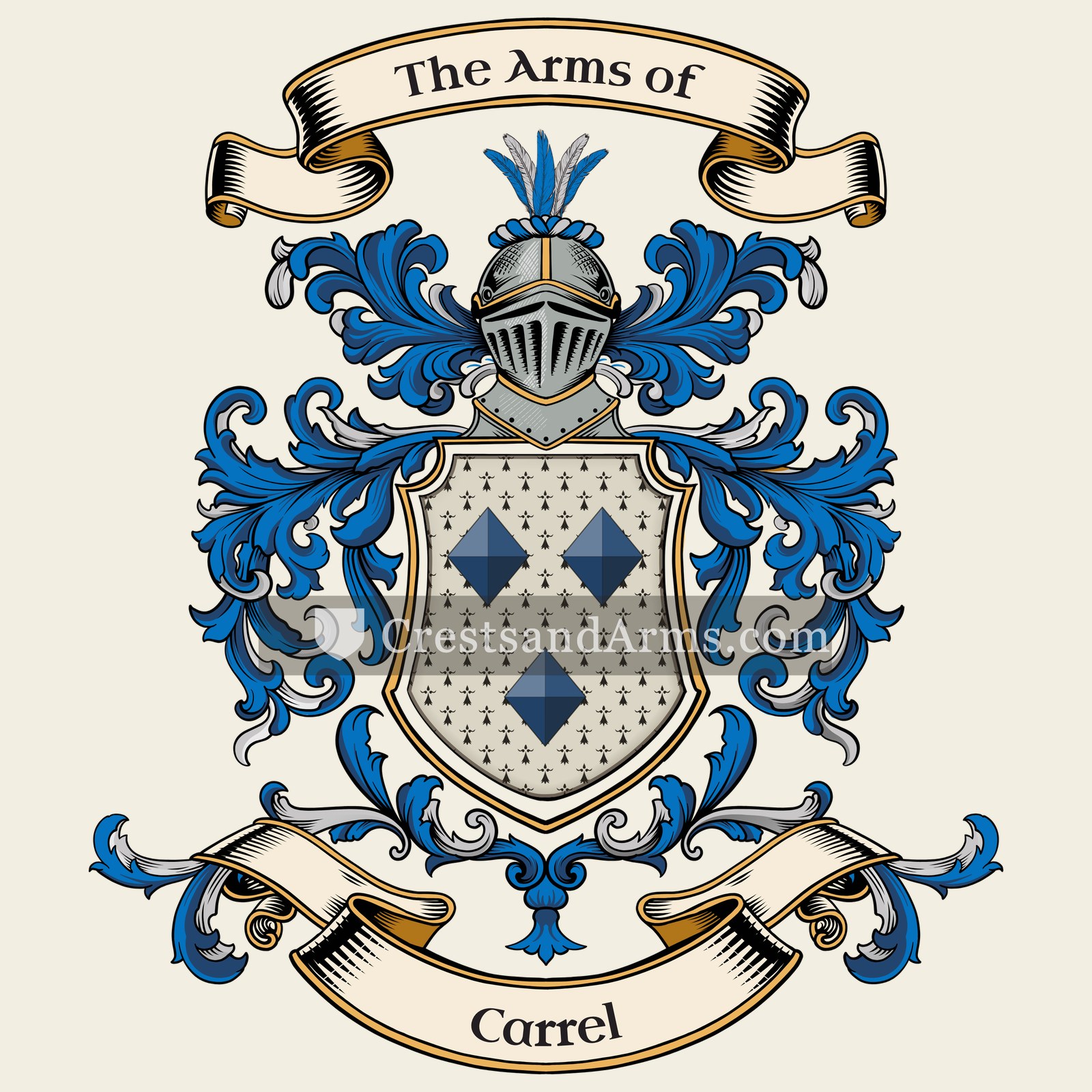
lozengeHonour and nobility, and the arms of a woman
Colours
ErmineMeans: Dignity
Blue (Azure)Means: Loyalty and truth
Historical info
Source
Sir Bernard Burke, The General Armory of England, Scotland, Ireland and Wales, London: Harrison & Sons, 1884
Blazon (the actual original written record)
“Erm. three lozenges (carreaux) az”
JerseyJersey, c. 1688
Digital archive packCoat of arms PNG, gold border print PDF, vector SVG and the certificate of authenticity. Sent to your email in minutes.
The body that granted and recorded arms in Jersey in this period.
James II of England
Sovereign of the period
James II of England
1685–1688
Reigning in France when the Carrel arms are first recorded.
How Arms Worked in Jersey
Arms in the Channel Islands were granted and recorded by the College of Arms in London, under the same law of arms as England. They could be used by all legitimate descendants of the original owner: the eldest son kept the original design, and other family members used the same shield without registering a version of their own.
Granting authority
The College of Arms in London has regulated the use of coats of arms for Jersey and the other Channel Islands since 1484.
How they got arms
Families typically obtained their coats of arms through a formal grant from the Crown or by proving their ancient right to them.
Where arms were recorded
All official coats of arms are recorded in the registers kept at the College of Arms, which date back to the fifteenth century.
The family's standing
Recorded among the armigerous families of Jersey.
Origin & History of the Carrel Family in Jersey
The Carrel family has deep roots in the island of Jersey, with records confirming their presence there as early as 1688. The name likely originated from the Old French word "carrel," which referred to a square tile or a stone mason. This suggests that the earliest members of the family were skilled craftsmen who worked in construction or masonry. By settling in Jersey, these individuals became part of a unique community that blended French cultural influences with English administrative traditions. Over the generations, the family integrated into the local island society, often participating in the maritime and agricultural activities that defined life in the Channel Islands. Their long history on the island reflects the broader movement of families across the English Channel during the seventeenth century, establishing a lasting legacy in the local records of the parish.
Carrel Meaning & Related Branches
Root word
Carrum
Latin term for a four-wheeled wagon or cart.
This name
CarrelAn occupational name for a carter, wagoner, or someone who transported goods.
also spelled
Carel
Karel
Carrell
Carle
Related arms
Carelvariant spelling
Carlevariant spelling
Documented Sources
J. B. Rietstap, Armorial Général, Gouda: G. B. van Goor Zonen, 1884–87
Dauzat, Albert. Dictionnaire étymologique des noms de famille et prénoms de France. 1951
Morlet, Marie-Thérèse. Dictionnaire étymologique des noms de famille. 1991
Archives Nationales de France, Minutier central des notaires de Paris
Digital archive packCoat of arms PNG, gold border print PDF, vector SVG and the certificate of authenticity. Sent to your email in minutes.


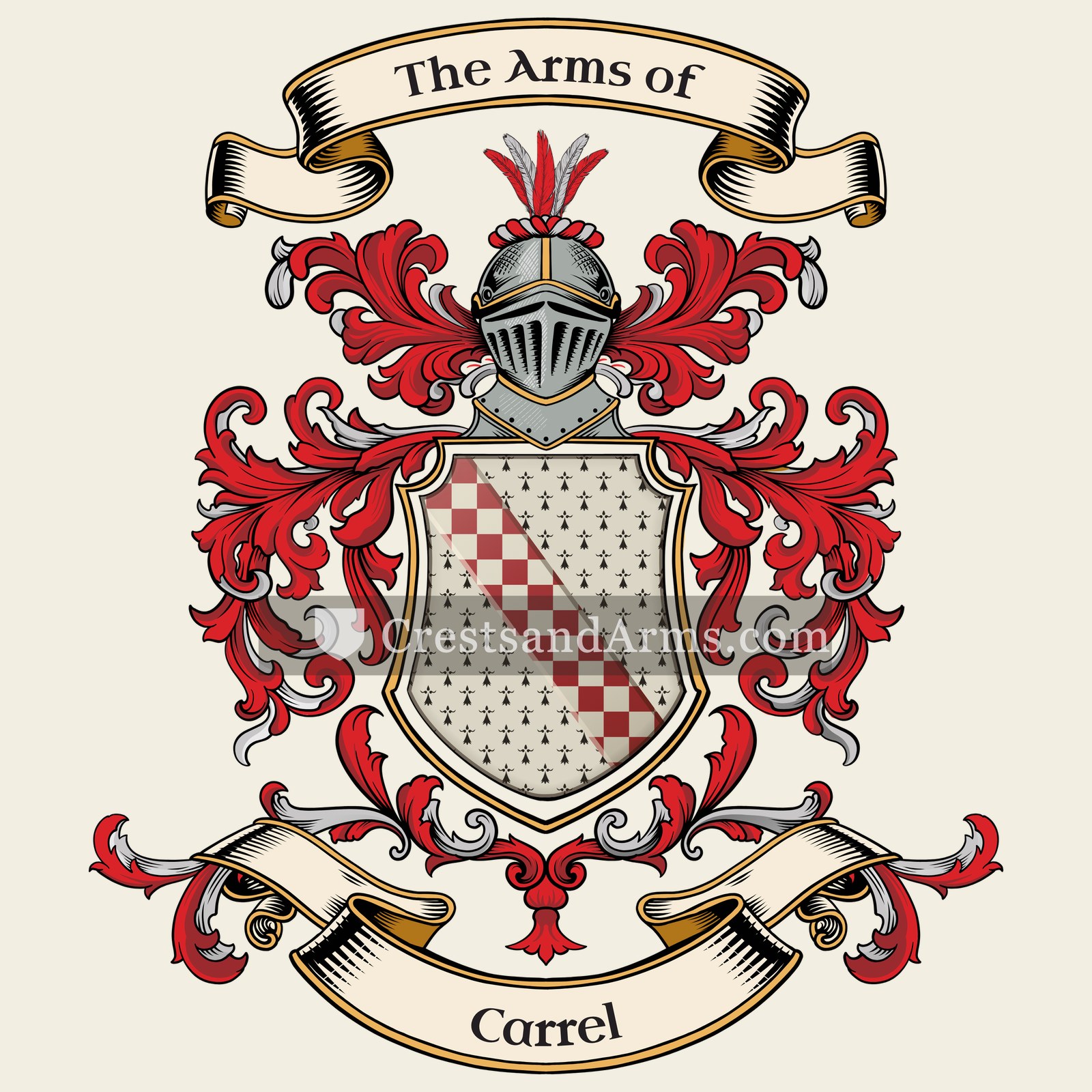
 bendDefence, and the scarf of a commander
 bendDefence, and the scarf of a commander


 cantonA mark of honour granted by the sovereign
 arrowReadiness for battle, and affliction endured
 mulletThe third son, and a divine quality from above

 lozengeHonour and nobility, and the arms of a woman