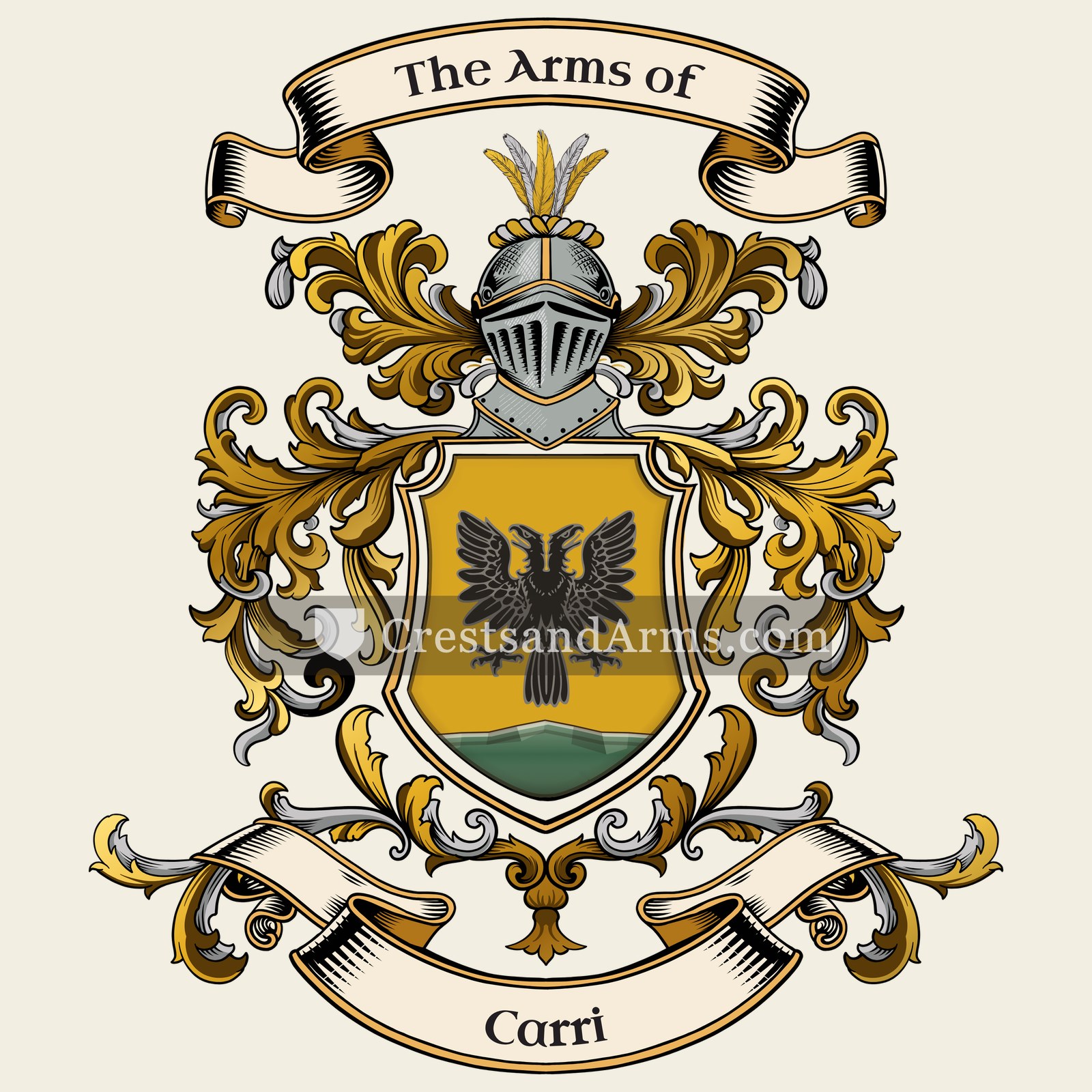
A record of documented arms, meaning and origin, researched for the Carri family of Italy.
Reg. 2078 · Italian, A–C
Coat of Arms & Family Crest Details
Symbols on this shield
mountThe ground held, and steadfastness upon it
eagleNobility, strength and a keen mind
Colours
Gold (Or)Means: Generosity
Green (Vert)Means: Hope
Black (Sable)Means: Constancy
Historical info
Source
J. B. Rietstap, Armorial Général, Gouda: G. B. van Goor Zonen, 1884–87
Blazon (the actual original written record)
“D'or à l'aigle ép. de sa., ayant sur l'estomac un écusson d'arg., ch. d'un chariot de gu., soutenu d'une terrasse de sin. et surm. de trois étoiles d'or, rangées en chef.”
ItalyMantoue, c. 1775
Digital archive packCoat of arms PNG, gold border print PDF, vector SVG and the certificate of authenticity. Sent to your email in minutes.
Map of Italy showing where the Carri arms are recorded
The Carri arms were recorded in Mantoue, c. 1775.
This is where the arms were entered in the register. Families often moved to other parts of the country, so the same name can turn up in more than one region.
The body that granted and recorded arms in Italy in this period.
Alvise Giovanni Mocenigo
Sovereign of the period
Alvise Giovanni Mocenigo
1763–1778
Reigning in Italy when the Carri arms are first recorded.
How Arms Worked in Italy
In the Italian states, coats of arms were often used by noble families to show their status and history. These symbols were passed down through the generations to all legitimate male descendants. Younger branches of a family usually kept the original design but sometimes added small changes to distinguish their specific line from the main branch.
Granting authority
Various local rulers and city governments controlled the use of coats of arms across the different Italian states.
How they got arms
Families often assumed their own arms or received them as official grants from local lords, popes, or city councils.
Where arms were recorded
Arms were recorded in local city archives or private family books rather than in one single national register.
The family's standing
Recorded among the armigerous families of Italy.
Origin & History of the Carri Family in Italy
The family name Carri has deep roots in the northern Italian region of Lombardy, with documented evidence placing the family in the city of Mantua by 1775. During the late 18th century, Mantua was a bustling center of trade and culture under the influence of the Habsburg monarchy. Families like the Carris often lived in urban settings where they contributed to the local economy through skilled trades or administrative roles. As the name spread through the surrounding countryside, it became associated with the agricultural traditions of the Po Valley. Over time, the family transitioned from these early urban foundations into various professional paths, maintaining a consistent presence in the historical records of the Mantua province throughout the 19th century.
Carri Meaning & Related Branches
Root word
Carrus
Latin term referring to a four-wheeled wagon or cart.
This name
CarriDerived from an occupational name for a carter, wagoner, or someone who transported goods.
also spelled
Karri
Carry
Cari
Documented Sources
J. B. Rietstap, Armorial Général, Gouda: G. B. van Goor Zonen, 1884–87
Archivio di Stato di Mantova, Stato Civile della Restaurazione
Dizionario dei cognomi italiani, Emidio De Felice, 1978
Storia di Mantova, Roberto Navarrini, 1995
Digital archive packCoat of arms PNG, gold border print PDF, vector SVG and the certificate of authenticity. Sent to your email in minutes.


 mountThe ground held, and steadfastness upon it
 eagleNobility, strength and a keen mind
 mountThe ground held, and steadfastness upon it
 eagleNobility, strength and a keen mind