Map of France showing where the Carrig arms are recorded
The Carrig arms were recorded in Forez, c. 1663.
Forez was a small upland county in central France, thick with minor gentry holding modest estates. Its families were more numerous than wealthy, and even a small holding was enough for a shield of one's own.
This is where the arms were entered in the register. Families often moved to other parts of the country, so the same name can turn up in more than one region.
The body that granted and recorded arms in France in this period.
Louis XIV of France
Sovereign of the period
Louis XIV of France
1643–1715
Reigning in France when the Carrig arms are first recorded.
How Arms Worked in France
In France, a coat of arms was a mark of honor that passed down through the male line to all legitimate descendants. Families often used the same shield without changes to show their shared heritage. If a branch wanted to stand out, they could add a small mark to their shield to show their specific place in the family tree.
Granting authority
The Juge d'armes de France acted as the official authority that regulated and verified coats of arms across the country.
How they got arms
Families typically inherited their arms from ancestors, though they could also receive them through royal grants or by proving their noble status.
Where arms were recorded
Coats of arms were officially recorded in the Armorial Général de France, which began its main collection in the year 1696.
The family's standing
Recorded among the armigerous families of Forez.
Origin & History of the Carrig Family in France
The history of the Carrig family in France is deeply rooted in the historical province of Forez, a region known for its rolling hills and strong agricultural traditions. By the year 1663, records confirm that members of the family were well-established residents within this area, which was then a vital part of the Kingdom of France. During the seventeenth century, families in Forez often lived in tightly knit rural communities where they played essential roles in local commerce and land management. The name Carrig likely evolved as a reflection of the family's connection to the rocky or rugged terrain characteristic of the Massif Central mountains. As the family grew, they became integrated into the social fabric of the region, participating in the parish life and economic activities that defined life in pre-revolutionary France. Their presence in the historical registers of Forez provides a clear window into the lives of provincial families who helped shape the local culture and history of the French countryside.
Meaning of the Carrig family crest colors & symbols
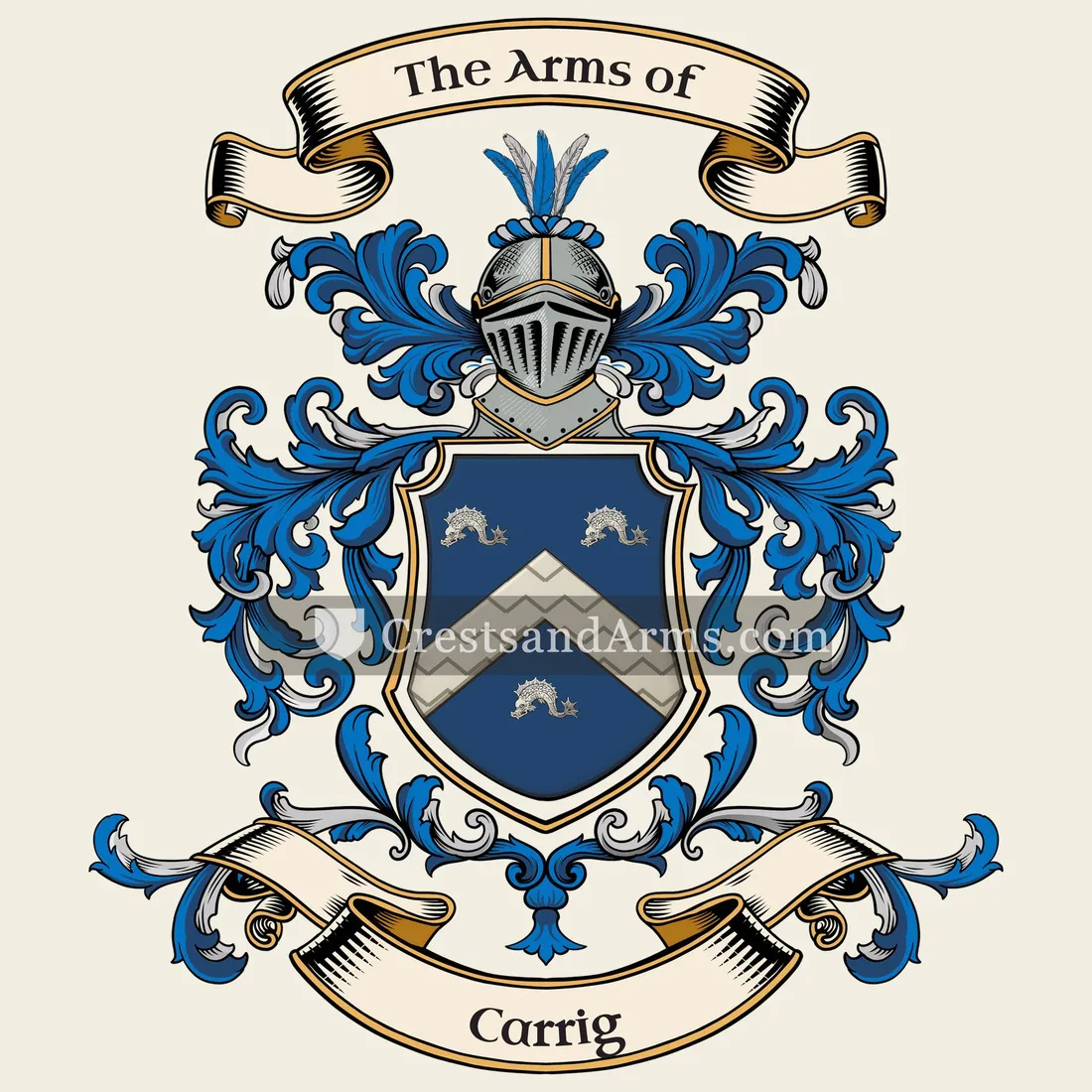
Symbols on this shield
chevronProtection, and faithful service completed
dolphinSwiftness, charity and love
Colours
Blue (Azure)Means: Loyalty and truth
Silver (Argent)Means: Peace and sincerity
Historical info
Source
Sir Bernard Burke, The General Armory of England, Scotland, Ireland and Wales, London: Harrison & Sons, 1884
Blazon (the actual original written record)
“Az. a chev. betw. three dolphins haurient ar. the back, fins, head, and tail or”
CarnarvonCarreg · Carnarvon, c. 1647
Digital archive packCoat of arms PNG, gold border print PDF, vector SVG and the certificate of authenticity. Sent to your email in minutes.
Map of Wales showing where the Carrig arms are recorded
The Carrig arms were recorded in Carnarvon, c. 1647.
Carnarvonshire was mountain country in north-west Wales with a royal castle on its coast. Land was held in small estates by families who stayed for centuries, and long tenure brought arms.
This is where the arms were entered in the register. Families often moved to other parts of the country, so the same name can turn up in more than one region.
The body that granted and recorded arms in Wales in this period.
Charles I of England
Sovereign of the period
Charles I of England
1625–1649
Reigning in France when the Carrig arms are first recorded.
How Arms Worked in Wales
English heraldry allowed arms to be shared by all legitimate descendants of the original owner. These symbols were treated as personal property that moved through the generations to all children. While the eldest son kept the original design, other family members could use the same shield without needing to change it or register their own unique versions.
Granting authority
The College of Arms in London has regulated the use of coats of arms throughout England and Wales since 1484.
How they got arms
Families typically obtained their coats of arms through a formal grant from the Crown or by proving their ancient right to them.
Where arms were recorded
All official coats of arms are recorded in the registers kept at the College of Arms, which date back to the fifteenth century.
The family's standing
Recorded among the armigerous families of Carnarvon.
Origin & History of the Carrig Family in Wales
The family name Carrig finds its roots in the rugged landscape of North Wales, where it is closely tied to the historic region of Carnarvon. By the year 1647, records confirm that members of the family were already established residents in this area. The name itself is thought to be derived from the Welsh word *carreg*, which translates to stone or rock. This suggests that the family likely lived near a prominent rocky outcrop or a specific stone landmark that served as a local identifier for their home. During the mid-seventeenth century, Carnarvon was a significant center for trade and military administration due to its famous castle. Living in such a strategic location indicates that the early Carrig family members were likely integrated into the local community life of this bustling Welsh town during a period of great political change in Britain.
Carrig Meaning & Related Branches
Root word
carric
A Gaulish or Old French term referring to a rocky outcrop.
This name
CarrigA topographic surname denoting someone who lived near a prominent rocky hill or cliff.
also spelled
Carige
Carrig
Karrige
Carij
Documented Sources
J. B. Rietstap, Armorial Général, Gouda: G. B. van Goor Zonen, 1884–87
Forestie, Édouard, Notes historiques sur le Forez, 1888
Archives départementales de la Loire, Registres paroissiaux et d'état civil de la province du Forez, 1663
Digital archive packCoat of arms PNG, gold border print PDF, vector SVG and the certificate of authenticity. Sent to your email in minutes.


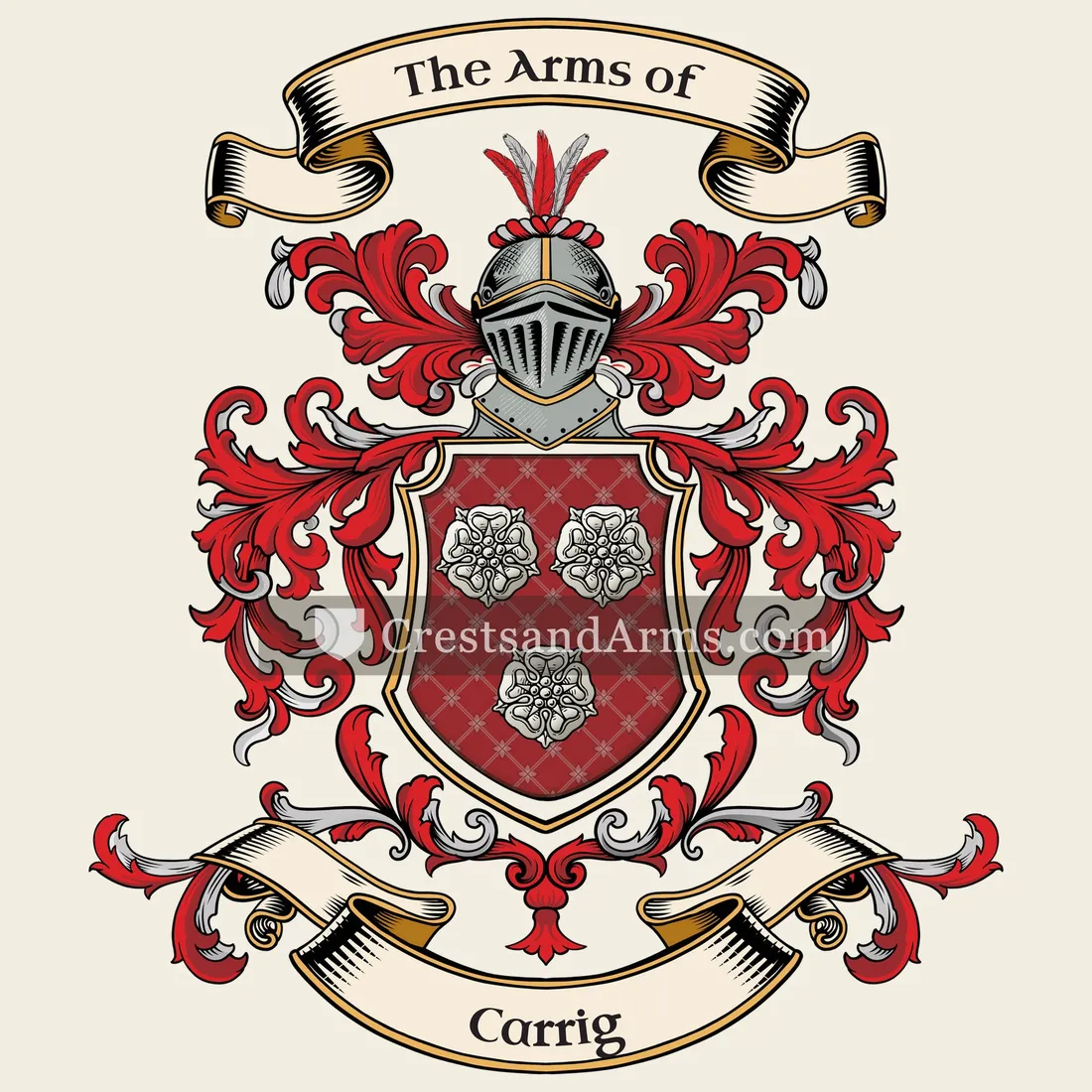
 roseThe seventh son, and beauty with grace
 roseThe seventh son, and beauty with grace


 chevronProtection, and faithful service completed
 dolphinSwiftness, charity and love