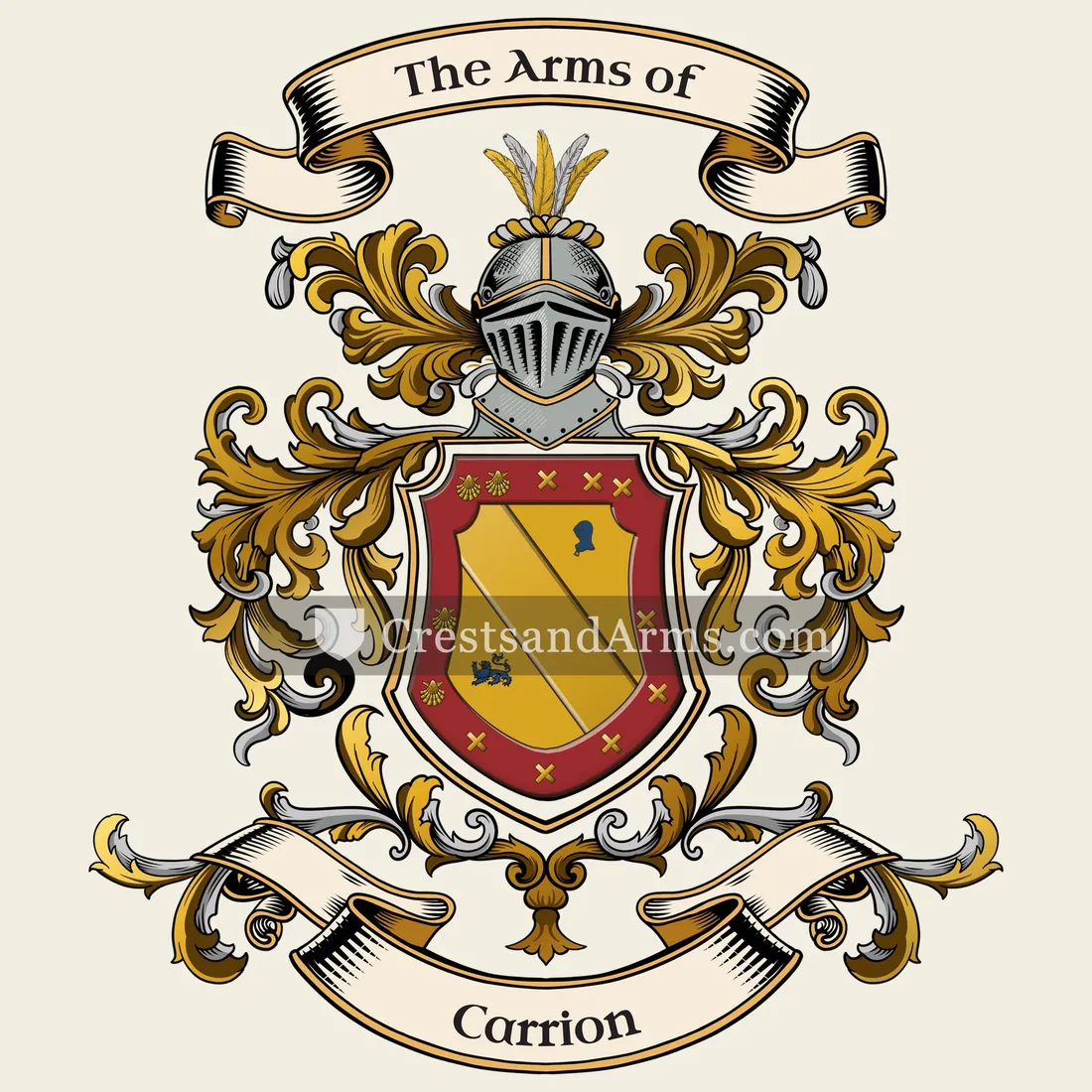
A record of documented arms, meaning and origin, researched for the Carrion family of Spain.
Reg. 1491 · Spanish, A–C
Meaning of the Carrion family crest colors & symbols
Symbols on this shield
bendDefence, and the scarf of a commander
helmetWisdom and security in defence
lionCourage, strength and royalty
saltire coupedResolution, and the cross of St Andrew
escallopThe pilgrim's shell, and a long journey made
Colours
Gold (Or)Means: Generosity
Blue (Azure)Means: Loyalty and truth
Red (Gules)Means: Military strength
Historical info
Source
J. B. Rietstap, Armorial Général, Gouda: G. B. van Goor Zonen, 1884–87
Blazon (the actual original written record)
“Coupé: au 1 d'or à un casque d'azur, taré de profil, la visière baissée; au 2 parti: a. d'azur au lion d'or, b. d'azur à trois bandes d'or. L'écu entouré d'une bord. de gu., ch. de huit flanchis d'or, alternant avec huit coquilles du même.”
SpainMurcie, c. 1722
Digital archive packCoat of arms PNG, gold border print PDF, vector SVG and the certificate of authenticity. Sent to your email in minutes.
Map of Spain showing where the Carrion arms are recorded
The Carrion arms were recorded in Murcie, c. 1722.
This is where the arms were entered in the register. Families often moved to other parts of the country, so the same name can turn up in more than one region.
The body that granted and recorded arms in Spain in this period.
Philip V of Spain
Sovereign of the period
Philip V of Spain
1714–1724
Reigning in Spain when the Carrion arms are first recorded.
How Arms Worked in Spain
In Spain, a coat of arms was considered a form of property that belonged to the entire family line. These arms were passed down from a father to all his children equally. Younger branches of the family usually kept the original design without needing to add any special marks to distinguish their specific line.
Granting authority
The Cronista Rey de Armas was the official body that regulated and granted coats of arms throughout Spain.
How they got arms
Families often obtained their arms through royal grants or by proving their noble status to the official heraldic authority.
Where arms were recorded
Coats of arms were officially recorded in the registers of the Cronista Rey de Armas starting in 1496.
The family's standing
Recorded among the armigerous families of Spain.
Origin & History of the Carrion Family in Spain
The surname Carrión is deeply rooted in the geography of Spain, taking its name from the town of Carrión de los Condes in the province of Palencia. Historically, the name functioned as a locative surname, which was a common way to identify individuals by the place where they were born or lived. By the early 18th century, members of the family had established a notable presence in the region of Murcia. In 1722, records confirm that the family was integrated into the local social and administrative fabric of this southeastern Spanish city. During this era, families with this name were often involved in local agriculture, trade, or civil service, helping to shape the development of the Murcian landscape. As the family moved across the Iberian Peninsula, they carried this geographic identifier with them, preserving a link to their ancestral origins while building new lives in growing urban centers like Murcia.
Carrion Meaning & Related Branches
Root word
Carrion
Derived from the Latin word carraria meaning a road for carts.
This name
CarrionA topographic surname for someone who lived near a major carriage road.
also spelled
Carion
Karrion
Carrione
Caryon
Related arms
Carionvariant spelling
Carion de Kerleanvariant spelling
Carion de Rosangavetvariant spelling
Carion du Pastisvariant spelling
Documented Sources
J. B. Rietstap, Armorial Général, Gouda: G. B. van Goor Zonen, 1884–87
Moll, Francesc de Borja, Els llinatges catalans, 1959
Faure, Roberto, Diccionario de apellidos españoles, 2001
Archivo General de la Región de Murcia, Protocolos Notariales de Murcia, 1722
Digital archive packCoat of arms PNG, gold border print PDF, vector SVG and the certificate of authenticity. Sent to your email in minutes.


 bendDefence, and the scarf of a commander
 helmetWisdom and security in defence
 lionCourage, strength and royalty
 saltire coupedResolution, and the cross of St Andrew
 escallopThe pilgrim's shell, and a long journey made
 bendDefence, and the scarf of a commander
 helmetWisdom and security in defence
 lionCourage, strength and royalty
 saltire coupedResolution, and the cross of St Andrew
 escallopThe pilgrim's shell, and a long journey made