Map of Switzerland showing where the Cart arms are recorded
The Cart arms were recorded in Switzerland, c. 1745.
Arms such as these were typically recorded in Bern.
Bern was the largest of the Swiss cantons and ran itself, with its own council and its own courts. Its governing families held office for generations, and office of that kind carried a shield with it.
This is where the arms were entered in the register. Families often moved to other parts of the country, so the same name can turn up in more than one region.
The body that granted and recorded arms in Switzerland in this period.
How Arms Worked in Switzerland
In Switzerland, coats of arms were not restricted to the nobility and were often adopted by common citizens and families. These symbols were passed down through generations to show family identity. When branches of a family grew, they often changed small details of the design to distinguish their own line from the original group.
Granting authority
Cantonal and civic authorities managed the use of coats of arms within their specific regions and local jurisdictions.
How they got arms
Families typically assumed their own coats of arms based on local custom rather than receiving them from a central monarch.
Where arms were recorded
Arms were recorded in various cantonal and civic registers starting from the fourteenth century throughout the Swiss region.
The family's standing
Recorded among the armigerous families of Switzerland.
Origin & History of the Cart Family in Switzerland
The family name Cart has deep roots in the Swiss region, with historical records confirming that members of the family were well-established in the city of Bern by 1745. The name likely originated as a descriptive occupational surname, as the word relates to the construction or operation of carts and wagons during the medieval period. In the social structure of eighteenth-century Bern, families like the Carts often participated in the local craft guilds or agricultural networks that defined the city’s economy. As the family grew, they integrated into the administrative and social life of the Swiss cantons, moving from their early roles as tradespeople into various professional paths. Their presence in Bern during the mid-1700s highlights a period of stability where the family became a recognized part of the local population, contributing to the regional history of the Swiss plateau.
Coat of Arms & Family Crest Details
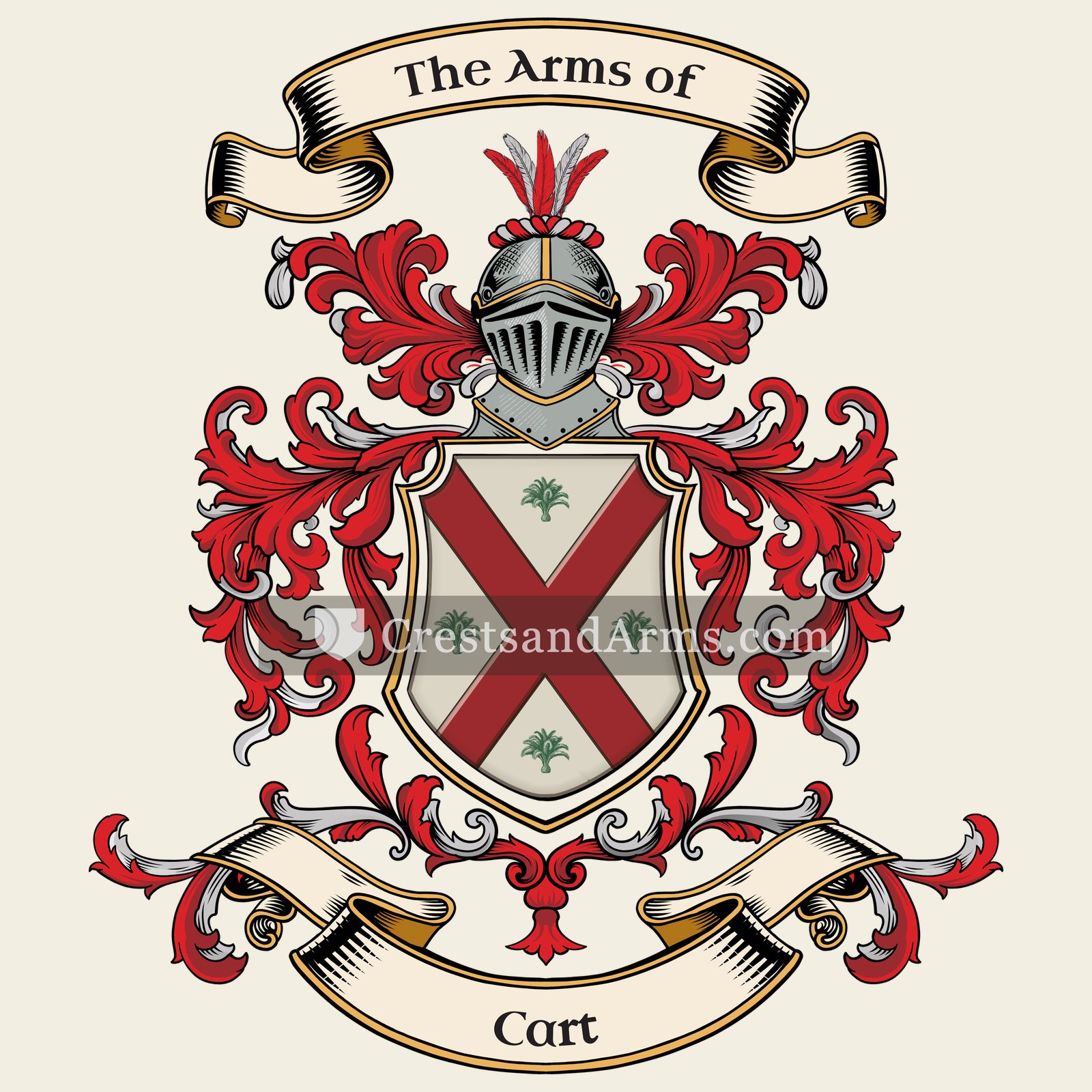
Symbols on this shield
saltireResolution, and St Andrew's cross
palm treeVictory, and righteousness that flourishes
Colours
Silver (Argent)Means: Peace and sincerity
Red (Gules)Means: Military strength
Green (Vert)Means: Hope
Historical info
Source
Sir Bernard Burke, The General Armory of England, Scotland, Ireland and Wales, London: Harrison & Sons, 1884
Blazon (the actual original written record)
“Ar. a saltire gu. betw. four palm trees, erased vert”
BedfordLondon · Bedford, c. 1620
Digital archive packCoat of arms PNG, gold border print PDF, vector SVG and the certificate of authenticity. Sent to your email in minutes.
Map of England showing where the Cart arms are recorded
The Cart arms were recorded in Bedford, c. 1620.
Bedfordshire was small, flat farming country close to London. Its manors were held by middling families rather than great ones, but a manor was a manor, and holding one brought arms.
This is where the arms were entered in the register. Families often moved to other parts of the country, so the same name can turn up in more than one region.
The body that granted and recorded arms in England in this period.
James VI and I
Sovereign of the period
James VI and I
1603–1625
Reigning in Switzerland when the Cart arms are first recorded.
How Arms Worked in England
English heraldry allowed arms to be shared by all legitimate descendants of the original owner. These symbols were treated as personal property that moved through the generations to all children. While the eldest son kept the original design, other family members could use the same shield without needing to change it or register their own unique versions.
Granting authority
The College of Arms in London has regulated the use of coats of arms throughout England and Wales since 1484.
How they got arms
Families typically obtained their coats of arms through a formal grant from the Crown or by proving their ancient right to them.
Where arms were recorded
All official coats of arms are recorded in the registers kept at the College of Arms, which date back to the fifteenth century.
The family's standing
Recorded among the armigerous families of Bedford.
Origin & History of the Cart Family in England
The surname Cart is rooted in the occupational history of medieval England, where it functioned as a descriptive name for someone who worked as a carter or a maker of carts. By the early 17th century, the family had established a notable presence in the county of Bedfordshire. Records confirm that members of the Cart family were living in Bedford by 1620, a time when the town was a bustling center of trade and local administration. During this period, families with this name were often integrated into the local economy as farmers or tradespeople who relied on the transport of goods to sustain their livelihoods. The transition from a simple occupational description to a formal family name reflects the way many English surnames became fixed during the late Middle Ages and the early modern era. As the family settled in Bedford, they became part of the long-standing social fabric of the region, contributing to the agricultural and commercial life of the English Midlands.
Cart Meaning & Related Branches
Root word
Cartus
Latin term referring to a two-wheeled cart or carriage.
This name
CartAn occupational surname for a carter, wagoner, or someone who transported goods.
also spelled
Kart
Karth
Documented Sources
J. B. Rietstap, Armorial Général, Gouda: G. B. van Goor Zonen, 1884–87
Dictionnaire historique de la Suisse, Dictionnaire historique de la Suisse, 2002
Familiennamenbuch der Schweiz, Familiennamenbuch der Schweiz, 1989
Staatsarchiv des Kantons Bern, Bürgerrodel der Stadt Bern
Digital archive packCoat of arms PNG, gold border print PDF, vector SVG and the certificate of authenticity. Sent to your email in minutes.


 crescentHonour by the sovereign, and the second son
 mulletThe third son, and a divine quality from above
 crescentHonour by the sovereign, and the second son
 mulletThe third son, and a divine quality from above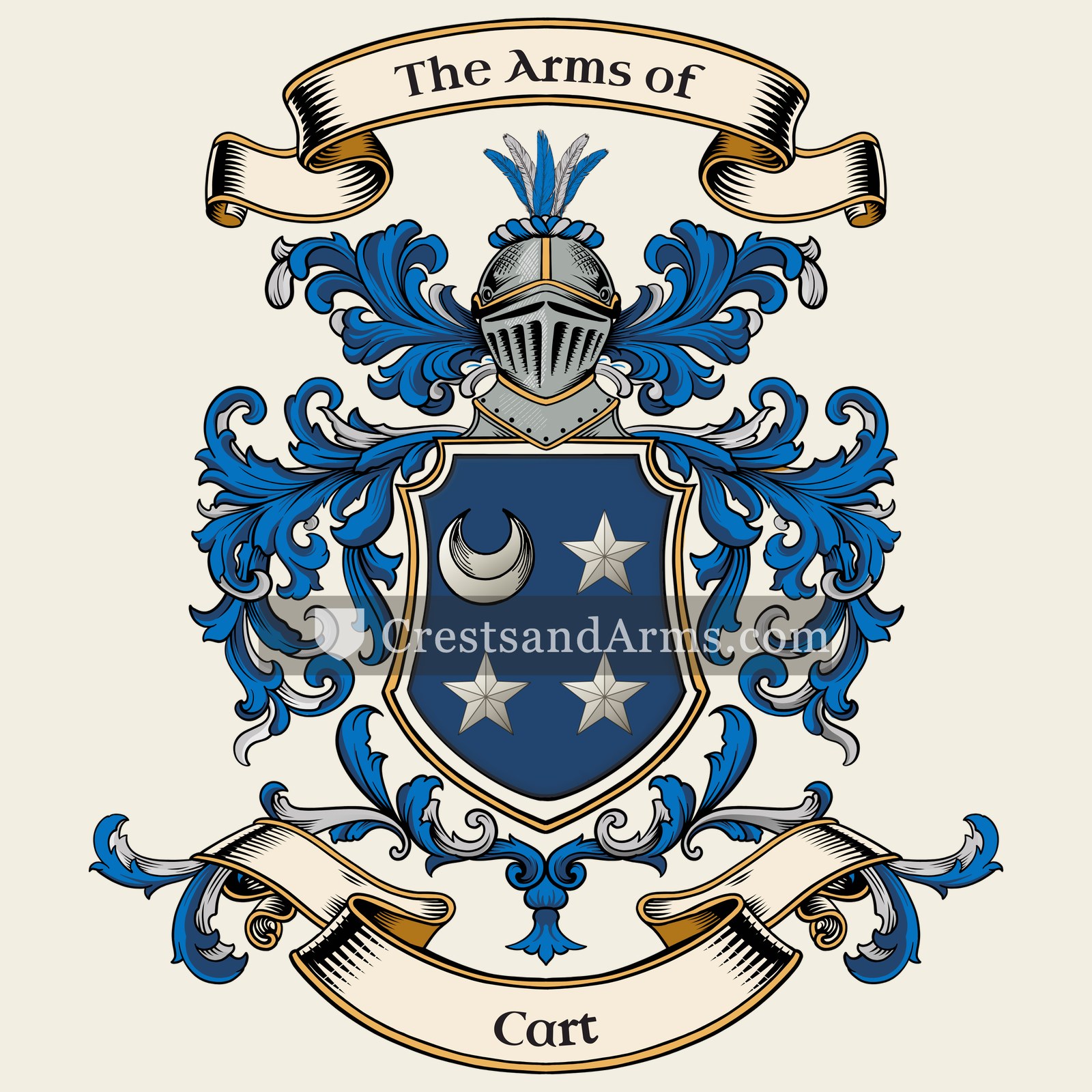

 saltireResolution, and St Andrew's cross
 palm treeVictory, and righteousness that flourishes