Map of Switzerland showing where the Cartia arms are recorded
The Cartia arms were recorded in Switzerland, c. 1745.
Arms such as these were typically recorded in Bern.
Bern was the largest of the Swiss cantons and ran itself, with its own council and its own courts. Its governing families held office for generations, and office of that kind carried a shield with it.
This is where the arms were entered in the register. Families often moved to other parts of the country, so the same name can turn up in more than one region.
The body that granted and recorded arms in Switzerland in this period.
How Arms Worked in Switzerland
In Switzerland, coats of arms were not restricted to the nobility and were often adopted by common citizens and families. These symbols were passed down through generations to show family identity. When branches of a family grew, they often changed small details of the design to distinguish their own line from the original group.
Granting authority
Cantonal and civic authorities managed the use of coats of arms within their specific regions and local jurisdictions.
How they got arms
Families typically assumed their own coats of arms based on local custom rather than receiving them from a central monarch.
Where arms were recorded
Arms were recorded in various cantonal and civic registers starting from the fourteenth century throughout the Swiss region.
The family's standing
Recorded among the armigerous families of Switzerland.
Origin & History of the Cartia Family in Switzerland
The Cartia family name holds a distinct place in the historical records of Bern, Switzerland, where members were documented as early as 1745. During this period, Bern was a powerful city-state governed by a strict social hierarchy, and families like the Cartias often integrated into the local urban fabric through trade, craftsmanship, or administrative service. Given the linguistic landscape of the region, the name likely emerged from a blend of local dialects and the influence of neighboring Italian-speaking cantons, suggesting a history of migration or cross-border commerce. By the mid-18th century, the family was established enough to appear in official municipal ledgers, which tracked residency and tax obligations for all citizens. Their presence in Bern indicates that they were part of the growing middle class that helped sustain the city’s economy during the Enlightenment era. This early documentation serves as a vital link to understanding how the family navigated the rigid social structures of 18th-century Switzerland while maintaining their unique identity.
Meaning of the Cartia family crest colors & symbols
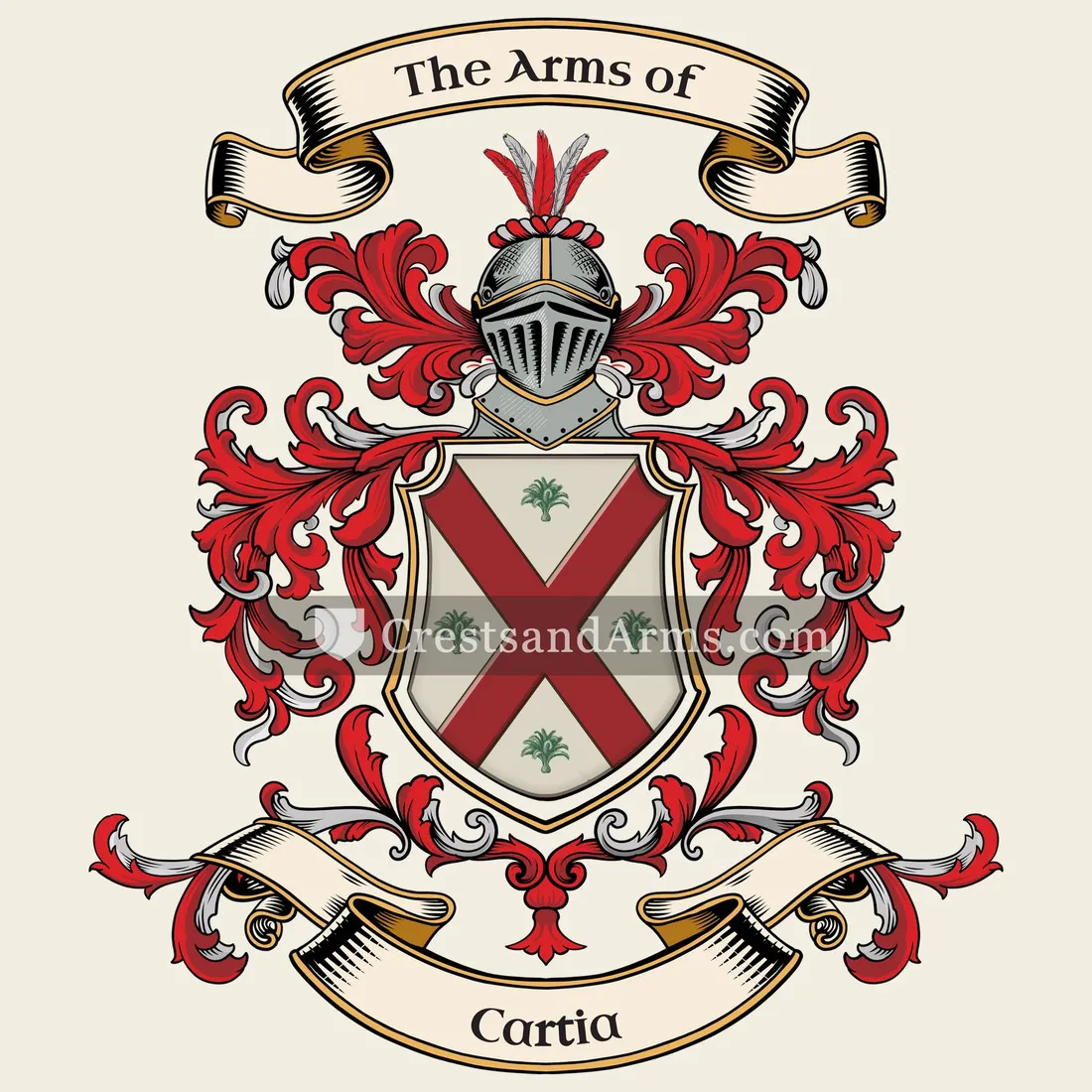
Symbols on this shield
saltireResolution, and St Andrew's cross
palm treeVictory, and righteousness that flourishes
Colours
Silver (Argent)Means: Peace and sincerity
Red (Gules)Means: Military strength
Green (Vert)Means: Hope
Historical info
Source
Sir Bernard Burke, The General Armory of England, Scotland, Ireland and Wales, London: Harrison & Sons, 1884
Blazon (the actual original written record)
“Ar. a saltire gu. betw. four palm trees, erased vert”
BedfordLondon · Bedford, c. 1620
Digital archive packCoat of arms PNG, gold border print PDF, vector SVG and the certificate of authenticity. Sent to your email in minutes.
Map of England showing where the Cartia arms are recorded
The Cartia arms were recorded in Bedford, c. 1620.
Bedfordshire was small, flat farming country close to London. Its manors were held by middling families rather than great ones, but a manor was a manor, and holding one brought arms.
This is where the arms were entered in the register. Families often moved to other parts of the country, so the same name can turn up in more than one region.
The body that granted and recorded arms in England in this period.
James VI and I
Sovereign of the period
James VI and I
1603–1625
Reigning in Switzerland when the Cartia arms are first recorded.
How Arms Worked in England
English heraldry allowed arms to be shared by all legitimate descendants of the original owner. These symbols were treated as personal property that moved through the generations to all children. While the eldest son kept the original design, other family members could use the same shield without needing to change it or register their own unique versions.
Granting authority
The College of Arms in London has regulated the use of coats of arms throughout England and Wales since 1484.
How they got arms
Families typically obtained their coats of arms through a formal grant from the Crown or by proving their ancient right to them.
Where arms were recorded
All official coats of arms are recorded in the registers kept at the College of Arms, which date back to the fifteenth century.
The family's standing
Recorded among the armigerous families of Bedford.
Origin & History of the Cartia Family in England
The history of the Cartia family in England begins with established roots in the town of Bedford by the year 1620. During the early seventeenth century, Bedford was a bustling market town where families often settled to participate in the local wool trade and agricultural commerce. The name likely arrived in the region as part of the broader patterns of migration and internal movement that defined England during the Stuart period. As residents of Bedford, the early members of the family would have lived through a time of significant social and political change, including the rise of religious nonconformity that later became a hallmark of the area. By embedding themselves in the local parish records and community life, the Cartia family helped shape the demographic fabric of Bedfordshire, transitioning from newcomers into established members of the local society over the course of several generations.
Cartia Meaning & Related Branches
Root word
Charta
Latin term for paper, leaf, or written document.
This name
CartiaDerived from a topographic or occupational name referring to someone living near or working with parchment.
also spelled
Kart
Karth
Documented Sources
J. B. Rietstap, Armorial Général, Gouda: G. B. van Goor Zonen, 1884–87
Staatsarchiv des Kantons Bern, Bürgerrodel der Stadt Bern
Staatsarchiv des Kantons Bern, Kirchenbücher der Stadt Bern
Dubler, Anne-Marie, Der Kanton Bern im 18. Jahrhundert, 1995
Historischer Verein des Kantons Bern, Berner Zeitschrift für Geschichte und Heimatkunde, 1940
Digital archive packCoat of arms PNG, gold border print PDF, vector SVG and the certificate of authenticity. Sent to your email in minutes.


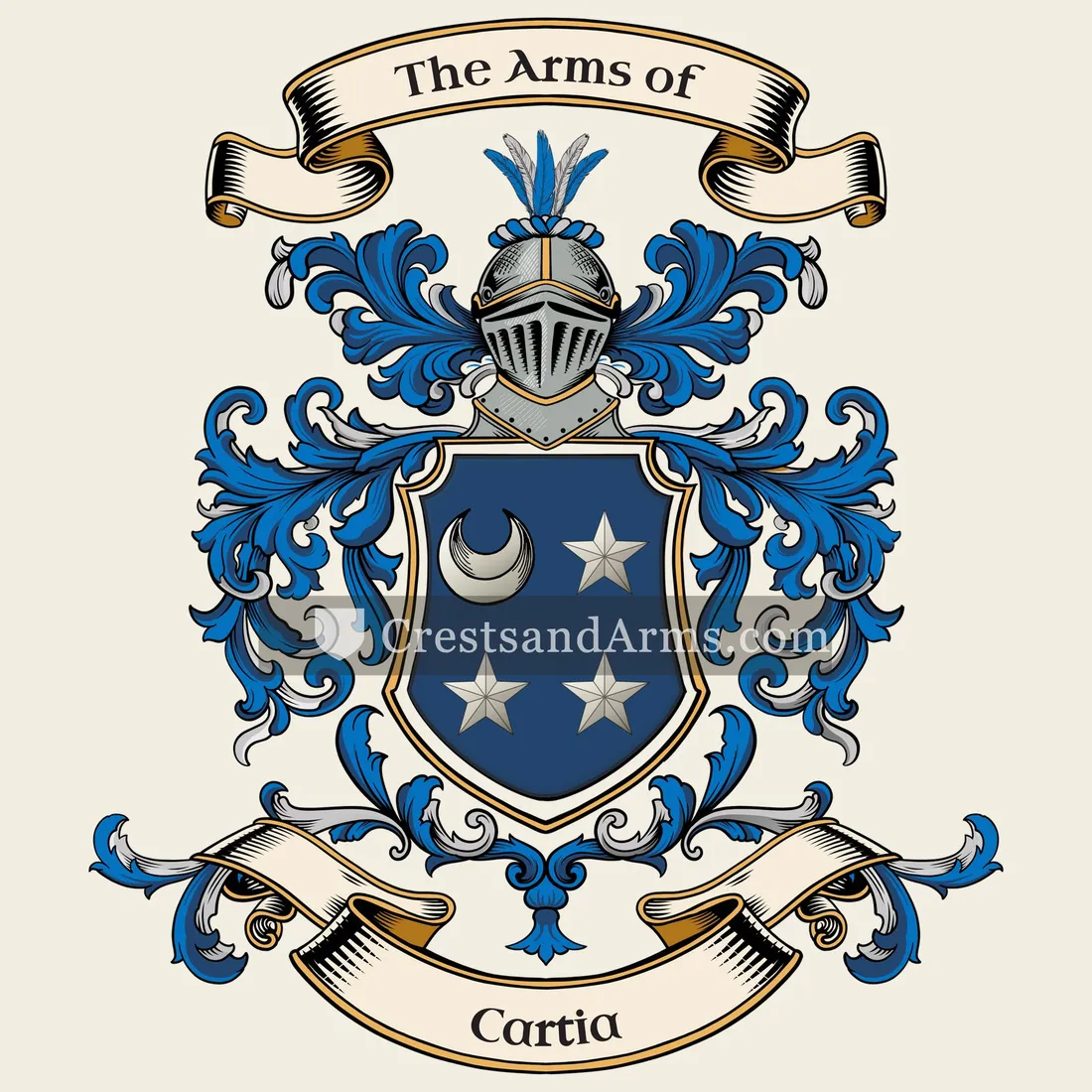
 crescentHonour by the sovereign, and the second son
 mulletThe third son, and a divine quality from above
 crescentHonour by the sovereign, and the second son
 mulletThe third son, and a divine quality from above

 saltireResolution, and St Andrew's cross
 palm treeVictory, and righteousness that flourishes