A record of documented arms, meaning and origin, researched for the Casamayor family lines. Documented in 2 countries.
Reg. 0045 · Spanish, A–C
Coat of Arms & Family Crest Details
Symbols on this shield
towerGrandeur and solidity, and a stronghold defended
treeLife, endurance and deep roots
Colours
Silver (Argent)Means: Peace and sincerity
Historical info
Source
J. B. Rietstap, Armorial Général, Gouda: G. B. van Goor Zonen, 1884–87
Blazon (the actual original written record)
“D'arg. à une tour de deux étages au nat., accostée de deux arbres de sin., le tout soutenu d'une terrasse du même; à la champagne d'arg. ch. de deux fasces ondées d'azur; ladite tour ch. d'un écusson éc. de gu. à cinq fleurs-de-lis d'or, 2, 1 et 2, et d'or à cinq croiss. de gu., 2, 1 et 2, posé au-dessus de la porte.”
SpainAsturies, c. 1722
Digital archive packCoat of arms PNG, gold border print PDF, vector SVG and the certificate of authenticity. Sent to your email in minutes.
Map of Spain showing where the Casamayor arms are recorded
The Casamayor arms were recorded in Asturies, c. 1722.
This is where the arms were entered in the register. Families often moved to other parts of the country, so the same name can turn up in more than one region.
The body that granted and recorded arms in Spain in this period.
Philip V of Spain
Sovereign of the period
Philip V of Spain
1714–1724
Reigning in Spain when the Casamayor arms are first recorded.
How Arms Worked in Spain
In Spain, a coat of arms was considered a form of property that belonged to the entire family line. These arms were passed down from a father to all his children equally. Younger branches of the family usually kept the original design without needing to add any special marks to distinguish their specific line.
Granting authority
The Cronista Rey de Armas was the official body that regulated and granted coats of arms throughout Spain.
How they got arms
Families often obtained their arms through royal grants or by proving their noble status to the official heraldic authority.
Where arms were recorded
Coats of arms were officially recorded in the registers of the Cronista Rey de Armas starting in 1496.
The family's standing
Recorded among the armigerous families of Spain.
Origin & History of the Casamayor Family in Spain
The surname Casamayor traces its roots to the northern regions of Spain, where it emerged as a descriptive name likely referring to a prominent or "major" house within a local community. By the early 18th century, historical records confirm that members of the family were well-established in the rugged landscape of Asturias. During this period, the family lived in a region defined by its mountainous terrain and deep-rooted traditions of land ownership and local governance. As the name spread from these northern origins, it became linked to families who played active roles in the social and administrative life of their parishes. The history of the Casamayor name reflects the broader movement of families across the Iberian Peninsula, as they transitioned from localized rural life toward the more structured societal roles that defined Spanish history in the 1700s.
Coat of Arms & Family Crest Details
Symbols on this shield
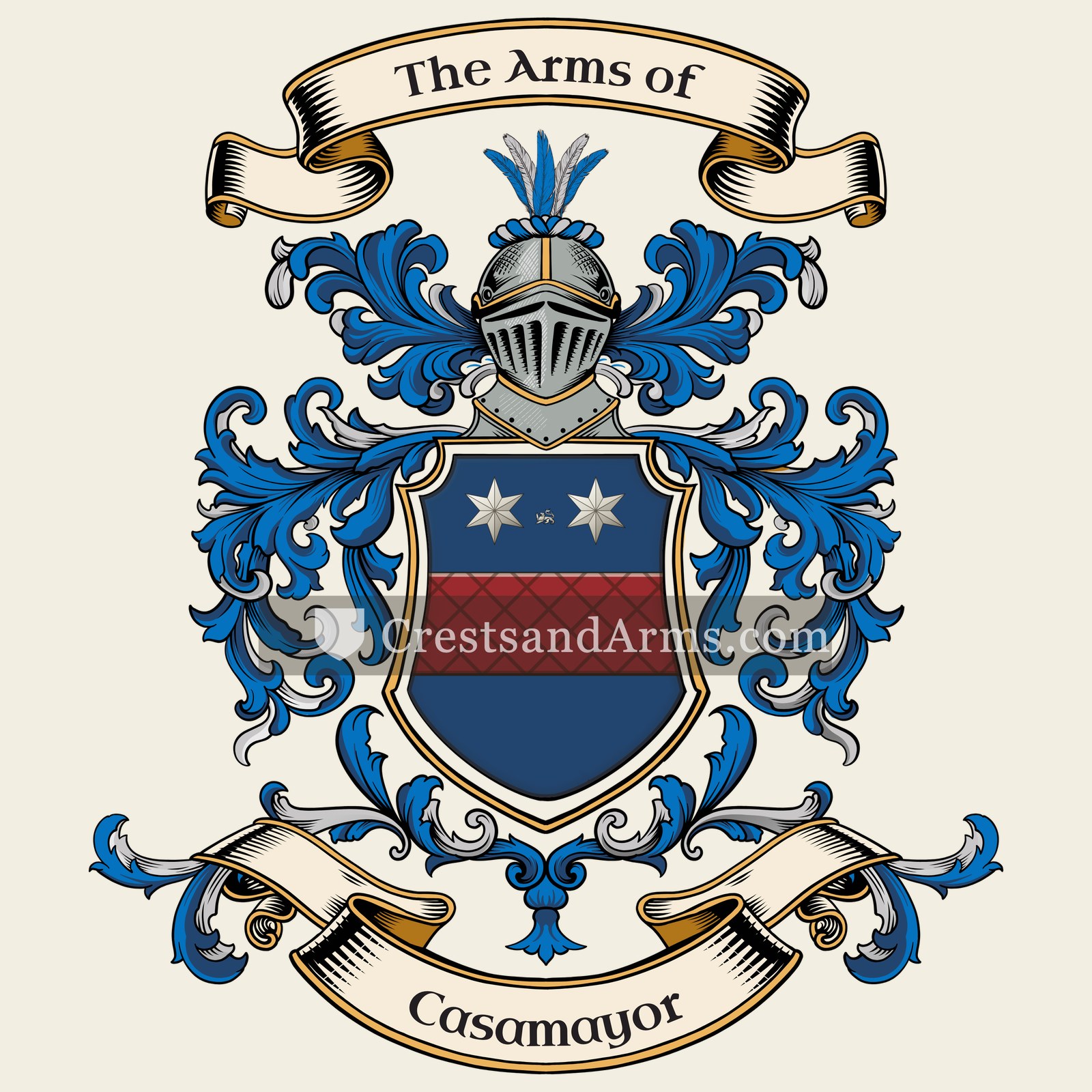
fessThe military belt, and readiness to serve
lionCourage, strength and royalty
starThe celestial goddess, and nobility
Colours
Blue (Azure)Means: Loyalty and truth
Red (Gules)Means: Military strength
Silver (Argent)Means: Peace and sincerity
Historical info
Source
J. B. Rietstap, Armorial Général, Gouda: G. B. van Goor Zonen, 1884–87
Blazon (the actual original written record)
“D'azur au lion d'arg., acc. en chef de deux étoiles du même; à la fasce de gu., br. sur le tout.”
GuyenneGuadeloupe · Guyenne, c. 1663
Digital archive packCoat of arms PNG, gold border print PDF, vector SVG and the certificate of authenticity. Sent to your email in minutes.
Map of France showing where the Casamayor arms are recorded
The Casamayor arms were recorded in Guyenne, c. 1663.
Guyenne was the great wine country of south-western France, shipping claret to England for centuries. The trade made merchant families rich, they bought vineyards and estates with the money, and land of that kind brought arms with it.
This is where the arms were entered in the register. Families often moved to other parts of the country, so the same name can turn up in more than one region.
The body that granted and recorded arms in France in this period.
Louis XIV of France
Sovereign of the period
Louis XIV of France
1643–1715
Reigning in Spain when the Casamayor arms are first recorded.
How Arms Worked in France
In France, a coat of arms was a mark of honor that passed down through the male line to all legitimate descendants. Families often used the same shield without changes to show their shared heritage. If a branch wanted to stand out, they could add a small mark to their shield to show their specific place in the family tree.
Granting authority
The Juge d'armes de France acted as the official authority that regulated and verified coats of arms across the country.
How they got arms
Families typically inherited their arms from ancestors, though they could also receive them through royal grants or by proving their noble status.
Where arms were recorded
Coats of arms were officially recorded in the Armorial Général de France, which began its main collection in the year 1696.
The family's standing
Recorded among the armigerous families of Guyenne.
Origin & History of the Casamayor Family in France
The surname Casamayor has deep roots in the southwestern region of France known as Guyenne. By the year 1663, records confirm that members of the family were already established in this area, which was historically significant for its wine production and its complex relationship with the French crown. The name itself is thought to be a compound of two words that suggest a "major house" or a prominent dwelling, pointing to a family that likely held a position of local responsibility or land ownership. During the seventeenth century, families in Guyenne often lived through periods of transition as the region moved toward tighter integration with the rest of France. The Casamayor family would have been part of this local social fabric, navigating the agricultural life and the regional politics of the time. Their presence in the historical record during this era highlights a long-standing connection to the landscape and the community of southwestern France.
Casamayor Meaning & Related Branches
Root word
Casa + Mayor
House or dwelling combined with the adjective meaning greater or chief.
This name
CasamayorRefers to the principal house or the main residence of a family estate.
also spelled
Casamajor
Kasamayor
Casamayore
Related arms
Casamajorvariant spelling
Documented Sources
J. B. Rietstap, Armorial Général, Gouda: G. B. van Goor Zonen, 1884–87
Archivo Histórico Diocesano de Oviedo, Libros Sacramentales de la Parroquia de San Martín de Luiña, 1722
Moll, Francesc de Borja, Els llinatges catalans: Catalunya, País Valencià i Illes Balears, 1959
Pérez-Bustamante, Rogelio, El sistema señorial en la España moderna, 1984
Digital archive packCoat of arms PNG, gold border print PDF, vector SVG and the certificate of authenticity. Sent to your email in minutes.


 towerGrandeur and solidity, and a stronghold defended
 treeLife, endurance and deep roots
 towerGrandeur and solidity, and a stronghold defended
 treeLife, endurance and deep roots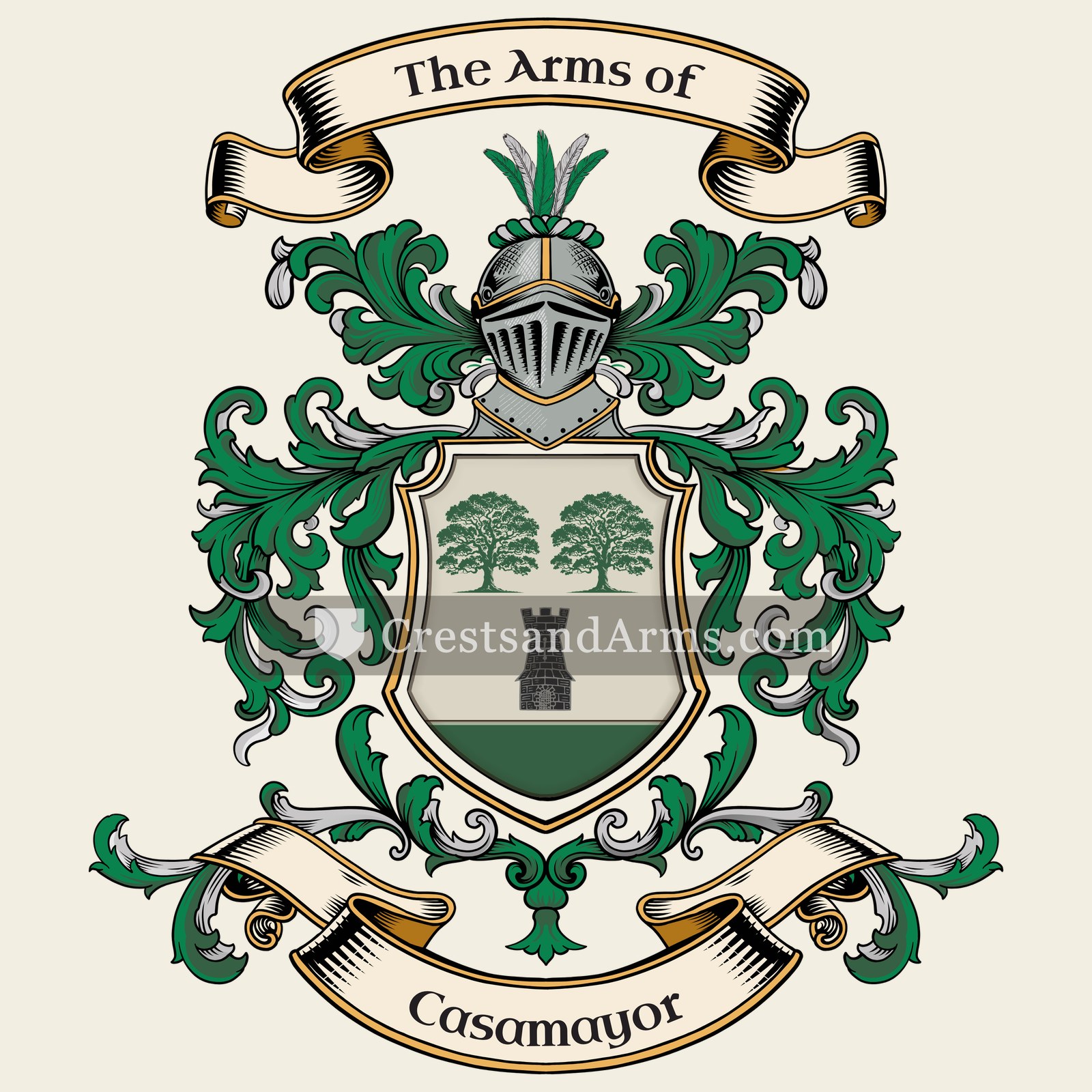


 fessThe military belt, and readiness to serve
 lionCourage, strength and royalty
 starThe celestial goddess, and nobility