A record of documented arms, meaning and origin, researched for the Casanova family lines. Documented in 2 countries.
Reg. 3872 · Italian, A–C
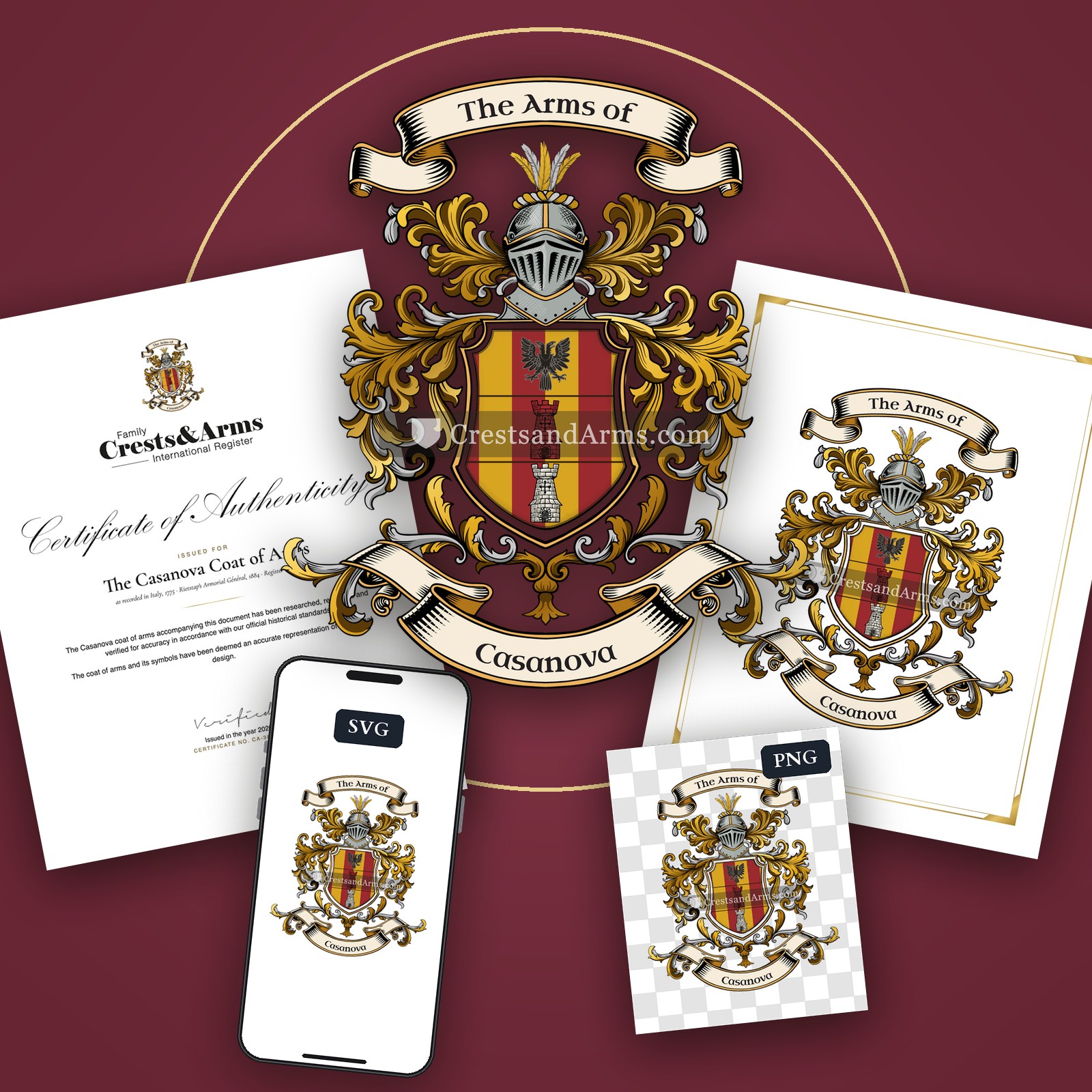
Coat of Arms & Family Crest Details
Symbols on this shield
paleMilitary strength, and a fortified defence
eagleNobility, strength and a keen mind
towerGrandeur and solidity, and a stronghold defended
Colours
Gold (Or)Means: Generosity
Black (Sable)Means: Constancy
Red (Gules)Means: Military strength
Silver (Argent)Means: Peace and sincerity
Historical info
Source
J. B. Rietstap, Armorial Général, Gouda: G. B. van Goor Zonen, 1884–87
Blazon (the actual original written record)
“Tiercé en fasce: au 1 d'or à l'aigle de sa., cour. du champ; au 2 parti: a. d'or à un château de gu., sommé de deux tours du même, ouv. et aj. du champ, supp. entre les tours une colombe au vol levé d'arg., tenant en son bec un rameau d'olivier de sin.; b. d'azur à une maison d'arg., essorée de gu., ouv. et aj. du champ; au 3 palé d'or et de gu.”
ItalyMilan, c. 1775
Digital archive packCoat of arms PNG, gold border print PDF, vector SVG and the certificate of authenticity. Sent to your email in minutes.
Map of Italy showing where the Casanova arms are recorded
The Casanova arms were recorded in Milan, c. 1775.
This is where the arms were entered in the register. Families often moved to other parts of the country, so the same name can turn up in more than one region.
The body that granted and recorded arms in Italy in this period.
Alvise Giovanni Mocenigo
Sovereign of the period
Alvise Giovanni Mocenigo
1763–1778
Reigning in Italy when the Casanova arms are first recorded.
How Arms Worked in Italy
In the Italian states, coats of arms were often used by noble families to show their status and history. These symbols were passed down through the generations to all legitimate male descendants. Younger branches of a family usually kept the original design but sometimes added small changes to distinguish their specific line from the main branch.
Granting authority
Various local rulers and city governments controlled the use of coats of arms across the different Italian states.
How they got arms
Families often assumed their own arms or received them as official grants from local lords, popes, or city councils.
Where arms were recorded
Arms were recorded in local city archives or private family books rather than in one single national register.
The family's standing
Recorded among the armigerous families of Italy.
Origin & History of the Casanova Family in Italy
The surname Casanova originates from the Italian words "casa" and "nuova," which translate literally to "new house." During the Middle Ages, this name was often given to families who built a new home on a piece of land or settled in a newly established village. Because this was a descriptive name, it appeared independently in several different regions across Italy rather than belonging to a single bloodline. By the time the family was firmly established in Milan in 1775, they were part of a long tradition of families who used the name to signify their status as landowners or settlers. Over the centuries, the name spread from rural farming communities into the busy urban centers of Northern Italy. In these cities, members of the family often worked as merchants, artisans, or professionals who helped shape the growing economy of the region.
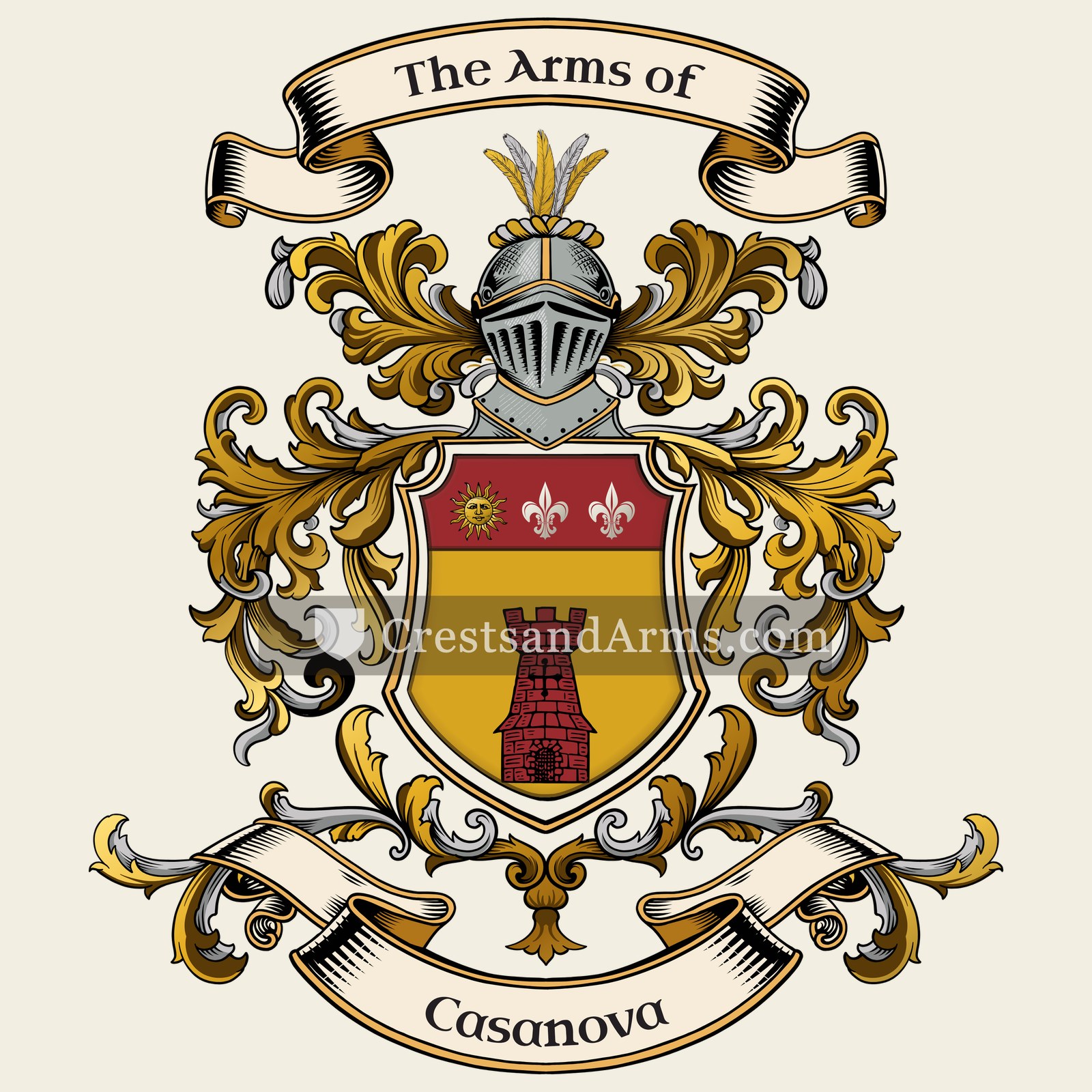
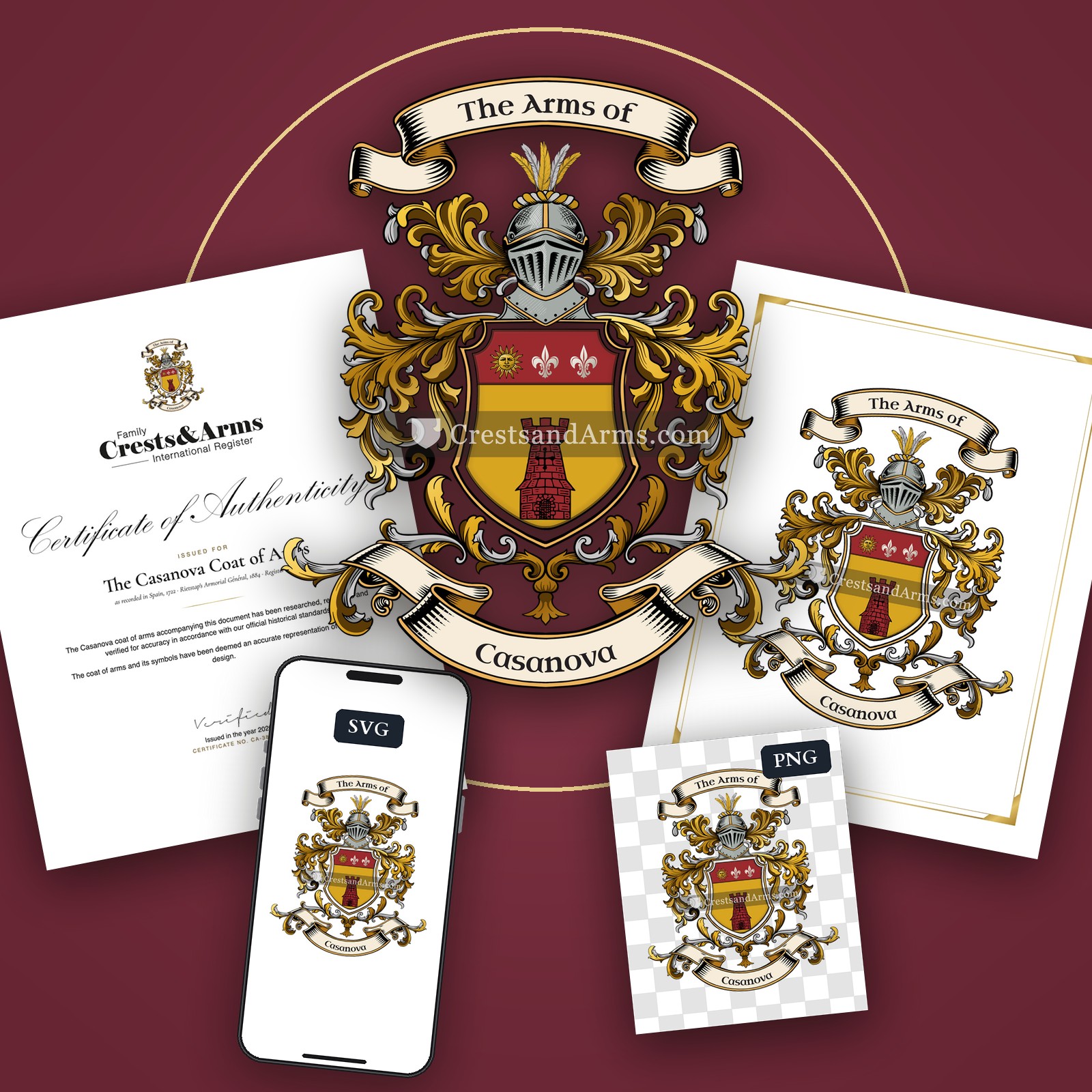
Coat of Arms & Family Crest Details
Symbols on this shield
chiefAuthority, wisdom and dominion
towerGrandeur and solidity, and a stronghold defended
sunGlory, splendour and the source of life
fleur de lisPurity, light, and the sixth son
Colours
Gold (Or)Means: Generosity
Red (Gules)Means: Military strength
Silver (Argent)Means: Peace and sincerity
Historical info
Source
J. B. Rietstap, Armorial Général, Gouda: G. B. van Goor Zonen, 1884–87
Blazon (the actual original written record)
“D'or à une maison carrée de gu.; au chef du même, ch. d'un soleil d'or entre deux fleurs-de-lis d'arg.”
SpainMurcie, c. 1722
Digital archive packCoat of arms PNG, gold border print PDF, vector SVG and the certificate of authenticity. Sent to your email in minutes.
Map of Spain showing where the Casanova arms are recorded
The Casanova arms were recorded in Murcie, c. 1722.
This is where the arms were entered in the register. Families often moved to other parts of the country, so the same name can turn up in more than one region.
The body that granted and recorded arms in Spain in this period.
Philip V of Spain
Sovereign of the period
Philip V of Spain
1714–1724
Reigning in Italy when the Casanova arms are first recorded.
How Arms Worked in Spain
In Spain, a coat of arms was considered a form of property that belonged to the entire family line. These arms were passed down from a father to all his children equally. Younger branches of the family usually kept the original design without needing to add any special marks to distinguish their specific line.
Granting authority
The Cronista Rey de Armas was the official body that regulated and granted coats of arms throughout Spain.
How they got arms
Families often obtained their arms through royal grants or by proving their noble status to the official heraldic authority.
Where arms were recorded
Coats of arms were officially recorded in the registers of the Cronista Rey de Armas starting in 1496.
The family's standing
Recorded among the armigerous families of Spain.
Origin & History of the Casanova Family in Spain
The surname Casanova originates from the Catalan and Occitan languages, where it literally translates to "new house." This name was typically given to families who moved into a newly constructed home or settled on land that had been recently cleared for farming. By the early 18th century, the family had established a notable presence in the region of Murcia. In 1722, records indicate that members of the Casanova family were integrated into the local social and economic fabric of this Spanish province. During this era, families with this name often worked as landowners or laborers who helped expand the agricultural output of the Mediterranean coast. Because the name describes a physical location rather than a specific trade, it appeared independently in various towns across Spain as families built new homesteads and expanded their influence within their local communities.
Casanova Meaning & Related Branches
Root word
Casa and Nova
Latin for house and new.
This name
CasanovaRefers to someone who lived in a newly built house or a new settlement.
also spelled
Casanove
Kasanova
Casanov
Related arms
Casanovevariant spelling
Documented Sources
J. B. Rietstap, Armorial Général, Gouda: G. B. van Goor Zonen, 1884–87
De Felice, Emidio. Dizionario dei cognomi italiani. 1978
Fucile, Roberto. I cognomi d'Italia: Storia e diffusione. 1999
Archivio di Stato di Milano, Anagrafe civica
Digital archive packCoat of arms PNG, gold border print PDF, vector SVG and the certificate of authenticity. Sent to your email in minutes.


 paleMilitary strength, and a fortified defence
 eagleNobility, strength and a keen mind
 towerGrandeur and solidity, and a stronghold defended
 paleMilitary strength, and a fortified defence
 eagleNobility, strength and a keen mind
 towerGrandeur and solidity, and a stronghold defended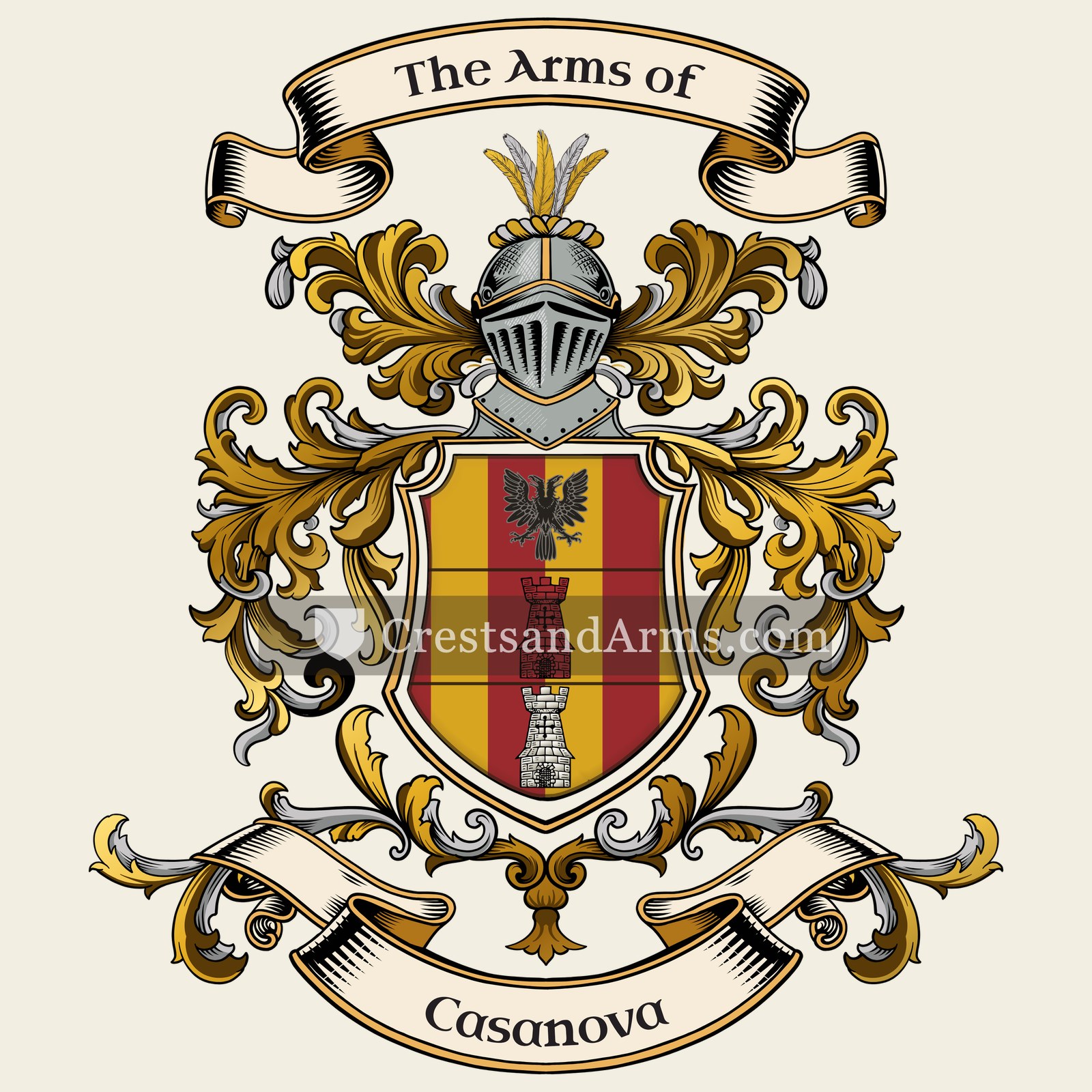


 chiefAuthority, wisdom and dominion
 sunGlory, splendour and the source of life
 fleur de lisPurity, light, and the sixth son