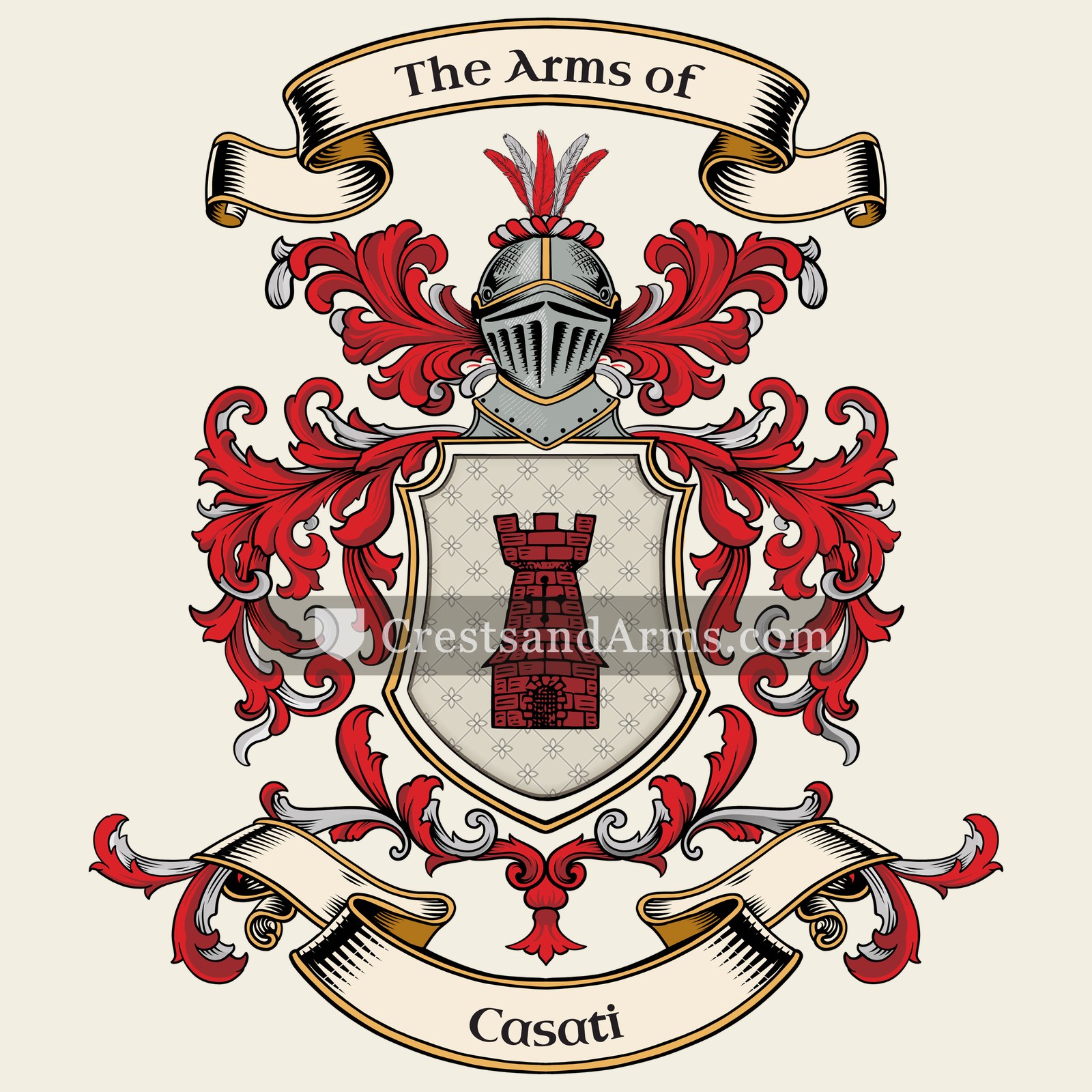
A record of documented arms, meaning and origin, researched for the Casati family of France.
Reg. 4760 · French, A–C
Coat of Arms & Family Crest Details
Symbols on this shield
towerGrandeur and solidity, and a stronghold defended
Colours
Silver (Argent)Means: Peace and sincerity
Red (Gules)Means: Military strength
Historical info
Source
J. B. Rietstap, Armorial Général, Gouda: G. B. van Goor Zonen, 1884–87
Blazon (the actual original written record)
“D'arg. à une tour de deux étages de gu., couverte d'un toit pointu, embrassée de deux tresses de cheveux du sec., les pieds passés en saut. Cq. cour. C.: une aigle de sa., cour. d'or.”
Francec. 1725
Digital archive packCoat of arms PNG, gold border print PDF, vector SVG and the certificate of authenticity. Sent to your email in minutes.
Map of France showing where the Casati arms are recorded
The Casati arms were recorded in France, c. 1725.
Arms such as these were typically recorded in Bretagne.
More families held coats of arms in Bretagne than anywhere else in France. The land was divided into many small estates rather than a few large ones, so far more households counted as gentry, and each needed a shield of its own to be told apart.
This is where the arms were entered in the register. Families often moved to other parts of the country, so the same name can turn up in more than one region.
The body that granted and recorded arms in France in this period.
Louis XV of France
Sovereign of the period
Louis XV of France
1715–1774
Reigning in France when the Casati arms are first recorded.
How Arms Worked in France
In France, a coat of arms was a mark of honor that passed down through the male line to all legitimate descendants. Families often used the same shield without changes to show their shared heritage. If a branch wanted to stand out, they could add a small mark to their shield to show their specific place in the family tree.
Granting authority
The Juge d'armes de France acted as the official authority that regulated and verified coats of arms across the country.
How they got arms
Families typically inherited their arms from ancestors, though they could also receive them through royal grants or by proving their noble status.
Where arms were recorded
Coats of arms were officially recorded in the Armorial Général de France, which began its main collection in the year 1696.
The family's standing
Recorded among the armigerous families of France.
Origin & History of the Casati Family in France
The Casati family name carries a rich history that traces its roots back to the northern regions of Italy before spreading across Europe. By the early 18th century, members of the family had established a presence in the Bretagne region of France, where they integrated into the local social and economic fabric by 1725. The name itself is thought to be topographic in origin, likely derived from the Latin word "casa," meaning a house or a small dwelling. This suggests that the earliest ancestors were identified by their residence or their role as caretakers of a specific estate. As the family moved through different regions, they adapted to new cultures while maintaining their distinct identity. Their migration into France highlights the mobility of families during this era, as individuals traveled across borders for trade, service, or new opportunities.
Casati Meaning & Related Branches
Root word
Casa
Latin term referring to a cottage, hut, or small house.
This name
CasatiA topographic name for someone who lived in or near a small house or dwelling.
also spelled
Casato
Kasati
Casaty
Documented Sources
J. B. Rietstap, Armorial Général, Gouda: G. B. van Goor Zonen, 1884–87
De Felice, Emidio. Dizionario dei cognomi italiani. 1978
Morlet, Marie-Thérèse. Dictionnaire étymologique des noms de famille. 1991
Archives départementales d'Ille-et-Vilaine, Registres paroissiaux et d'état civil
Digital archive packCoat of arms PNG, gold border print PDF, vector SVG and the certificate of authenticity. Sent to your email in minutes.


 towerGrandeur and solidity, and a stronghold defended
 towerGrandeur and solidity, and a stronghold defended