Map of England showing where the Cascone arms are recorded
The Cascone arms were recorded in Cambridge, c. 1620.
Cambridgeshire was flat, rich farming country with the university at its centre. Fen drainage made new land and new fortunes, and families who gained by it bought manors and took arms to match.
This is where the arms were entered in the register. Families often moved to other parts of the country, so the same name can turn up in more than one region.
The body that granted and recorded arms in England in this period.
James VI and I
Sovereign of the period
James VI and I
1603–1625
Reigning in England when the Cascone arms are first recorded.
How Arms Worked in England
English heraldry allowed arms to be shared by all legitimate descendants of the original owner. These symbols were treated as personal property that moved through the generations to all children. While the eldest son kept the original design, other family members could use the same shield without needing to change it or register their own unique versions.
Granting authority
The College of Arms in London has regulated the use of coats of arms throughout England and Wales since 1484.
How they got arms
Families typically obtained their coats of arms through a formal grant from the Crown or by proving their ancient right to them.
Where arms were recorded
All official coats of arms are recorded in the registers kept at the College of Arms, which date back to the fifteenth century.
The family's standing
Recorded among the armigerous families of Cambridge.
Origin & History of the Cascone Family in England
The surname Cascone finds its roots in the linguistic traditions of Southern Italy, where it likely originated as a descriptive nickname derived from the Italian word "casco," meaning a helmet or a protective head covering. This suggests that early ancestors may have been recognized for their roles as soldiers or perhaps for a distinct physical feature. While the name is deeply tied to Mediterranean history, members of the family were documented as being present in Cambridge by 1620. This indicates that the family was part of the early wave of movement that connected continental European lineages to the developing intellectual and social landscape of England. By settling in such a prominent academic center during the early seventeenth century, these early family members helped establish a presence that bridged their traditional Italian heritage with the evolving cultural identity of the British Isles.
Related Branches & Arms
Root word
Casco
Derived from the Italian word for helmet or headgear.
This name
CasconeAn occupational name for a maker or wearer of helmets.
also spelled
Casonne
Casoni
Documented Sources
Sir Bernard Burke, The General Armory of England, Scotland, Ireland and Wales, London: Harrison & Sons, 1884
De Felice, Emidio. Dizionario dei cognomi italiani. 1978
Fucilla, Joseph G. Our Italian Surnames. 1949
The National Archives, UK. State Papers Domestic, James I. 1620
Digital archive packCoat of arms PNG, gold border print PDF, vector SVG and the certificate of authenticity. Sent to your email in minutes.


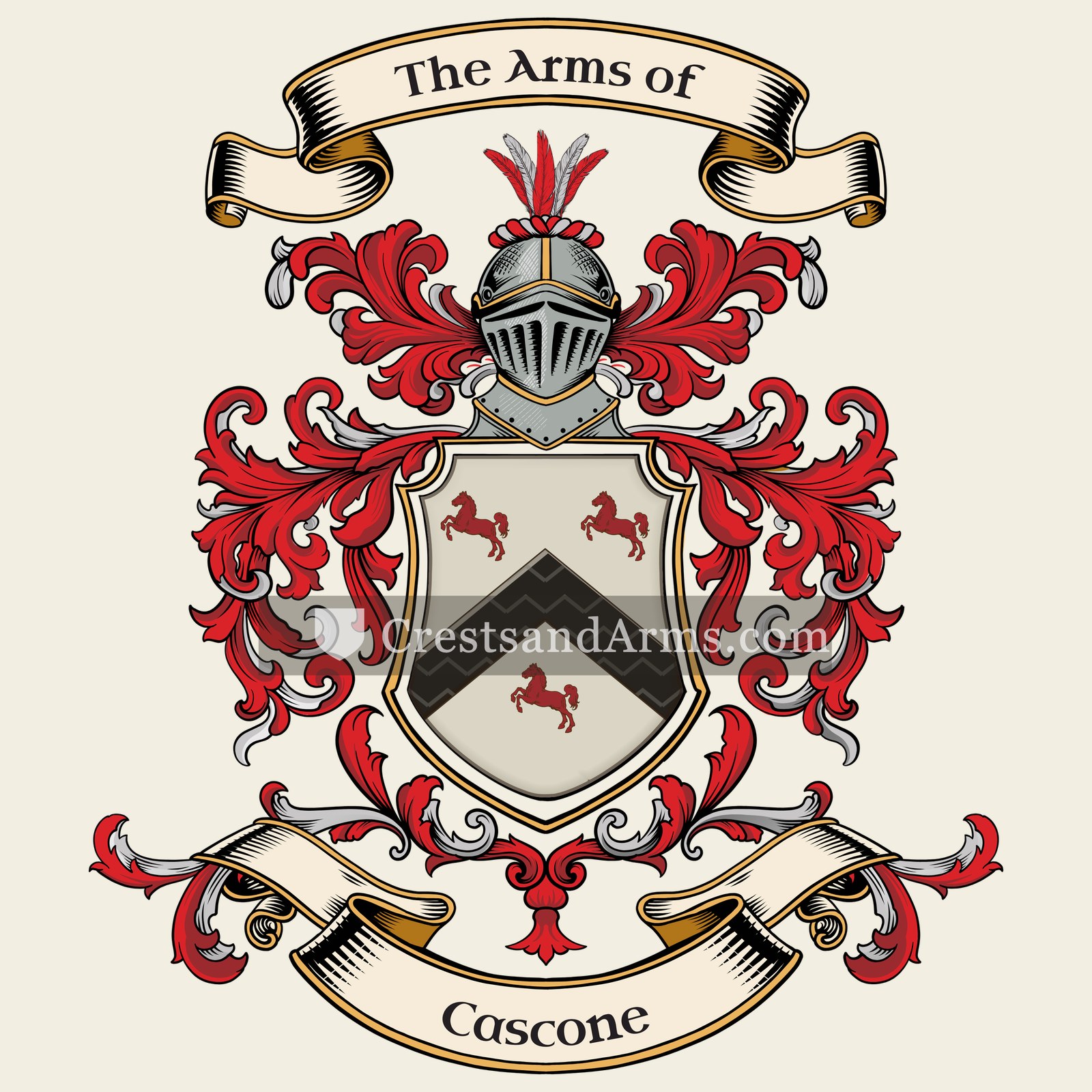
 chevronProtection, and faithful service completed
 horseReadiness to serve king and country
 chevronProtection, and faithful service completed
 horseReadiness to serve king and country