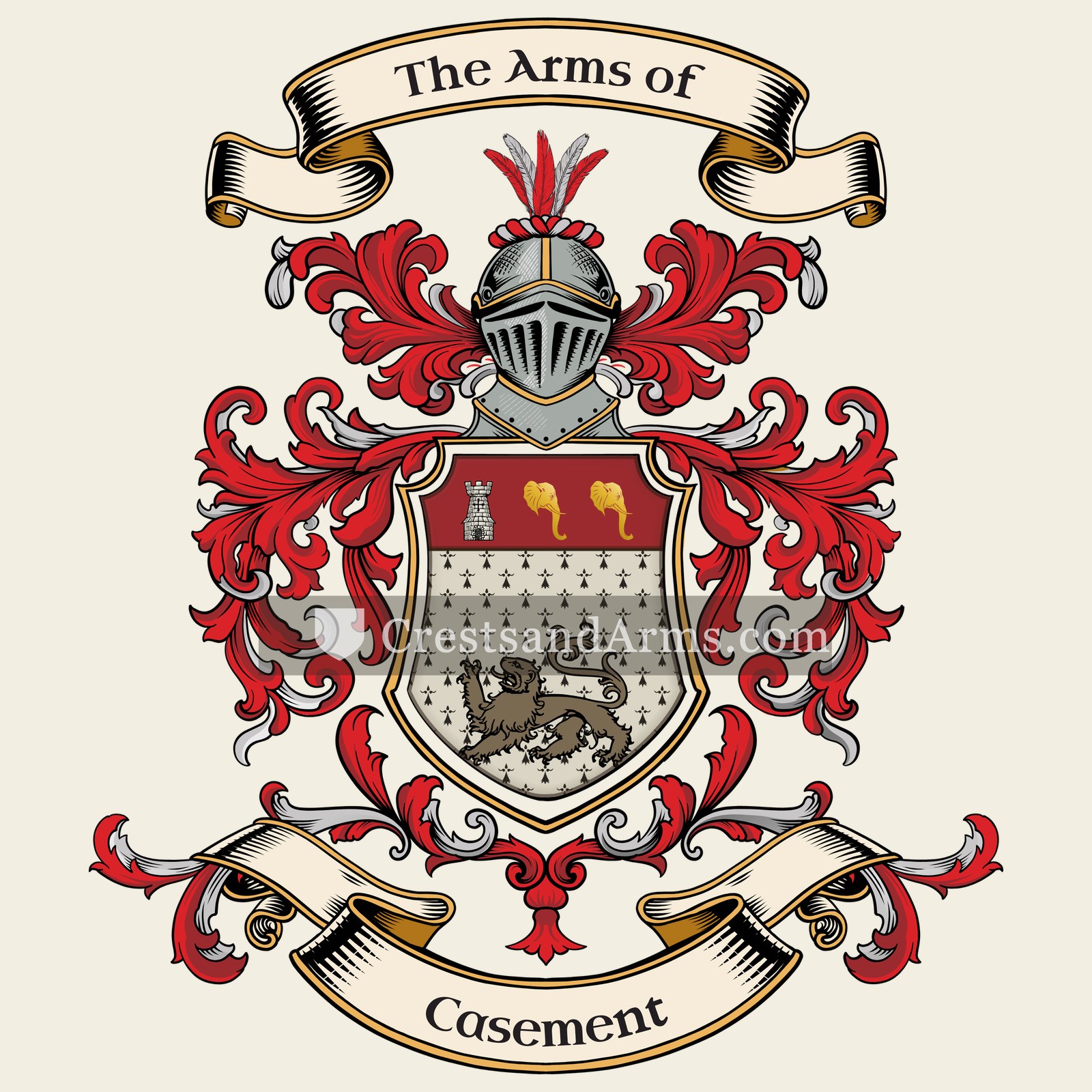
A record of documented arms, meaning and origin, researched for the Casement family of Ireland.
Reg. 3754 · Irish, A–C
Coat of Arms & Family Crest Details
Symbols on this shield
chiefAuthority, wisdom and dominion
lionCourage, strength and royalty
towerGrandeur and solidity, and a stronghold defended
elephantGreat strength, wit and ambition
Colours
ErmineMeans: Dignity
Red (Gules)Means: Military strength
Silver (Argent)Means: Peace and sincerity
Gold (Or)Means: Generosity
Historical info
Source
Sir Bernard Burke, The General Armory of England, Scotland, Ireland and Wales, London: Harrison & Sons, 1884
Blazon (the actual original written record)
“Erm. a lion ramp. guard. ppr. charged with a mullet gu., and holding in the paws a sword erect also ppr., pommel and hilt gold, encircled round the point with a wreath vert; on a chief embattled gu. a tower ar. betw. two elephants' heads erased or”
AntrimAntrim, c. 1645
Digital archive packCoat of arms PNG, gold border print PDF, vector SVG and the certificate of authenticity. Sent to your email in minutes.
Map of Ireland showing where the Casement arms are recorded
The Casement arms were recorded in Antrim, c. 1645.
Antrim was north-eastern Irish country settled from Scotland in the seventeenth century. The new landowners took formal grants and had them recorded, so their arms are unusually well documented.
This is where the arms were entered in the register. Families often moved to other parts of the country, so the same name can turn up in more than one region.
The body that granted and recorded arms in Ireland in this period.
Charles I of England
Sovereign of the period
Charles I of England
1625–1649
Reigning in Ireland when the Casement arms are first recorded.
How Arms Worked in Ireland
The Ulster King of Arms granted coats of arms to individuals who proved their social standing and good character. These symbols were typically inherited by all legitimate descendants of the original holder. If a family branch wanted a unique look, they could apply for a specific change to their design through the office to ensure their identity remained distinct.
Granting authority
The Ulster King of Arms acted as the official body that regulated and issued all coats of arms throughout Ireland.
How they got arms
Families obtained their arms through formal grants issued by the office after proving their eligibility and paying the required fees.
Where arms were recorded
All official grants were recorded in the registers held by the Ulster King of Arms starting from the year 1552.
The family's standing
Recorded among the armigerous families of Antrim.
Origin & History of the Casement Family in Ireland
The Casement family name has deep roots in County Antrim, where records confirm their presence by the year 1645. Historians believe the name is likely of Gaelic origin, evolving from the Irish surname *Mac Asmain*, which translates to "son of Asman." This name was gradually anglicized as families integrated into the changing social landscape of seventeenth-century Ulster. During this period, the Casements established themselves as prominent landowners and merchants in the northeast of Ireland. Their early history is closely tied to the development of the region, as they moved from being local figures to influential participants in the economic and political life of County Antrim. By settling in this area, the family became part of the complex cultural tapestry that defined the north of Ireland for generations.
Casement Meaning & Related Branches
Root word
cas
A Latin term referring to a helmet or protective head covering.
This name
CasementAn occupational name for a maker or seller of helmets.
also spelled
Casemant
Casemint
Casemunt
Documented Sources
Sir Bernard Burke, The General Armory of England, Scotland, Ireland and Wales, London: Harrison & Sons, 1884
Bell, Robert, The Book of Ulster Surnames, 1988
MacLysaght, Edward, The Surnames of Ireland, 1985
Public Record Office of Northern Ireland, D/1620: Casement Family Papers
Digital archive packCoat of arms PNG, gold border print PDF, vector SVG and the certificate of authenticity. Sent to your email in minutes.


 chiefAuthority, wisdom and dominion
 lionCourage, strength and royalty
 towerGrandeur and solidity, and a stronghold defended
 elephantGreat strength, wit and ambition
 chiefAuthority, wisdom and dominion
 lionCourage, strength and royalty
 towerGrandeur and solidity, and a stronghold defended
 elephantGreat strength, wit and ambition