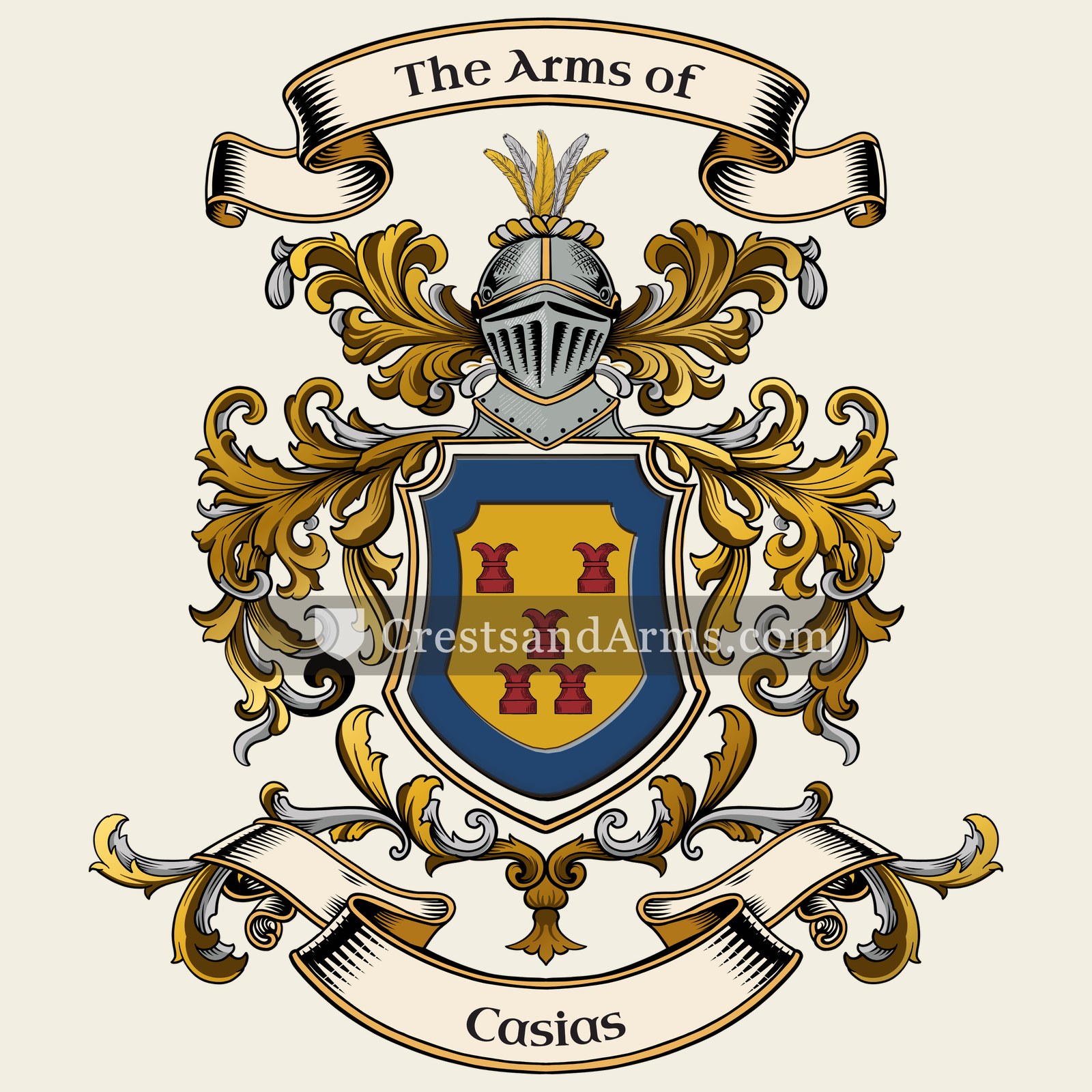
A record of documented arms, meaning and origin, researched for the Casias family of Spain.
Reg. 2949 · Spanish, A–C
Coat of Arms & Family Crest Details
Symbols on this shield
chess rookStrategy, and the defence of a position
Colours
Gold (Or)Means: Generosity
Blue (Azure)Means: Loyalty and truth
Red (Gules)Means: Military strength
Historical info
Source
J. B. Rietstap, Armorial Général, Gouda: G. B. van Goor Zonen, 1884–87
Blazon (the actual original written record)
“D'or à cinq rocs d'échiquier en forme de coupes couvertes de gu., 2, 1 et 2; à la bord. d'azur, ch. de huit têtes d'aigle d'or, ensanglantées de gu., posées dans la direction de la bord.”
CastileCastile, c. 1722
Digital archive packCoat of arms PNG, gold border print PDF, vector SVG and the certificate of authenticity. Sent to your email in minutes.
Map of Spain showing where the Casias arms are recorded
The Casias arms were recorded in Castile, c. 1722.
Castile was the heart of Spain and the source of most of its noble families. Land won in the long wars against the Moors was granted out to fighting men, and a man granted land was granted arms along with it.
This is where the arms were entered in the register. Families often moved to other parts of the country, so the same name can turn up in more than one region.
The body that granted and recorded arms in Spain in this period.
Philip V of Spain
Sovereign of the period
Philip V of Spain
1714–1724
Reigning in Spain when the Casias arms are first recorded.
How Arms Worked in Spain
In Spain, a coat of arms was considered a form of property that belonged to the entire family line. These arms were passed down from a father to all his children equally. Younger branches of the family usually kept the original design without needing to add any special marks to distinguish their specific line.
Granting authority
The Cronista Rey de Armas was the official body that regulated and granted coats of arms throughout Spain.
How they got arms
Families often obtained their arms through royal grants or by proving their noble status to the official heraldic authority.
Where arms were recorded
Coats of arms were officially recorded in the registers of the Cronista Rey de Armas starting in 1496.
The family's standing
Recorded among the armigerous families of Castile.
Origin & History of the Casias Family in Spain
The surname Casias is deeply rooted in the historical landscape of the Castile region of Spain. By the early 18th century, records confirm that families bearing this name were well-established within this central plateau, a territory that served as the political and cultural heart of the Spanish kingdom. The name is often linked to the linguistic traditions of the Iberian Peninsula, where it likely evolved as a topographic identifier for people living near specific types of dwellings or fortified structures. As these families moved through the 1700s, they participated in the social and agricultural life of Castile, contributing to the local community structures that defined rural Spanish society during the Bourbon Restoration. Over time, the name spread as members of these lineages sought new opportunities, eventually carrying the Casias identity across borders and into the broader Spanish-speaking world.
Related Branches & Arms
Root word
Cassius
Latin origin meaning hollow or empty.
This name
CasiasA patronymic surname derived from the Roman name Cassius, signifying descendant of Cassius.
also spelled
Casau
Kasaus
Casauss
Documented Sources
J. B. Rietstap, Armorial Général, Gouda: G. B. van Goor Zonen, 1884–87
Archivo General de Simancas, Registro del Sello de Corte, 1722
Archivo Histórico Nacional, Sección Nobleza, Padrones y censos de Castilla, 1722
Moll, Francesc de Borja, Els llinatges catalans, 1959
Pescador del Hoyo, María del Carmen, Apellidos en España, 1996
Digital archive packCoat of arms PNG, gold border print PDF, vector SVG and the certificate of authenticity. Sent to your email in minutes.


 chess rookStrategy, and the defence of a position
 chess rookStrategy, and the defence of a position