A record of documented arms, meaning and origin, researched for the Cassanova family lines. Documented in 2 countries.
Reg. 6463 · Italian, A–C
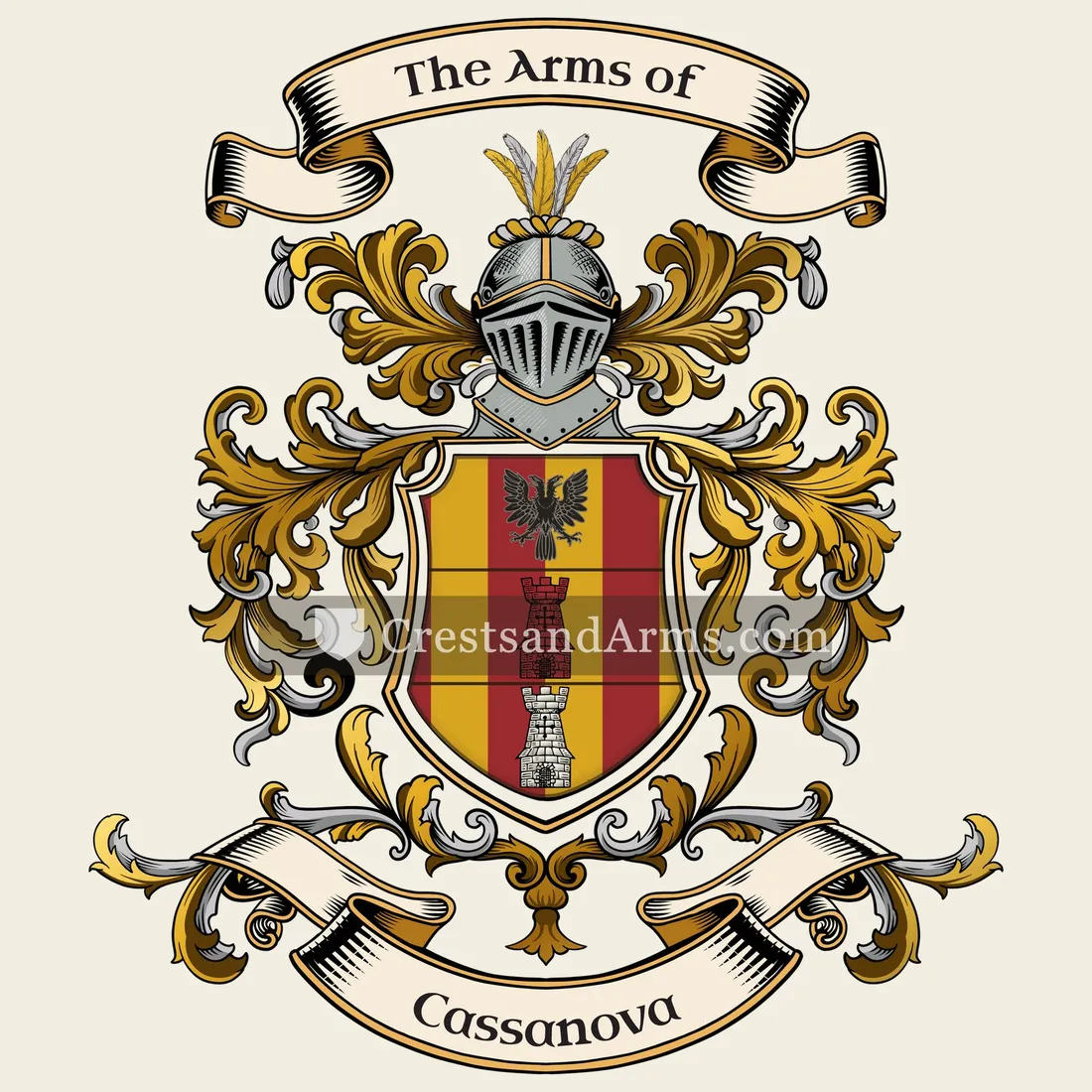
Meaning of the Cassanova family crest colors & symbols
Symbols on this shield
paleMilitary strength, and a fortified defence
eagleNobility, strength and a keen mind
towerGrandeur and solidity, and a stronghold defended
Colours
Gold (Or)Means: Generosity
Black (Sable)Means: Constancy
Red (Gules)Means: Military strength
Silver (Argent)Means: Peace and sincerity
Historical info
Source
J. B. Rietstap, Armorial Général, Gouda: G. B. van Goor Zonen, 1884–87
Blazon (the actual original written record)
“Tiercé en fasce: au 1 d'or à l'aigle de sa., cour. du champ; au 2 parti: a. d'or à un château de gu., sommé de deux tours du même, ouv. et aj. du champ, supp. entre les tours une colombe au vol levé d'arg., tenant en son bec un rameau d'olivier de sin.; b. d'azur à une maison d'arg., essorée de gu., ouv. et aj. du champ; au 3 palé d'or et de gu.”
ItalyMilan, c. 1775
Digital archive packCoat of arms PNG, gold border print PDF, vector SVG and the certificate of authenticity. Sent to your email in minutes.
Map of Italy showing where the Cassanova arms are recorded
The Cassanova arms were recorded in Milan, c. 1775.
This is where the arms were entered in the register. Families often moved to other parts of the country, so the same name can turn up in more than one region.
The body that granted and recorded arms in Italy in this period.
Alvise Giovanni Mocenigo
Sovereign of the period
Alvise Giovanni Mocenigo
1763–1778
Reigning in Italy when the Cassanova arms are first recorded.
How Arms Worked in Italy
In the Italian states, coats of arms were often used by noble families to show their status and history. These symbols were passed down through the generations to all legitimate male descendants. Younger branches of a family usually kept the original design but sometimes added small changes to distinguish their specific line from the main branch.
Granting authority
Various local rulers and city governments controlled the use of coats of arms across the different Italian states.
How they got arms
Families often assumed their own arms or received them as official grants from local lords, popes, or city councils.
Where arms were recorded
Arms were recorded in local city archives or private family books rather than in one single national register.
The family's standing
Recorded among the armigerous families of Italy.
Origin & History of the Cassanova Family in Italy
The surname Casanova is a topographic name that originated in northern Italy, derived from the Latin words *casa* meaning house and *nova* meaning new. This name was typically given to families who lived in a newly built home or a recently established settlement. By the eighteenth century, the family had established a notable presence in the city of Milan. During this period, Milan was a major center for trade and culture under the influence of the Habsburg monarchy. Families like the Casanovas often integrated into the urban fabric of the city by working in professional roles or contributing to the local administrative life. Their presence in 1775 reflects a time when many families were solidifying their social standing within the growing industrial and intellectual landscape of Lombardy.
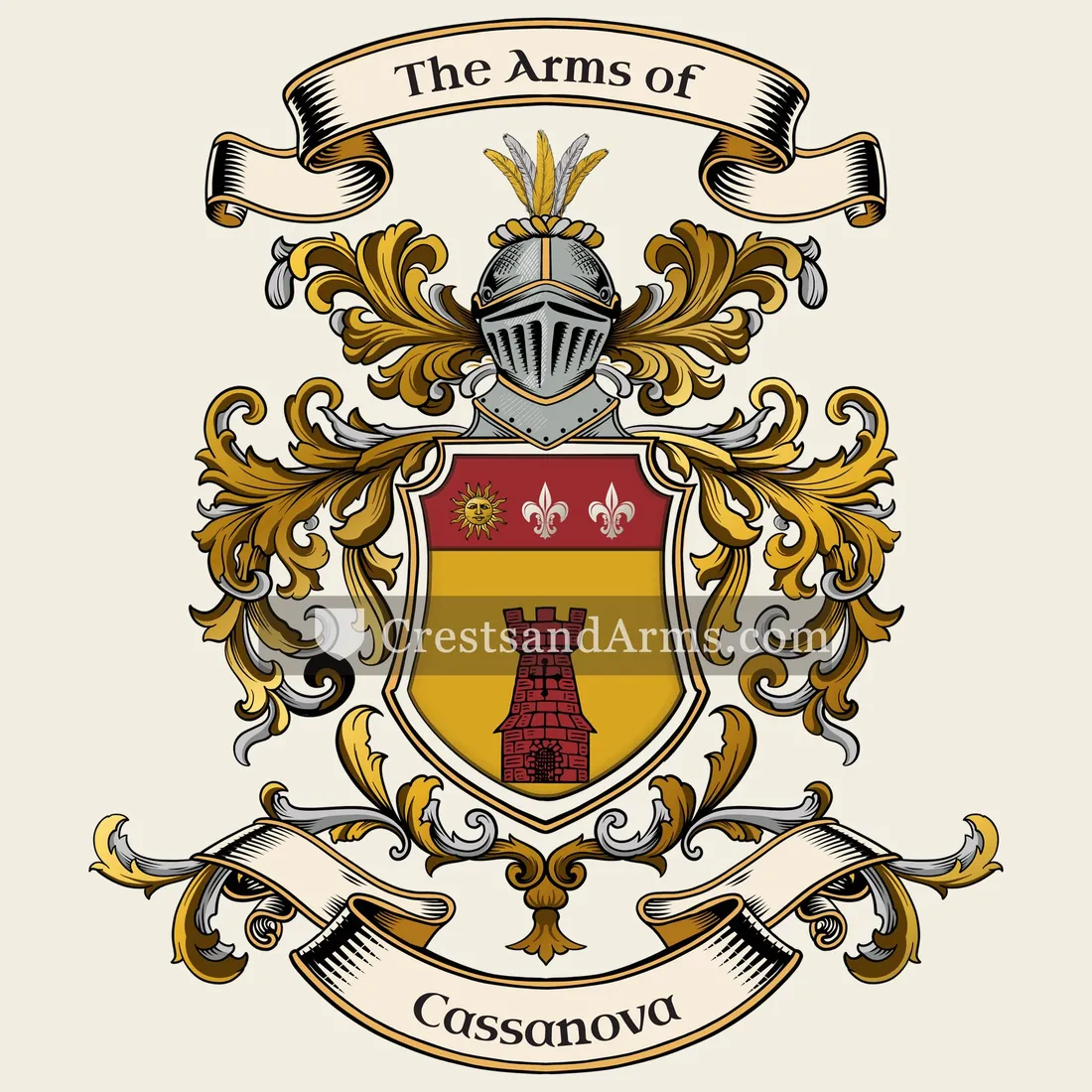
Meaning of the Cassanova family crest colors & symbols
Symbols on this shield
chiefAuthority, wisdom and dominion
towerGrandeur and solidity, and a stronghold defended
sunGlory, splendour and the source of life
fleur de lisPurity, light, and the sixth son
Colours
Gold (Or)Means: Generosity
Red (Gules)Means: Military strength
Silver (Argent)Means: Peace and sincerity
Historical info
Source
J. B. Rietstap, Armorial Général, Gouda: G. B. van Goor Zonen, 1884–87
Blazon (the actual original written record)
“D'or à une maison carrée de gu.; au chef du même, ch. d'un soleil d'or entre deux fleurs-de-lis d'arg.”
SpainMurcie, c. 1722
Digital archive packCoat of arms PNG, gold border print PDF, vector SVG and the certificate of authenticity. Sent to your email in minutes.
Map of Spain showing where the Cassanova arms are recorded
The Cassanova arms were recorded in Murcie, c. 1722.
This is where the arms were entered in the register. Families often moved to other parts of the country, so the same name can turn up in more than one region.
The body that granted and recorded arms in Spain in this period.
Philip V of Spain
Sovereign of the period
Philip V of Spain
1714–1724
Reigning in Italy when the Cassanova arms are first recorded.
How Arms Worked in Spain
In Spain, a coat of arms was considered a form of property that belonged to the entire family line. These arms were passed down from a father to all his children equally. Younger branches of the family usually kept the original design without needing to add any special marks to distinguish their specific line.
Granting authority
The Cronista Rey de Armas was the official body that regulated and granted coats of arms throughout Spain.
How they got arms
Families often obtained their arms through royal grants or by proving their noble status to the official heraldic authority.
Where arms were recorded
Coats of arms were officially recorded in the registers of the Cronista Rey de Armas starting in 1496.
The family's standing
Recorded among the armigerous families of Spain.
Origin & History of the Cassanova Family in Spain
The surname Casanova, which translates to "new house" in various Romance languages, carries a long history rooted in the social and architectural changes of the Iberian Peninsula. While the name is often associated with Mediterranean regions, the presence of the family in Murcia by 1722 highlights their integration into the administrative and social fabric of southeastern Spain during the eighteenth century. During this era, families with this name were often landowners or farmers who established new homesteads on the outskirts of growing towns. This expansion was part of a broader trend where families moved to cultivate previously unused land, effectively marking their presence by the construction of these new dwellings. By the time the family was documented in Murcia, they had likely been part of the regional migration patterns that defined the Spanish countryside for generations, moving from rural settlements into the developing urban centers of the Spanish Levant.
Cassanova Meaning & Related Branches
Root word
casa and nova
Latin for house and new
This name
CassanovaRefers to someone who lived in a newly built house or a new settlement.
also spelled
Casanove
Kasanova
Casanov
Documented Sources
J. B. Rietstap, Armorial Général, Gouda: G. B. van Goor Zonen, 1884–87
De Felice, Emidio. Dizionario dei cognomi italiani. 1978
Fucile, Giovanni. I cognomi d'Italia: Dizionario storico ed etimologico. 2010
Archivio di Stato di Milano, Censimento generale dello Stato di Milano. 1775
Digital archive packCoat of arms PNG, gold border print PDF, vector SVG and the certificate of authenticity. Sent to your email in minutes.


 paleMilitary strength, and a fortified defence
 eagleNobility, strength and a keen mind
 towerGrandeur and solidity, and a stronghold defended
 paleMilitary strength, and a fortified defence
 eagleNobility, strength and a keen mind
 towerGrandeur and solidity, and a stronghold defended


 chiefAuthority, wisdom and dominion
 sunGlory, splendour and the source of life
 fleur de lisPurity, light, and the sixth son