Map of France showing where the Cassé arms are recorded
The Cassé arms were recorded in Bretagne, c. 1663.
More families held coats of arms in Bretagne than anywhere else in France. The land was divided into many small estates rather than a few large ones, so far more households counted as gentry, and each needed a shield of its own to be told apart.
This is where the arms were entered in the register. Families often moved to other parts of the country, so the same name can turn up in more than one region.
The body that granted and recorded arms in France in this period.
Louis XIV of France
Sovereign of the period
Louis XIV of France
1643–1715
Reigning in France when the Cassé arms are first recorded.
How Arms Worked in France
In France, a coat of arms was a mark of honor that passed down through the male line to all legitimate descendants. Families often used the same shield without changes to show their shared heritage. If a branch wanted to stand out, they could add a small mark to their shield to show their specific place in the family tree.
Granting authority
The Juge d'armes de France acted as the official authority that regulated and verified coats of arms across the country.
How they got arms
Families typically inherited their arms from ancestors, though they could also receive them through royal grants or by proving their noble status.
Where arms were recorded
Coats of arms were officially recorded in the Armorial Général de France, which began its main collection in the year 1696.
The family's standing
Recorded among the armigerous families of Bretagne.
Origin & History of the Cassé Family in France
The surname Cassé finds its roots in the linguistic traditions of medieval France, where it likely originated as a descriptive nickname. In the French language, the term often relates to the concept of being broken or shattered, which may have originally identified an individual who worked in a trade involving crushing materials or perhaps someone with a specific physical trait. By the mid-seventeenth century, the family established a notable presence in the region of Bretagne. Records confirm that members of the Cassé family were living in this northwestern province by 1663, a time when the area was known for its distinct cultural identity and maritime influence. Settling in Bretagne allowed the family to participate in the local agricultural and social structures of the era, contributing to the rich tapestry of Breton history as the name gradually became a fixed identifier for their lineage.
Coat of Arms & Family Crest Details
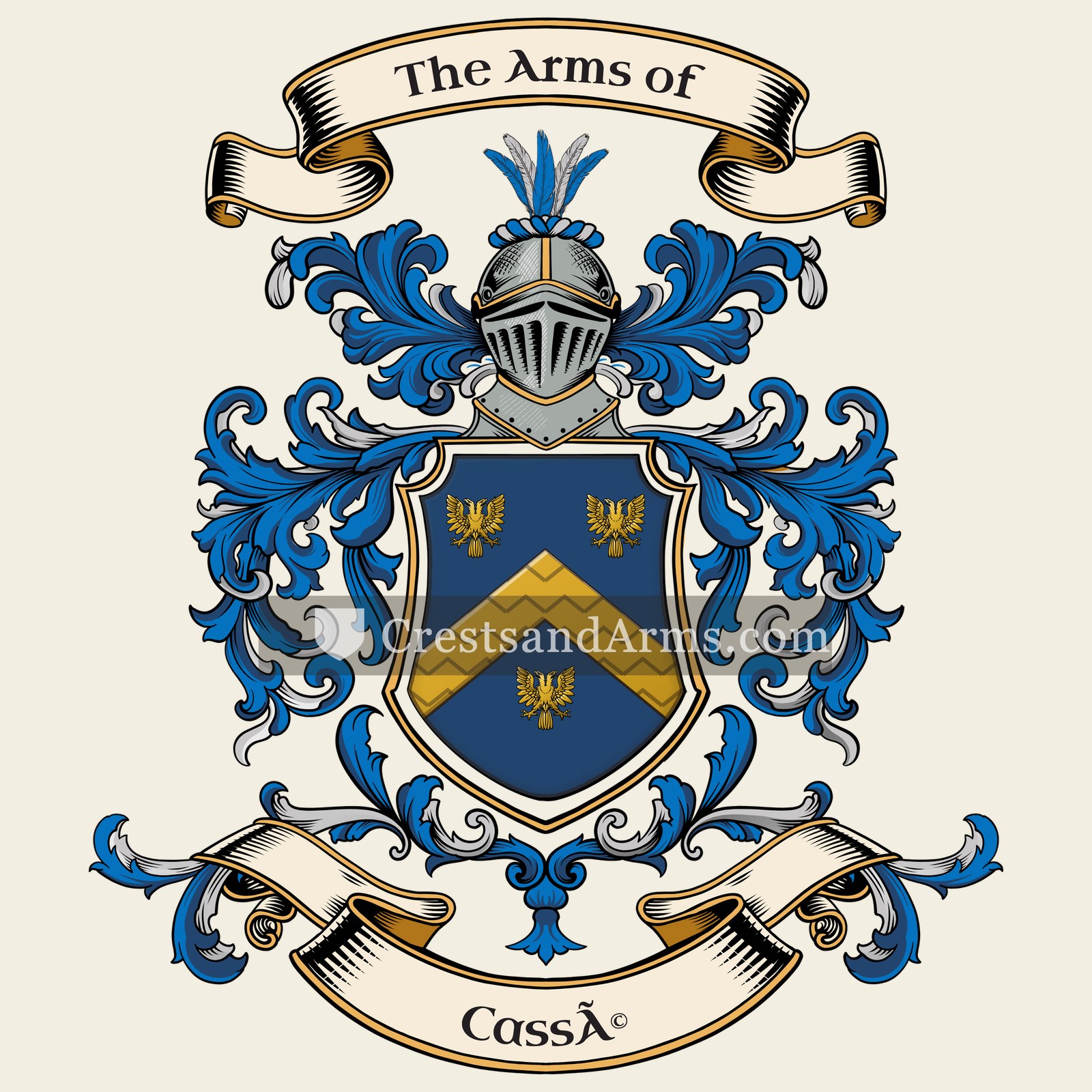
Symbols on this shield
chevronProtection, and faithful service completed
eagleNobility, strength and a keen mind
Colours
Blue (Azure)Means: Loyalty and truth
Gold (Or)Means: Generosity
Historical info
Source
Sir Bernard Burke, The General Armory of England, Scotland, Ireland and Wales, London: Harrison & Sons, 1884
Blazon (the actual original written record)
“Az. a chev. betw. three eagles' heads erased or”
GloucesterGloucester, c. 1620
Digital archive packCoat of arms PNG, gold border print PDF, vector SVG and the certificate of authenticity. Sent to your email in minutes.
Map of England showing where the Cassé arms are recorded
The Cassé arms were recorded in Gloucester, c. 1620.
Gloucestershire had good farmland, a cloth trade in its valleys and a river carrying goods to Bristol. All three made money, and money bought the estates that brought arms with them.
This is where the arms were entered in the register. Families often moved to other parts of the country, so the same name can turn up in more than one region.
The body that granted and recorded arms in England in this period.
James VI and I
Sovereign of the period
James VI and I
1603–1625
Reigning in France when the Cassé arms are first recorded.
How Arms Worked in England
English heraldry allowed arms to be shared by all legitimate descendants of the original owner. These symbols were treated as personal property that moved through the generations to all children. While the eldest son kept the original design, other family members could use the same shield without needing to change it or register their own unique versions.
Granting authority
The College of Arms in London has regulated the use of coats of arms throughout England and Wales since 1484.
How they got arms
Families typically obtained their coats of arms through a formal grant from the Crown or by proving their ancient right to them.
Where arms were recorded
All official coats of arms are recorded in the registers kept at the College of Arms, which date back to the fifteenth century.
The family's standing
Recorded among the armigerous families of Gloucester.
Origin & History of the Cassé Family in England
The family name Cassé has deep roots in the English landscape, with early records confirming that members of the family were well-established in the city of Gloucester by 1620. During this period, Gloucester was a bustling center for trade and religious life, situated along the River Severn. Families with this surname were likely involved in the local merchant guilds or the skilled crafts that defined the city’s economy at the time. The name itself suggests a connection to the movement of people across the English Channel, as it shares linguistic ties to Old French terms related to breaking or clearing land. By settling in a prominent administrative hub like Gloucester, the early Cassé family members positioned themselves within a community that valued industriousness and civic participation. Their presence in the city during the early seventeenth century marks them as part of the stable middle class that helped sustain the local economy before many families began looking toward the American colonies for new opportunities.
Cassé Meaning & Related Branches
Root word
quassare
Latin verb meaning to shake, shatter, or break into pieces.
This name
CasséA nickname for a person who was physically broken, infirm, or perhaps a habitual breaker of objects.
also spelled
Kasse
Cazse
Kase
Cas
Related arms
Casesvariant spelling
Cassavariant spelling
Cassyvariant spelling
Documented Sources
J. B. Rietstap, Armorial Général, Gouda: G. B. van Goor Zonen, 1884–87
Archives départementales d'Ille-et-Vilaine, Série B (Fonds des juridictions seigneuriales)
Dauzat, Albert, Dictionnaire étymologique des noms et prénoms de France, 1951
Morlet, Marie-Thérèse, Dictionnaire étymologique des noms de famille, 1991
Digital archive packCoat of arms PNG, gold border print PDF, vector SVG and the certificate of authenticity. Sent to your email in minutes.


 fessThe military belt, and readiness to serve
 escallopThe pilgrim's shell, and a long journey made
 fessThe military belt, and readiness to serve
 escallopThe pilgrim's shell, and a long journey made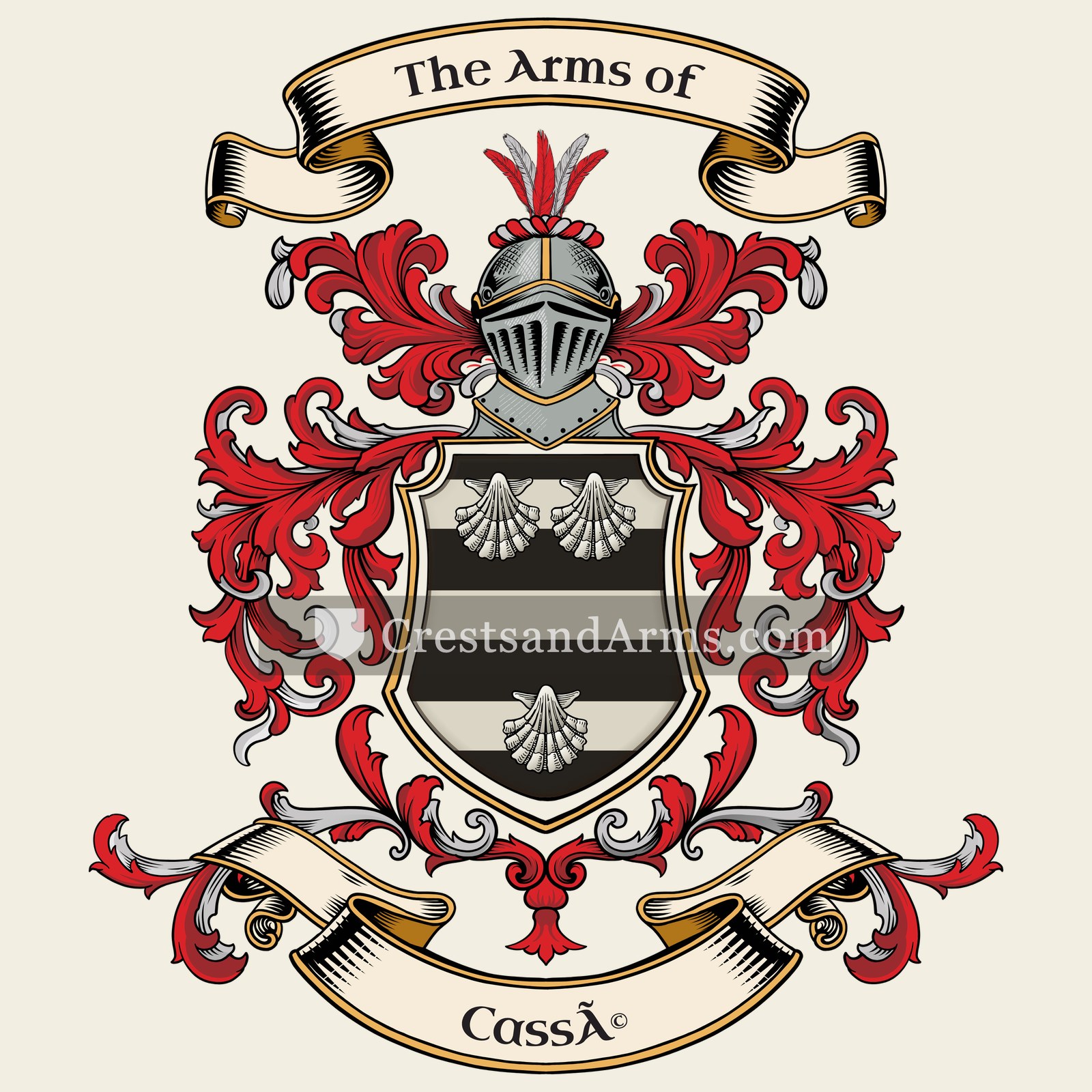


 chevronProtection, and faithful service completed
 eagleNobility, strength and a keen mind