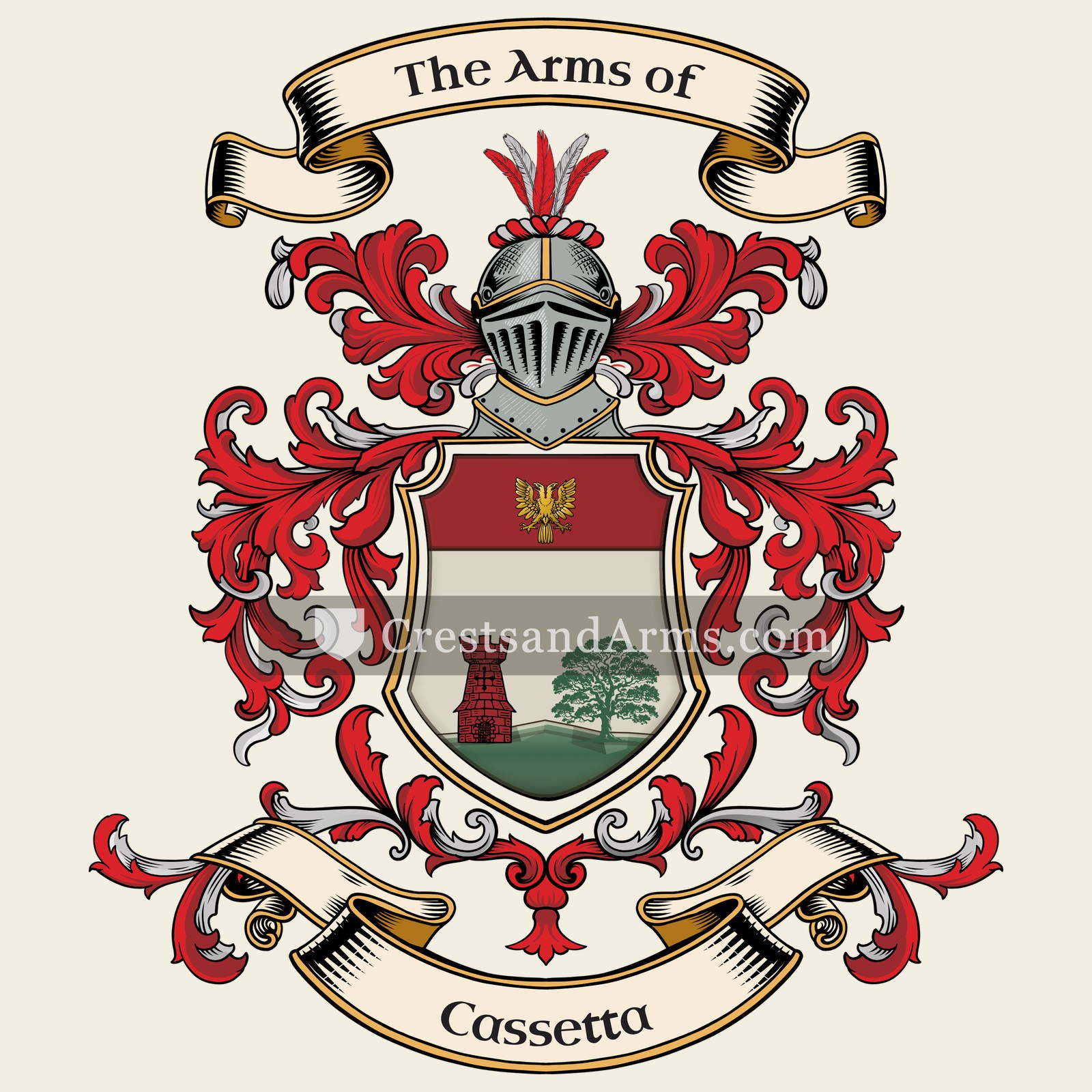
A record of documented arms, meaning and origin, researched for the Cassetta family of Belgium.
Reg. 2649 · Belgian, A–C
Coat of Arms & Family Crest Details
Symbols on this shield
mountThe ground held, and steadfastness upon it
chiefAuthority, wisdom and dominion
towerGrandeur and solidity, and a stronghold defended
treeLife, endurance and deep roots
eagleNobility, strength and a keen mind
Colours
Silver (Argent)Means: Peace and sincerity
Red (Gules)Means: Military strength
Green (Vert)Means: Hope
Gold (Or)Means: Generosity
Historical info
Source
J. B. Rietstap, Armorial Général, Gouda: G. B. van Goor Zonen, 1884–87
Blazon (the actual original written record)
“D'arg. à une maisonnette de gu., essorée d'azur, posée sur une terrasse isolée de sin. et br. sur un arbre du même; au chef de gu., ch. d'une aigle iss. d'or. C.: l'aigle de l'écu.”
BelgiumBruges, c. 1737
Digital archive packCoat of arms PNG, gold border print PDF, vector SVG and the certificate of authenticity. Sent to your email in minutes.
Map of Belgium showing where the Cassetta arms are recorded
The Cassetta arms were recorded in Bruges, c. 1737.
This is where the arms were entered in the register. Families often moved to other parts of the country, so the same name can turn up in more than one region.
The body that granted and recorded arms in Belgium in this period.
Charles VI, Holy Roman Emperor
Sovereign of the period
Charles VI, Holy Roman Emperor
1711–1740
Reigning in Belgium when the Cassetta arms are first recorded.
How Arms Worked in Belgium
In Belgium, a coat of arms is considered personal property that is passed down through the male line to legitimate descendants. Families often use the same shield design across generations to show their shared heritage. If a branch of the family wants to change the design, they must apply for an official update to their specific version of the arms.
Granting authority
The Conseil héraldique is the official body that regulates and approves all coats of arms in Belgium.
How they got arms
Families obtain their coats of arms through formal royal grants or by confirming their historical right to use existing designs.
Where arms were recorded
All approved coats of arms are officially recorded in the public registers of the Conseil héraldique since 1844.
The family's standing
Recorded among the armigerous families of Belgium.
Origin & History of the Cassetta Family in Belgium
The family name Cassetta is rooted in the linguistic traditions of Italy, where it is derived from the word for a small box or chest. This suggests that early ancestors may have been skilled craftsmen, such as cabinetmakers or woodworkers, who were known for creating these useful items. By 1737, members of the family had established a presence in the historic city of Bruges. During this era, Bruges was a significant center for trade and craftsmanship in the Low Countries. The family likely migrated to this region to take advantage of the bustling merchant economy and the high demand for specialized artisanal goods. Their relocation to such a prominent European hub indicates that they were part of a mobile class of workers who carried their professional skills across borders to find new opportunities.
Cassetta Meaning & Related Branches
Root word
cassa
A Latin term referring to a box, chest, or case.
This name
CassettaA diminutive form indicating a small box or a maker of small wooden containers.
also spelled
Cassette
Cassetti
Casseto
Kaseta
Documented Sources
J. B. Rietstap, Armorial Général, Gouda: G. B. van Goor Zonen, 1884–87
De Smet, Antoine, Les étrangers en Belgique, 1950
Stadsarchief Brugge, Registers van de Burgerlijke Stand, 1737
Digital archive packCoat of arms PNG, gold border print PDF, vector SVG and the certificate of authenticity. Sent to your email in minutes.


 mountThe ground held, and steadfastness upon it
 chiefAuthority, wisdom and dominion
 towerGrandeur and solidity, and a stronghold defended
 treeLife, endurance and deep roots
 eagleNobility, strength and a keen mind
 mountThe ground held, and steadfastness upon it
 chiefAuthority, wisdom and dominion
 towerGrandeur and solidity, and a stronghold defended
 treeLife, endurance and deep roots
 eagleNobility, strength and a keen mind