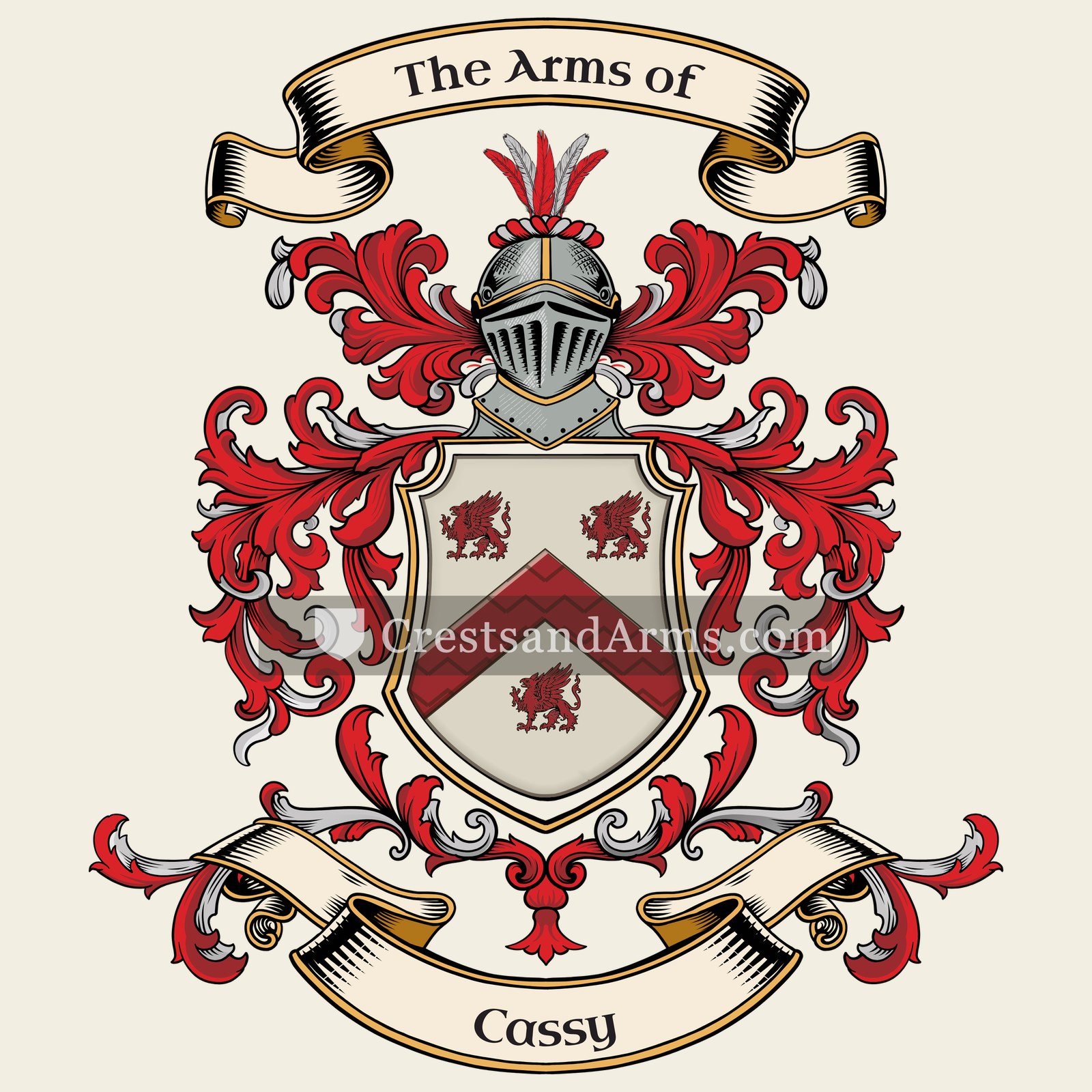
A record of documented arms, meaning and origin, researched for the Cassy family of England.
Reg. 6025 · English, A–C
Coat of Arms & Family Crest Details
Symbols on this shield
chevronProtection, and faithful service completed
griffinValour and vigilance, guarding great treasure
Colours
Silver (Argent)Means: Peace and sincerity
Red (Gules)Means: Military strength
Historical info
Source
Sir Bernard Burke, The General Armory of England, Scotland, Ireland and Wales, London: Harrison & Sons, 1884
Blazon (the actual original written record)
“Ar. a chev. betw. three griffins' heads erased gu”
GloucesterGloucester, c. 1620
Where the Cassy Arms Were Recorded
Gloucester
Map of England showing where the Cassy arms are recorded
The Cassy arms were recorded in Gloucester, c. 1620.
Gloucestershire had good farmland, a cloth trade in its valleys and a river carrying goods to Bristol. All three made money, and money bought the estates that brought arms with them.
This is where the arms were entered in the register. Families often moved to other parts of the country, so the same name can turn up in more than one region.
The body that granted and recorded arms in England in this period.
James VI and I
Sovereign of the period
James VI and I
1603–1625
Reigning in England when the Cassy arms are first recorded.
How Arms Worked in England
English heraldry allowed arms to be shared by all legitimate descendants of the original owner. These symbols were treated as personal property that moved through the generations to all children. While the eldest son kept the original design, other family members could use the same shield without needing to change it or register their own unique versions.
Granting authority
The College of Arms in London has regulated the use of coats of arms throughout England and Wales since 1484.
How they got arms
Families typically obtained their coats of arms through a formal grant from the Crown or by proving their ancient right to them.
Where arms were recorded
All official coats of arms are recorded in the registers kept at the College of Arms, which date back to the fifteenth century.
The family's standing
Recorded among the armigerous families of Gloucester.
Origin & History of the Cassy Family in England
The surname Cassy has deep roots in the coastal landscape of England, with historical records confirming that members of the family were established in Gloucester by 1620. During the seventeenth century, individuals bearing this name were often associated with the local merchant class and the administrative life of the city. As Gloucester served as a vital port and trade hub, the family likely participated in the regional economy through maritime commerce or skilled trades. The name itself is thought to be a variation of older occupational or locational descriptors that evolved as families moved through the West Country. By the early 1600s, the Cassy family had become part of the social fabric of the region, contributing to the growth of the city during a period of significant economic transition in England.
Related Branches & Arms
Root word
Cassius
A Roman family name derived from the Latin word for hollow.
This name
CassyA diminutive form of names like Cassandra or Catherine, often signifying a helper or pure one.
also spelled
Cassie
Casse
Casye
Related arms
Cassevariant spelling
Casseyvariant spelling
Cassievariant spelling
Casyevariant spelling
Documented Sources
Sir Bernard Burke, The General Armory of England, Scotland, Ireland and Wales, London: Harrison & Sons, 1884
Atkyns, Robert. The Ancient and Present State of Glostershire. 1712
Gloucestershire Archives. Records of the Corporation of Gloucester, GBR/B/3/1
Rudder, Samuel. A New History of Gloucestershire. 1779
Digital archive packCoat of arms PNG, gold border print PDF, vector SVG and the certificate of authenticity. Sent to your email in minutes.


 chevronProtection, and faithful service completed
 griffinValour and vigilance, guarding great treasure
 chevronProtection, and faithful service completed
 griffinValour and vigilance, guarding great treasure