Map of France showing where the Casteel arms are recorded
The Casteel arms were recorded in France, c. 1274.
Arms such as these were typically recorded in Bretagne.
More families held coats of arms in Bretagne than anywhere else in France. The land was divided into many small estates rather than a few large ones, so far more households counted as gentry, and each needed a shield of its own to be told apart.
This is where the arms were entered in the register. Families often moved to other parts of the country, so the same name can turn up in more than one region.
The body that granted and recorded arms in France in this period.
Philip III of France
Sovereign of the period
Philip III of France
1270–1285
Reigning in France when the Casteel arms are first recorded.
How Arms Worked in France
In France, a coat of arms was a mark of honor that passed down through the male line to all legitimate descendants. Families often used the same shield without changes to show their shared heritage. If a branch wanted to stand out, they could add a small mark to their shield to show their specific place in the family tree.
Granting authority
The Juge d'armes de France acted as the official authority that regulated and verified coats of arms across the country.
How they got arms
Families typically inherited their arms from ancestors, though they could also receive them through royal grants or by proving their noble status.
Where arms were recorded
Coats of arms were officially recorded in the Armorial Général de France, which began its main collection in the year 1696.
The family's standing
Recorded among the armigerous families of France.
Origin & History of the Casteel Family in France
The family name Casteel finds its roots in the historical region of Bretagne, where records confirm the presence of family members as early as 1274. The name is derived from the Old French word for a castle, which suggests that the earliest ancestors were likely associated with the construction, maintenance, or administration of fortified structures during the Middle Ages. Living in Bretagne during the thirteenth century placed the family in a unique cultural landscape defined by a mix of local Breton traditions and the growing influence of the French crown. As the name spread throughout the region, it became tied to the social shifts of the era, reflecting a time when surnames began to transition from simple descriptions of a person's trade or location into permanent family identifiers. This connection to the landscape and the architecture of the time highlights how the Casteel name served as a direct link to the physical and social environment of medieval France.
Meaning of the Casteel family crest colors & symbols
Symbols on this shield
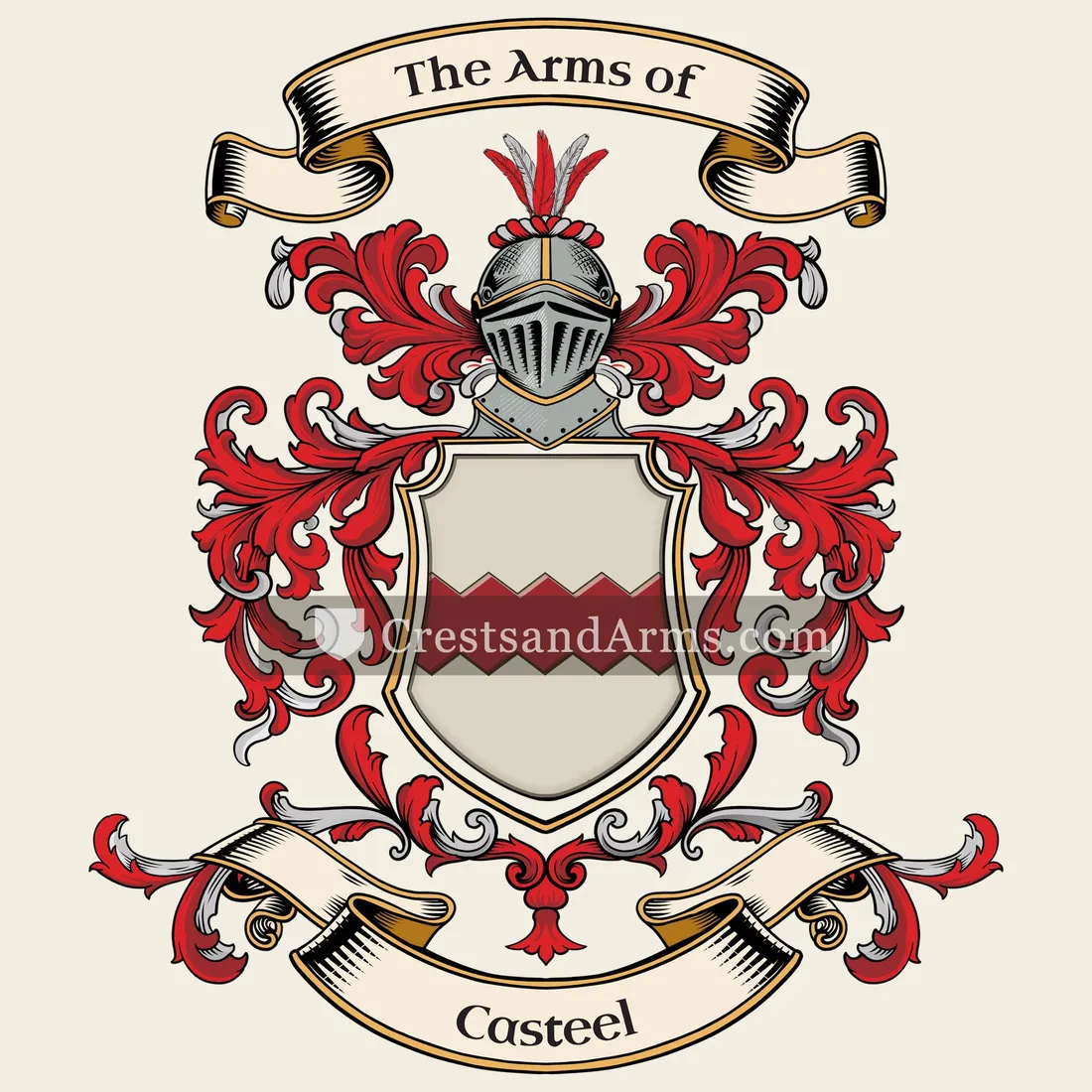
fessThe military belt, and readiness to serve
Colours
Silver (Argent)Means: Peace and sincerity
Red (Gules)Means: Military strength
Historical info
Source
J. B. Rietstap, Armorial Général, Gouda: G. B. van Goor Zonen, 1884–87
Blazon (the actual original written record)
“D'arg. à la fasce vivrée de gu. C.: un ange iss., hab. d'arg. (ou une tête et col de lion d'arg.), entre un vol aux armes de l'écu.”
GermanyPalatinat, c. 1765
Digital archive packCoat of arms PNG, gold border print PDF, vector SVG and the certificate of authenticity. Sent to your email in minutes.
Map of Germany showing where the Casteel arms are recorded
The Casteel arms were recorded in Palatinat, c. 1765.
This is where the arms were entered in the register. Families often moved to other parts of the country, so the same name can turn up in more than one region.
The body that granted and recorded arms in Germany in this period.
Francis I, Holy Roman Emperor
Sovereign of the period
Francis I, Holy Roman Emperor
1745–1765
Reigning in France when the Casteel arms are first recorded.
How Arms Worked in Germany
In the Holy Roman Empire, coats of arms were often granted to individuals by the Emperor or his representatives. These arms were then passed down through the generations to all legitimate descendants of the original holder. Younger branches of a family usually kept the same shield design without needing to change it, as the arms belonged to the entire lineage.
Granting authority
The Holy Roman Emperor held the sole power to grant new coats of arms throughout his vast imperial territories.
How they got arms
Families typically obtained their coats of arms through a formal imperial grant or by proving their noble status to the authorities.
Where arms were recorded
These grants were officially recorded in the Imperial Chancery registers, which began keeping formal records of such honors during the Middle Ages.
The family's standing
Recorded among the armigerous families of Germany.
Origin & History of the Casteel Family in Germany
The family name Casteel finds its roots in the historical region of the Palatinate, a territory in southwestern Germany known for its rolling hills and long history of agricultural life. By 1765, records confirm that members of the family were firmly established in this area, living through a period marked by significant social change and economic shifts. The name itself is often associated with the German word *Kastell*, which refers to a fortified place or a small castle. This suggests that the earliest ancestors may have lived near or served at a local stronghold, a common way for families to receive a descriptive name during the Middle Ages. Life in the Palatinate during the eighteenth century was often difficult due to regional conflicts and land pressures, which eventually encouraged many families to seek new opportunities abroad. The Casteel family members who lived in this region were part of a resilient community that helped shape the local culture before many of them began their migrations to other parts of the world.
Meaning of the Casteel family crest colors & symbols
Colours
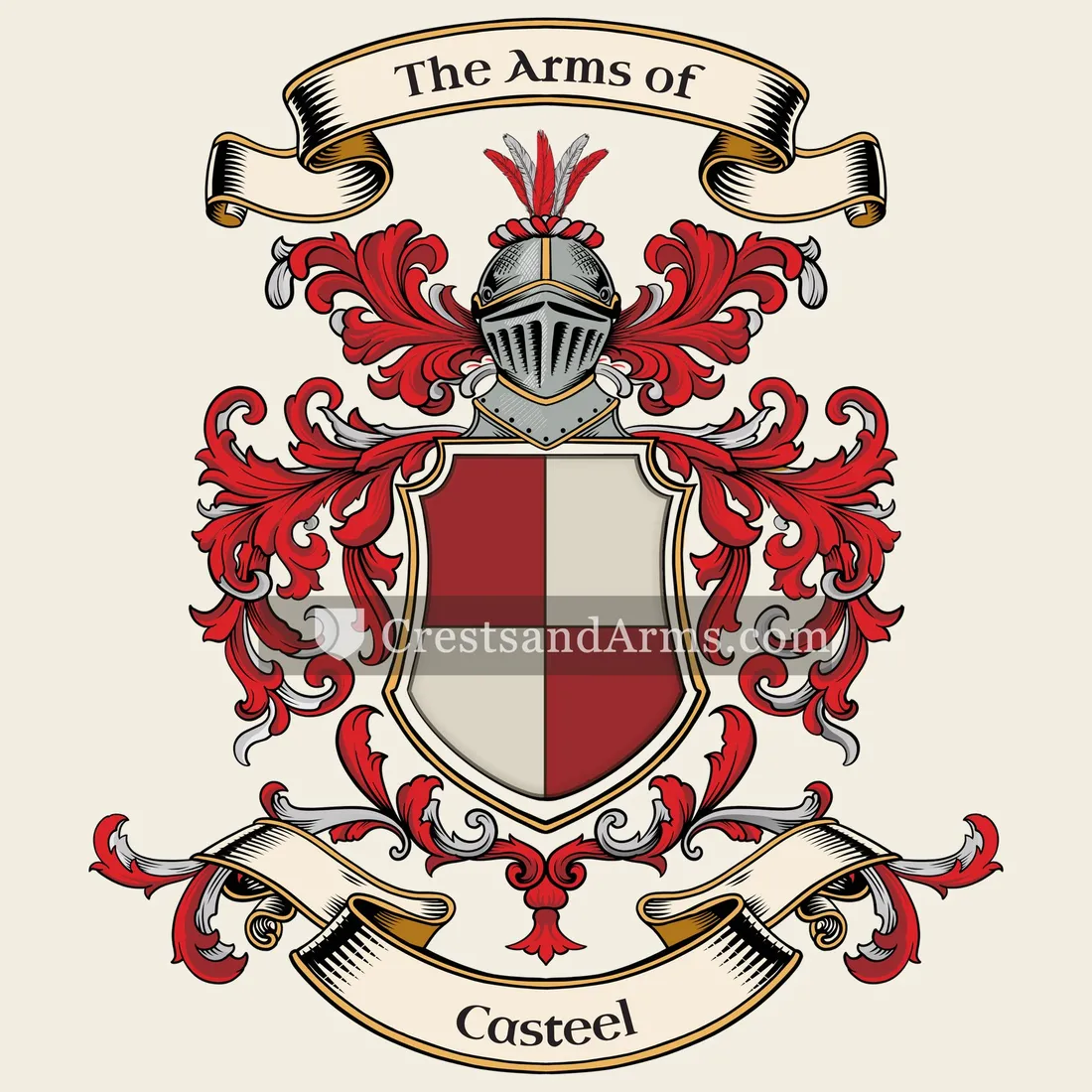
Red (Gules)Means: Military strength
Silver (Argent)Means: Peace and sincerity
Historical info
Source
Sir Bernard Burke, The General Armory of England, Scotland, Ireland and Wales, London: Harrison & Sons, 1884
Blazon (the actual original written record)
“Quarterly, gu. and ar. in the first a tower of the second”
Englandc. 1620
Digital archive packCoat of arms PNG, gold border print PDF, vector SVG and the certificate of authenticity. Sent to your email in minutes.
Map of England showing where the Casteel arms are recorded
The Casteel arms were recorded in England, c. 1620.
Arms such as these were typically recorded in York.
Yorkshire is the largest of the English counties, and it held more gentry families than any other. Land there was split among a great many households rather than a few, so a great many of them carried arms.
This is where the arms were entered in the register. Families often moved to other parts of the country, so the same name can turn up in more than one region.
The body that granted and recorded arms in England in this period.
James VI and I
Sovereign of the period
James VI and I
1603–1625
Reigning in France when the Casteel arms are first recorded.
How Arms Worked in England
English heraldry allowed arms to be shared by all legitimate descendants of the original owner. These symbols were treated as personal property that moved through the generations to all children. While the eldest son kept the original design, other family members could use the same shield without needing to change it or register their own unique versions.
Granting authority
The College of Arms in London has regulated the use of coats of arms throughout England and Wales since 1484.
How they got arms
Families typically obtained their coats of arms through a formal grant from the Crown or by proving their ancient right to them.
Where arms were recorded
All official coats of arms are recorded in the registers kept at the College of Arms, which date back to the fifteenth century.
The family's standing
Recorded among the armigerous families of England.
Origin & History of the Casteel Family in England
The family name Casteel has deep roots that connect to the historic city of York in Northern England. By the year 1620, records show that members of the family were already established residents in this region. The name itself is likely a variation of the Old French word for a castle, which suggests that the earliest ancestors may have lived near a fortification or served as guards for a local lord. During the seventeenth century, York was a bustling center of trade and religion, providing a stable environment for families to grow and develop their livelihoods. As the family became more settled in the area, they integrated into the local community through their work and social connections. This early presence in York serves as a foundation for the family history, marking the transition of the name into the English landscape long before later generations moved across the Atlantic.
Casteel Meaning & Related Branches
Root word
castellum
A Latin term referring to a fort, castle, or fortified place.
This name
CasteelA topographic surname for someone who lived near or worked at a castle or fortified structure.
also spelled
Kastel
Castell
Kastell
Castle
Castil
Documented Sources
J. B. Rietstap, Armorial Général, Gouda: G. B. van Goor Zonen, 1884–87
Poter, Arthur de la, Recherches sur la noblesse de Bretagne, 1839
Archives départementales d'Ille-et-Vilaine, Série E: Familles et seigneuries
Digital archive packCoat of arms PNG, gold border print PDF, vector SVG and the certificate of authenticity. Sent to your email in minutes.


 bendDefence, and the scarf of a commander
 labelThe eldest son, during his father's life
 eagleNobility, strength and a keen mind
 bendDefence, and the scarf of a commander
 labelThe eldest son, during his father's life
 eagleNobility, strength and a keen mind
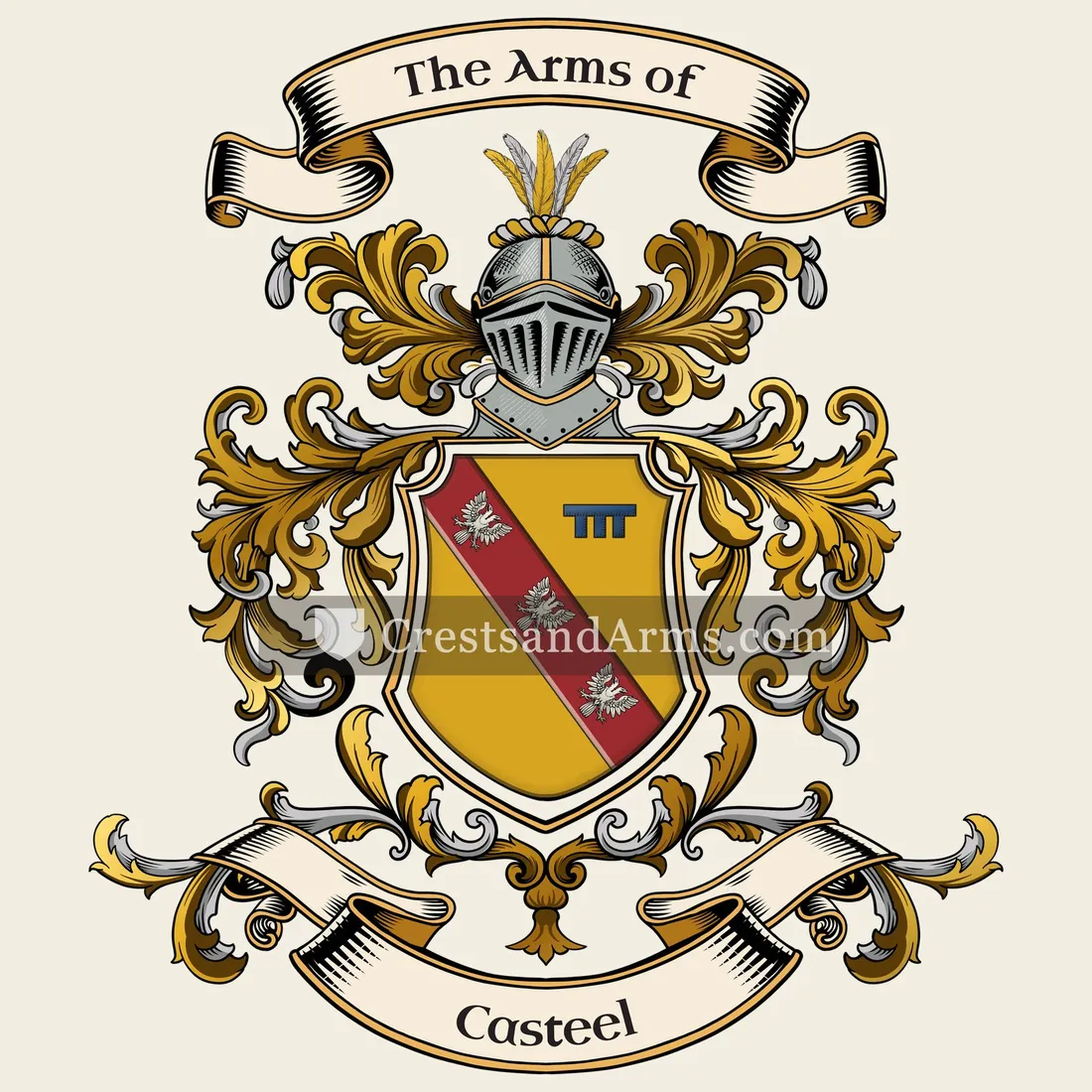


 fessThe military belt, and readiness to serve