Map of Italy showing where the Castelli arms are recorded
The Castelli arms were recorded in Italy, c. 1734.
Arms such as these were typically recorded in Venice.
Venice ran on trade, and its great families were merchants before they were anything else. The city kept a formal list of its noble houses, and a name on that list carried arms as a matter of record.
This is where the arms were entered in the register. Families often moved to other parts of the country, so the same name can turn up in more than one region.
The body that granted and recorded arms in Italy in this period.
Carlo Ruzzini
Sovereign of the period
Carlo Ruzzini
1732–1735
Reigning in Italy when the Castelli arms are first recorded.
How Arms Worked in Italy
In the Italian states, coats of arms were often used by noble families to show their status and history. These symbols were passed down through the generations to all legitimate male descendants. Younger branches of a family usually kept the original design but sometimes added small changes to distinguish their specific line from the main branch.
Granting authority
Various local rulers and city governments controlled the use of coats of arms across the different Italian states.
How they got arms
Families often assumed their own arms or received them as official grants from local lords, popes, or city councils.
Where arms were recorded
Arms were recorded in local city archives or private family books rather than in one single national register.
The family's standing
Recorded among the armigerous families of Italy.
Origin & History of the Castelli Family in Italy
The surname Castelli is a classic example of a topographic name, which means it was originally derived from the physical features of the landscape where a family lived. In Italian, the word *castello* refers to a castle or a fortified village, suggesting that the earliest ancestors of the Castelli line likely resided near or worked within such structures during the Middle Ages. By the time the family was firmly established in Venice by 1734, the name had already become a well-recognized identifier across various Italian regions. During this period, Venice was a powerful hub of trade and culture, and families like the Castelli were often integrated into the city’s complex social and economic fabric. Because the name is linked to a common architectural feature, it emerged independently in different parts of Italy rather than originating from a single person. This allowed the name to spread naturally as families moved between cities for commerce, eventually becoming a permanent fixture in the historical records of the Venetian Republic.
Coat of Arms & Family Crest Details
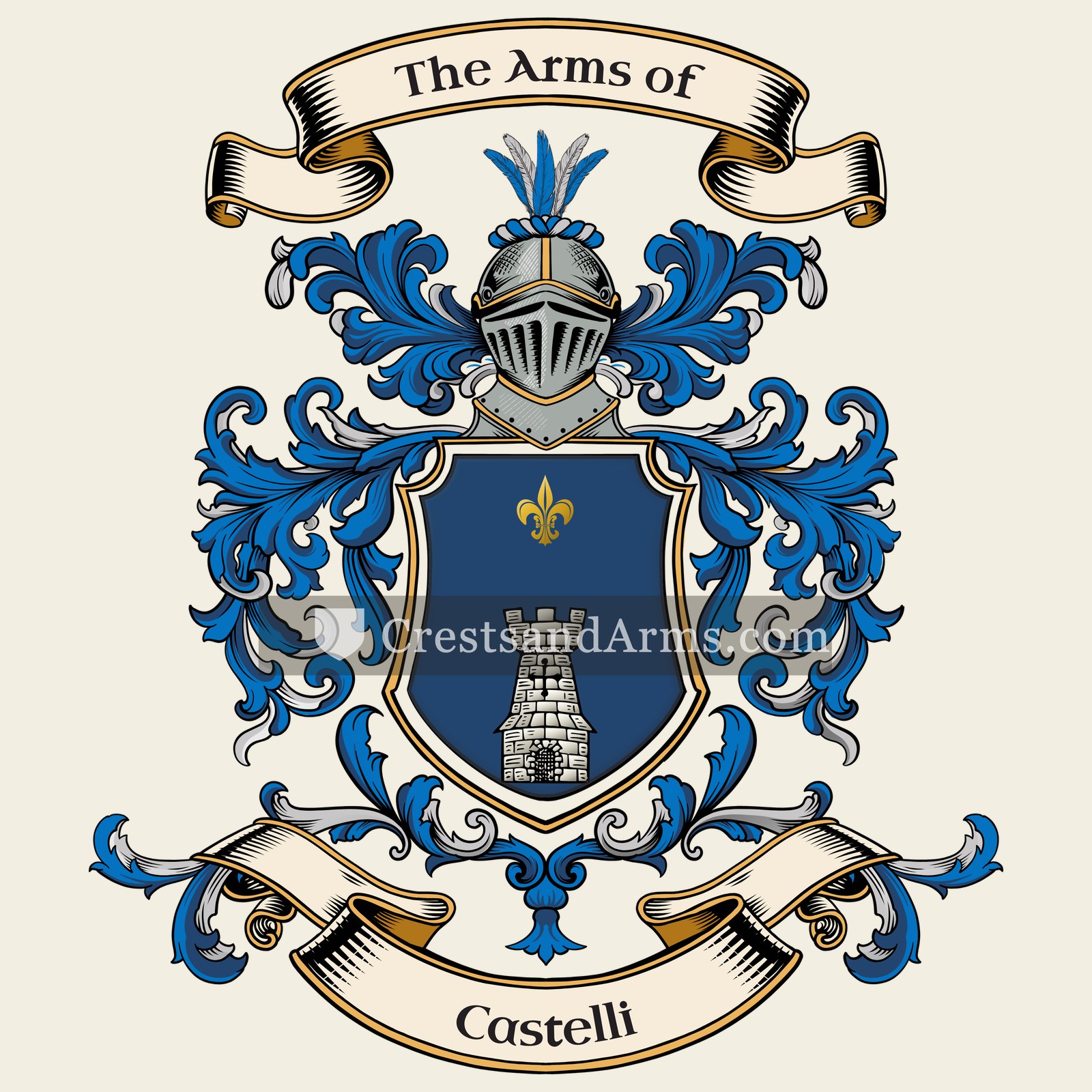
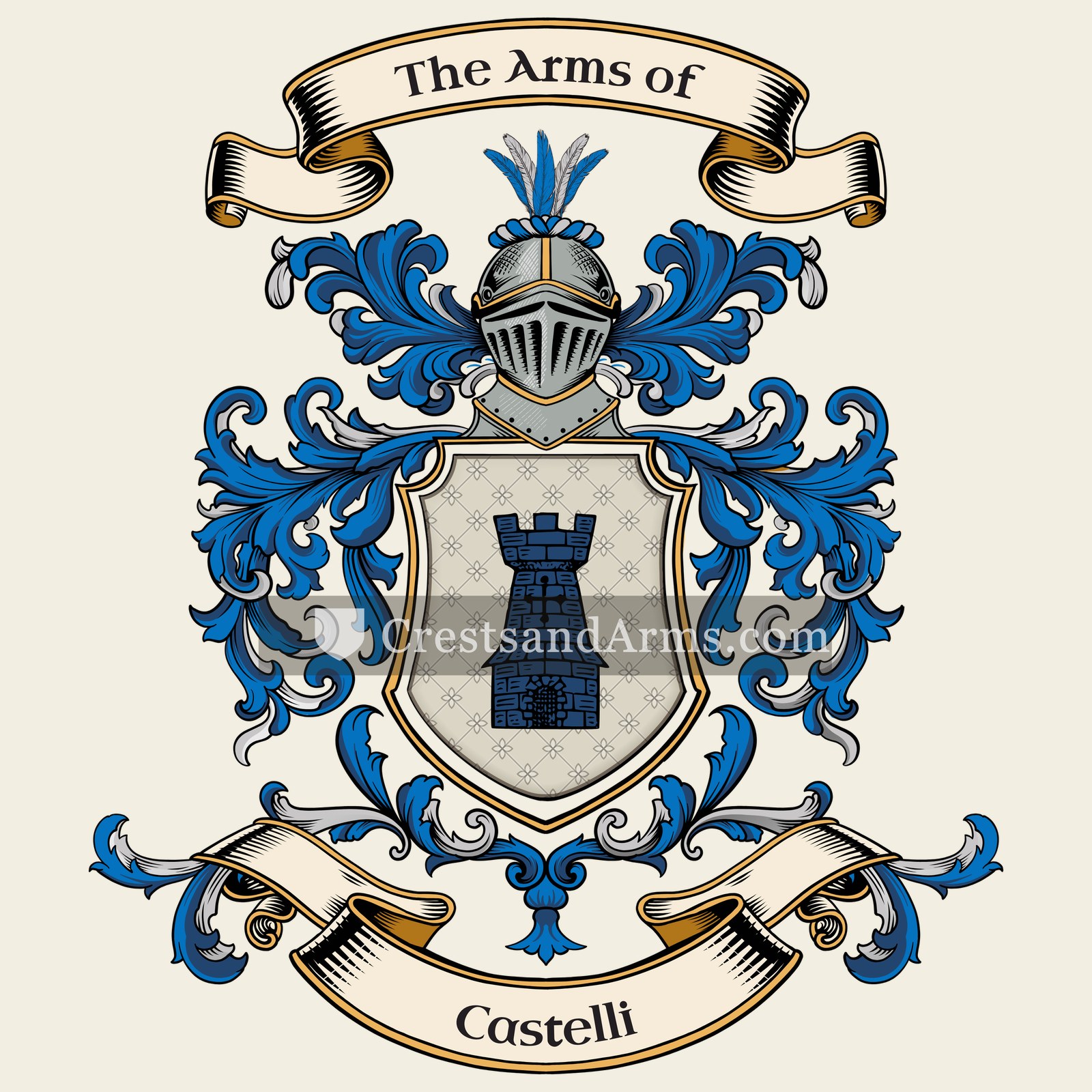
Symbols on this shield
towerGrandeur and solidity, and a stronghold defended
Colours
Silver (Argent)Means: Peace and sincerity
Blue (Azure)Means: Loyalty and truth
Historical info
Source
J. B. Rietstap, Armorial Général, Gouda: G. B. van Goor Zonen, 1884–87
Blazon (the actual original written record)
“D'arg. à un château d'azur, surm. d'une aigle de sa. S.: deux lions.”
FranceCorse, c. 1663
Digital archive packCoat of arms PNG, gold border print PDF, vector SVG and the certificate of authenticity. Sent to your email in minutes.
Map of France showing where the Castelli arms are recorded
The Castelli arms were recorded in Corse, c. 1663.
This is where the arms were entered in the register. Families often moved to other parts of the country, so the same name can turn up in more than one region.
The body that granted and recorded arms in France in this period.
Louis XIV of France
Sovereign of the period
Louis XIV of France
1643–1715
Reigning in Italy when the Castelli arms are first recorded.
How Arms Worked in France
In France, a coat of arms was a mark of honor that passed down through the male line to all legitimate descendants. Families often used the same shield without changes to show their shared heritage. If a branch wanted to stand out, they could add a small mark to their shield to show their specific place in the family tree.
Granting authority
The Juge d'armes de France acted as the official authority that regulated and verified coats of arms across the country.
How they got arms
Families typically inherited their arms from ancestors, though they could also receive them through royal grants or by proving their noble status.
Where arms were recorded
Coats of arms were officially recorded in the Armorial Général de France, which began its main collection in the year 1696.
The family's standing
Recorded among the armigerous families of France.
Origin & History of the Castelli Family in France
The name Castelli carries a deep connection to the rugged landscape of Corsica, where the family established a documented presence by 1663. While the name is often associated with Italian roots, its history in France is tied to the unique cultural and political evolution of the island during the seventeenth century. Families bearing this name were typically part of the local social structure, often serving as landowners or community leaders in the mountainous regions. Because Corsica was a crossroads for Mediterranean trade and influence, the Castelli family likely navigated a complex environment where they maintained strong ties to their local heritage while adapting to the shifting administrative control of the island. Their early history reflects the resilience of families who built their lives in the isolated villages of Corsica, focusing on agriculture and local governance long before the island became fully integrated into the French state.
Castelli Meaning & Related Branches
Root word
Castellum
A Latin term referring to a fort, castle, or fortified place.
This name
CastelliRefers to someone who lived near or worked at a castle or fortified settlement.
also spelled
Castello
Castella
Castell
Kasteli
Related arms
Castelletisimilar arms
Souburghsimilar arms
Castellvariant spelling
Castellavariant spelling
Documented Sources
J. B. Rietstap, Armorial Général, Gouda: G. B. van Goor Zonen, 1884–87
De Felice, Emidio. Dizionario dei cognomi italiani. 1978
Fucilla, Joseph G. Our Italian Surnames. 1949
Archivio di Stato di Venezia, Anagrafi di cittadini e forestieri
Digital archive packCoat of arms PNG, gold border print PDF, vector SVG and the certificate of authenticity. Sent to your email in minutes.


 towerGrandeur and solidity, and a stronghold defended
 fleur de lisPurity, light, and the sixth son
 towerGrandeur and solidity, and a stronghold defended
 fleur de lisPurity, light, and the sixth son