Map of France showing where the Castello arms are recorded
The Castello arms were recorded in Poitou, c. 1663.
Poitou was western French farming country, divided among a large number of small landed families. Its gentry were numerous and modest, and even a small estate was enough to justify a shield.
This is where the arms were entered in the register. Families often moved to other parts of the country, so the same name can turn up in more than one region.
The body that granted and recorded arms in France in this period.
Louis XIV of France
Sovereign of the period
Louis XIV of France
1643–1715
Reigning in France when the Castello arms are first recorded.
How Arms Worked in France
In France, a coat of arms was a mark of honor that passed down through the male line to all legitimate descendants. Families often used the same shield without changes to show their shared heritage. If a branch wanted to stand out, they could add a small mark to their shield to show their specific place in the family tree.
Granting authority
The Juge d'armes de France acted as the official authority that regulated and verified coats of arms across the country.
How they got arms
Families typically inherited their arms from ancestors, though they could also receive them through royal grants or by proving their noble status.
Where arms were recorded
Coats of arms were officially recorded in the Armorial Général de France, which began its main collection in the year 1696.
The family's standing
Recorded among the armigerous families of Poitou.
Origin & History of the Castello Family in France
The family name Castello carries a deep history rooted in the landscape of western France. By the year 1663, records confirm that members of the family were firmly established in the province of Poitou. During this era, Poitou was a region defined by its agricultural traditions and its complex social structure under the French monarchy. Families like the Castellos often lived in rural communities where they managed land or participated in local trades that supported the provincial economy. Because the name itself is linked to the Latin word for a castle or fortified structure, it is likely that the family’s earliest ancestors held roles related to the protection or administration of local estates. As they moved through the seventeenth century, these individuals contributed to the growth of their local parishes and helped shape the identity of the Poitou region before many families began to spread further across the country.
Coat of Arms & Family Crest Details
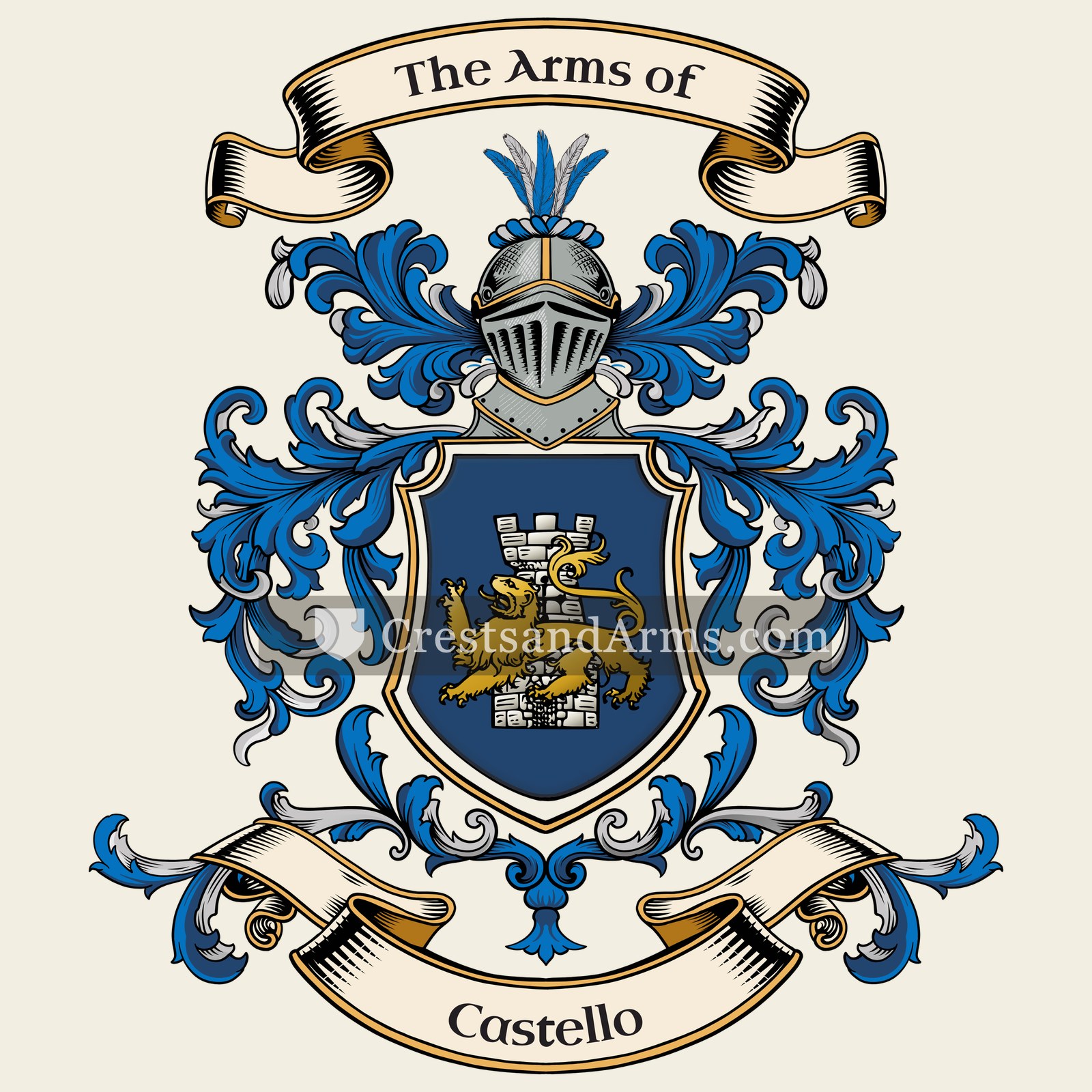
Symbols on this shield
towerGrandeur and solidity, and a stronghold defended
lionCourage, strength and royalty
Colours
Blue (Azure)Means: Loyalty and truth
Silver (Argent)Means: Peace and sincerity
Gold (Or)Means: Generosity
Historical info
Source
J. B. Rietstap, Armorial Général, Gouda: G. B. van Goor Zonen, 1884–87
Blazon (the actual original written record)
“Parti: au 1 d'azur à une tour d'arg.; au 2 d'azur au lion d'or.”
CataloniaCatalonia, c. 1722
Digital archive packCoat of arms PNG, gold border print PDF, vector SVG and the certificate of authenticity. Sent to your email in minutes.
Map of Spain showing where the Castello arms are recorded
The Castello arms were recorded in Catalonia, c. 1722.
Catalonia lived by sea trade, and its merchant houses were as powerful as its landowners. Both sorts of family took arms, and Barcelona kept records of the houses entitled to bear them.
This is where the arms were entered in the register. Families often moved to other parts of the country, so the same name can turn up in more than one region.
The body that granted and recorded arms in Spain in this period.
Philip V of Spain
Sovereign of the period
Philip V of Spain
1714–1724
Reigning in France when the Castello arms are first recorded.
How Arms Worked in Spain
In Spain, a coat of arms was considered a form of property that belonged to the entire family line. These arms were passed down from a father to all his children equally. Younger branches of the family usually kept the original design without needing to add any special marks to distinguish their specific line.
Granting authority
The Cronista Rey de Armas was the official body that regulated and granted coats of arms throughout Spain.
How they got arms
Families often obtained their arms through royal grants or by proving their noble status to the official heraldic authority.
Where arms were recorded
Coats of arms were officially recorded in the registers of the Cronista Rey de Armas starting in 1496.
The family's standing
Recorded among the armigerous families of Catalonia.
Origin & History of the Castello Family in Spain
The surname Castello originates from the Latin word *castellum*, which refers to a castle or a fortified place. In the context of medieval Spain, this name was often given to individuals who lived near a fortress or worked as guards within one. By the early 18th century, the family had established a notable presence in the Catalonia region. During this period, Catalonia was a center of agricultural and mercantile growth, and families like the Castellos were often integrated into the local social fabric through land ownership or trade. Because Catalonia served as a vital link between the Iberian Peninsula and the rest of Europe, the family likely benefited from the region's active economy and its distinct legal traditions. By 1722, the name was well-rooted in the local community, reflecting a long history of families settling in the shadow of the many stone fortifications that defined the Spanish landscape.
Coat of Arms & Family Crest Details
Colours
Silver (Argent)Means: Peace and sincerity
Black (Sable)Means: Constancy
Historical info
Source
J. B. Rietstap, Armorial Général, Gouda: G. B. van Goor Zonen, 1884–87
Blazon (the actual original written record)
“Parti d'arg. et de sa.”
ItalyTrévise, c. 1775
Digital archive packCoat of arms PNG, gold border print PDF, vector SVG and the certificate of authenticity. Sent to your email in minutes.
Map of Italy showing where the Castello arms are recorded
The Castello arms were recorded in Trévise, c. 1775.
This is where the arms were entered in the register. Families often moved to other parts of the country, so the same name can turn up in more than one region.
The body that granted and recorded arms in Italy in this period.
Alvise Giovanni Mocenigo
Sovereign of the period
Alvise Giovanni Mocenigo
1763–1778
Reigning in France when the Castello arms are first recorded.
How Arms Worked in Italy
In the Italian states, coats of arms were often used by noble families to show their status and history. These symbols were passed down through the generations to all legitimate male descendants. Younger branches of a family usually kept the original design but sometimes added small changes to distinguish their specific line from the main branch.
Granting authority
Various local rulers and city governments controlled the use of coats of arms across the different Italian states.
How they got arms
Families often assumed their own arms or received them as official grants from local lords, popes, or city councils.
Where arms were recorded
Arms were recorded in local city archives or private family books rather than in one single national register.
The family's standing
Recorded among the armigerous families of Italy.
Origin & History of the Castello Family in Italy
The surname Castello finds its roots in the architectural landscape of medieval Italy, where it functioned as a topographic name for families living near a castle or a fortified structure. During this period, the term "castello" described not just a military stronghold but often the center of a village or a community protected by walls. By the late eighteenth century, the family established a documented presence in the city of Treviso. This region, located in the Veneto, was a hub of trade and agricultural production under the influence of the Republic of Venice. Families bearing this name in Treviso were often integrated into the local urban fabric, participating in the social and economic life of the city as it transitioned through the political shifts of the late 1700s. The name reflects a long history of association with the fortified settlements that defined the Italian countryside and the growth of northern Italian municipalities.
Castello Meaning & Related Branches
Root word
Castellum
A Latin term referring to a fort, castle, or fortified village.
This name
CastelloA topographic name for someone who lived near or worked within a castle.
also spelled
Castelli
Castella
Castell
Kastelo
Related arms
Castellvariant spelling
Castellavariant spelling
Castellivariant spelling
Documented Sources
J. B. Rietstap, Armorial Général, Gouda: G. B. van Goor Zonen, 1884–87
Archives Départementales de la Vienne, Registres paroissiaux et d'état civil de la commune de Poitiers, 1663
Beauchet-Filleau, Henri, Dictionnaire historique et généalogique des familles du Poitou, 1891
Digital archive packCoat of arms PNG, gold border print PDF, vector SVG and the certificate of authenticity. Sent to your email in minutes.


 eagleNobility, strength and a keen mind
 eagleNobility, strength and a keen mind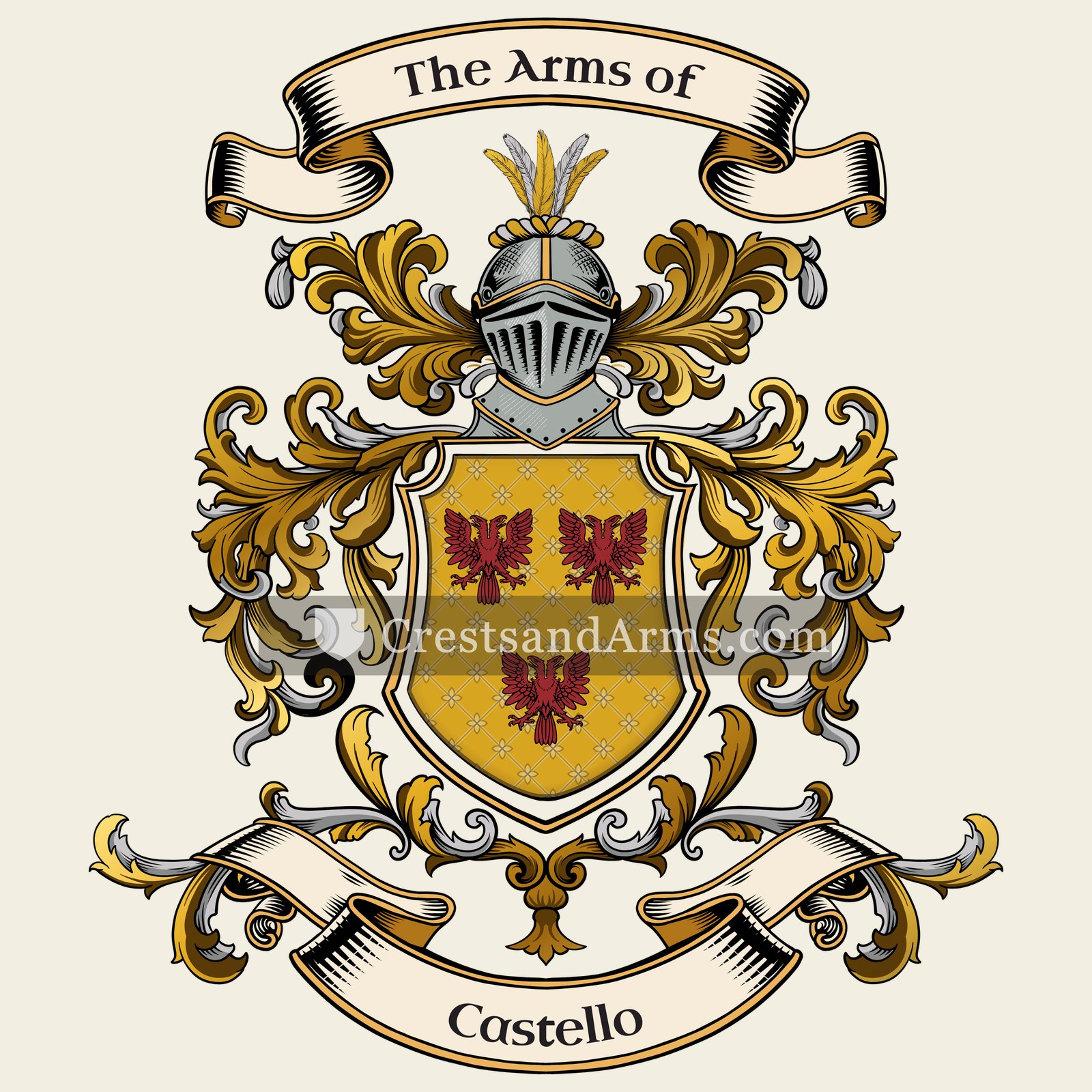


 towerGrandeur and solidity, and a stronghold defended
 lionCourage, strength and royalty