Map of France showing where the Castellon arms are recorded
The Castellon arms were recorded in Lorraine, c. 1669.
Lorraine sat on the border between France and the German lands, and border country bred soldiers. Families here held small estates and served in arms, and a fighting man was exactly the sort who carried a shield of his own.
This is where the arms were entered in the register. Families often moved to other parts of the country, so the same name can turn up in more than one region.
The body that granted and recorded arms in France in this period.
Louis XIV of France
Sovereign of the period
Louis XIV of France
1643–1715
Reigning in France when the Castellon arms are first recorded.
How Arms Worked in France
In France, a coat of arms was a mark of honor that passed down through the male line to all legitimate descendants. Families often used the same shield without changes to show their shared heritage. If a branch wanted to stand out, they could add a small mark to their shield to show their specific place in the family tree.
Granting authority
The Juge d'armes de France acted as the official authority that regulated and verified coats of arms across the country.
How they got arms
Families typically inherited their arms from ancestors, though they could also receive them through royal grants or by proving their noble status.
Where arms were recorded
Coats of arms were officially recorded in the Armorial Général de France, which began its main collection in the year 1696.
The family's standing
Recorded among the armigerous families of Lorraine.
Origin & History of the Castellon Family in France
The Castellon family name is rooted in the linguistic traditions of the Romance languages, where it typically functions as a topographic surname derived from the word for a castle or a fortified structure. By the year 1669, historical records confirm the presence of the family within the region of Lorraine. During this period, Lorraine served as a complex cultural crossroads between the French kingdom and the Holy Roman Empire. Families living in this area were often shaped by the shifting borders and the frequent military conflicts that defined the seventeenth century. As residents of Lorraine, the early Castellons likely navigated a society that blended local Germanic influences with the growing administrative reach of the French crown. Their presence in this specific territory suggests they were part of a community that valued land ownership and regional stability during a time of significant political transition in Eastern France.
Coat of Arms & Family Crest Details
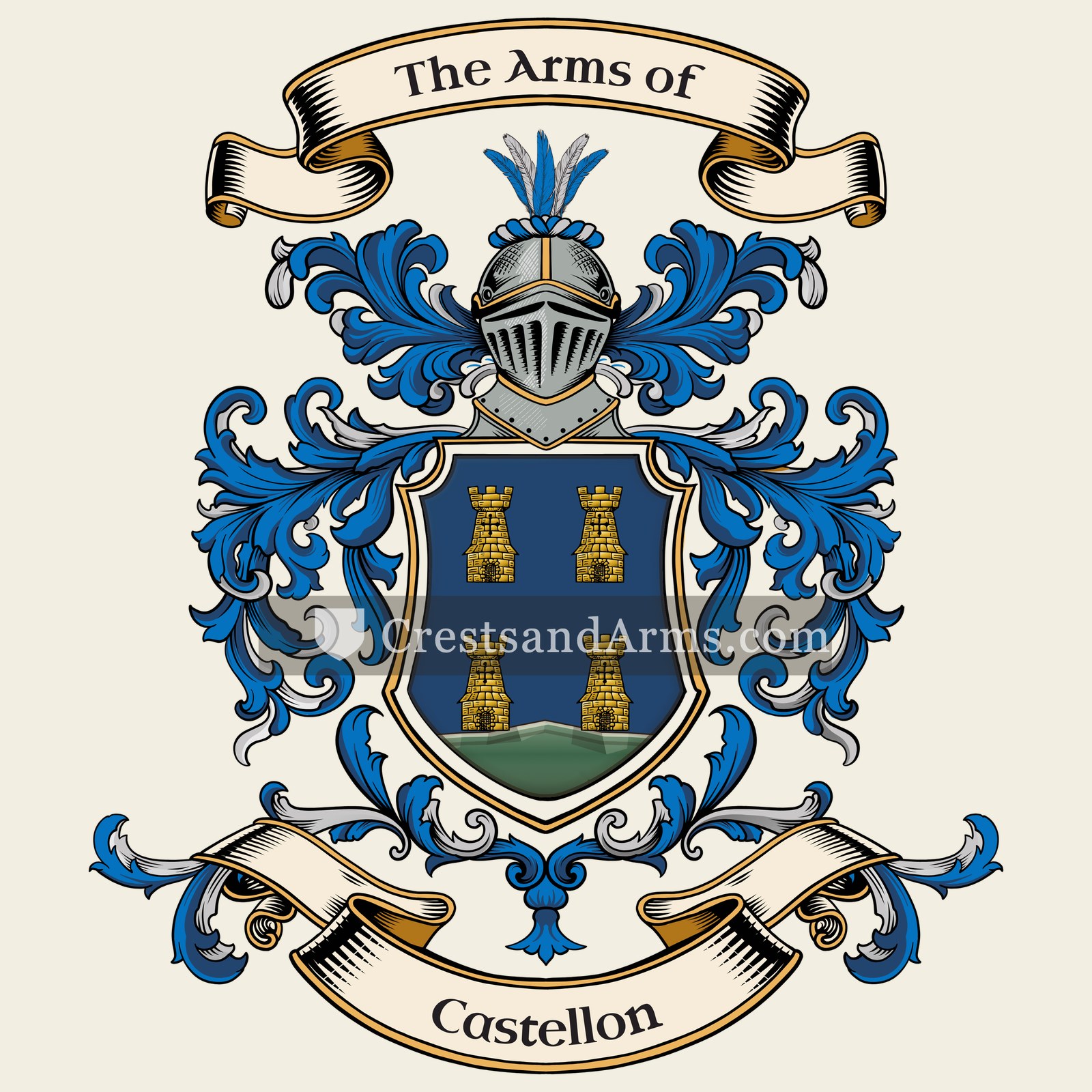
Symbols on this shield
mountThe ground held, and steadfastness upon it
towerGrandeur and solidity, and a stronghold defended
Colours
Blue (Azure)Means: Loyalty and truth
Green (Vert)Means: Hope
Gold (Or)Means: Generosity
Historical info
Source
J. B. Rietstap, Armorial Général, Gouda: G. B. van Goor Zonen, 1884–87
Blazon (the actual original written record)
“D'azur à une tour sommée de trois tourelles d'or, celle du milieu plus élevée, posée sur un tertre rocheux au nat., s'élevant d'une mer d'azur agitée d'arg.”
SpainMurcie, c. 1722
Digital archive packCoat of arms PNG, gold border print PDF, vector SVG and the certificate of authenticity. Sent to your email in minutes.
Map of Spain showing where the Castellon arms are recorded
The Castellon arms were recorded in Murcie, c. 1722.
This is where the arms were entered in the register. Families often moved to other parts of the country, so the same name can turn up in more than one region.
The body that granted and recorded arms in Spain in this period.
Philip V of Spain
Sovereign of the period
Philip V of Spain
1714–1724
Reigning in France when the Castellon arms are first recorded.
How Arms Worked in Spain
In Spain, a coat of arms was considered a form of property that belonged to the entire family line. These arms were passed down from a father to all his children equally. Younger branches of the family usually kept the original design without needing to add any special marks to distinguish their specific line.
Granting authority
The Cronista Rey de Armas was the official body that regulated and granted coats of arms throughout Spain.
How they got arms
Families often obtained their arms through royal grants or by proving their noble status to the official heraldic authority.
Where arms were recorded
Coats of arms were officially recorded in the registers of the Cronista Rey de Armas starting in 1496.
The family's standing
Recorded among the armigerous families of Spain.
Origin & History of the Castellon Family in Spain
The surname Castellón originates from the Spanish word *castillo*, which translates to castle, and it was historically used as a topographical name to identify individuals who lived near or worked within a fortress. By the early 18th century, the family had established a notable presence in the region of Murcia, a territory shaped by its complex history of transition between Moorish and Christian rule. In 1722, records confirm that members of the Castellón family were active participants in the social and economic life of this area. During this period, Murcia was a vital agricultural hub, and families like the Castellóns were often integrated into the local community through land ownership or trade. Their presence in the city reflects the broader movement of families who settled in the southeastern part of the Iberian Peninsula to help rebuild and develop the region after centuries of territorial change.
Castellon Meaning & Related Branches
Root word
castellum
A Latin term referring to a small fort or castle.
This name
CastellonRefers to someone who lived near or worked at a small castle or fortified settlement.
also spelled
Castellone
Castelloni
Castell
Kastelon
Related arms
Castelletsimilar arms
Châtelsimilar arms
Martorellsimilar arms
Castellvariant spelling
Documented Sources
J. B. Rietstap, Armorial Général, Gouda: G. B. van Goor Zonen, 1884–87
Archives départementales de Meurthe-et-Moselle, Série B (Cours et juridictions)
Bastien, Henri. Histoire de la Lorraine. 1978
Cabourdin, Guy. Quand Stanislas régnait en Lorraine. 1980
Digital archive packCoat of arms PNG, gold border print PDF, vector SVG and the certificate of authenticity. Sent to your email in minutes.


 lionCourage, strength and royalty
 lionCourage, strength and royalty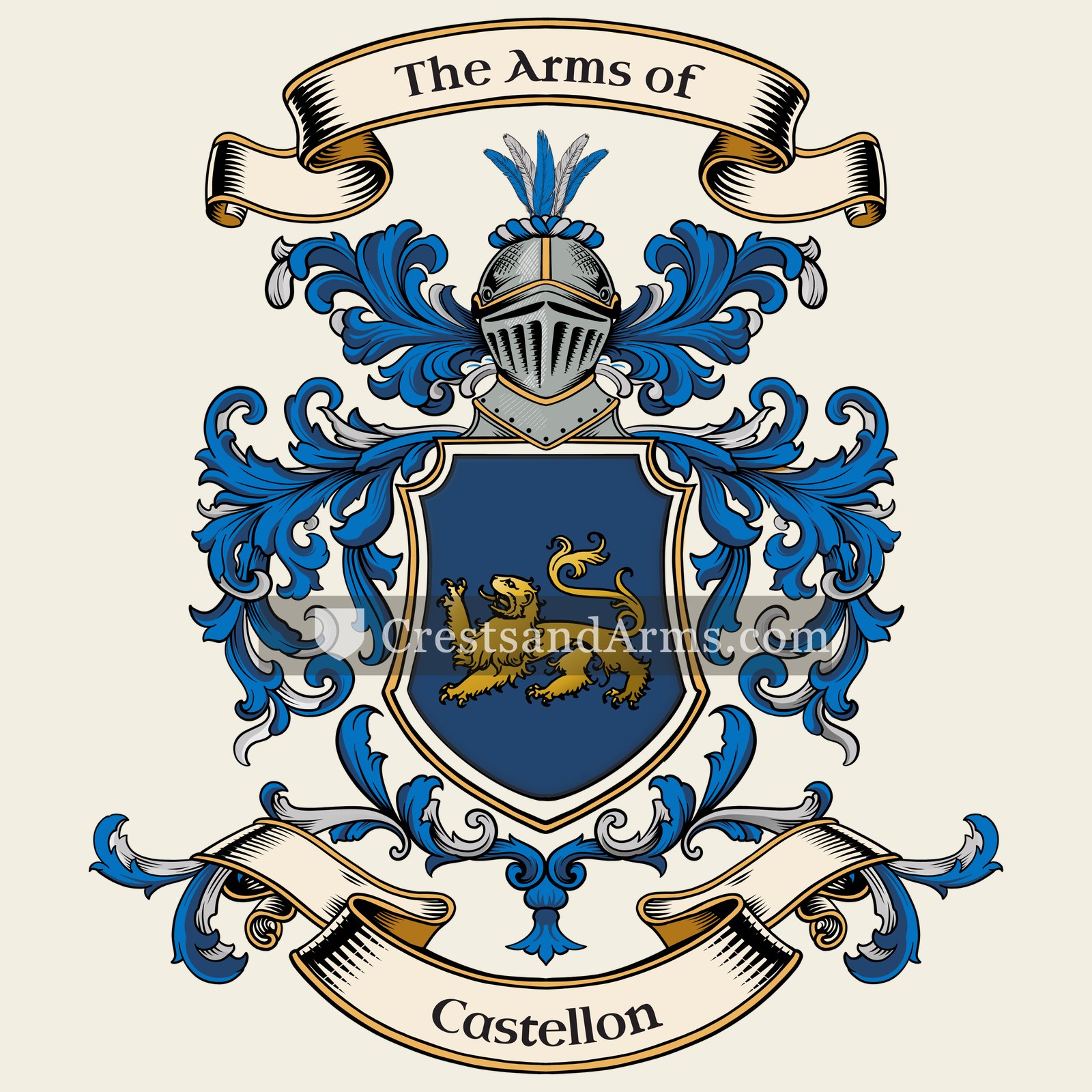


 mountThe ground held, and steadfastness upon it
 towerGrandeur and solidity, and a stronghold defended