Map of France showing where the Castelo arms are recorded
The Castelo arms were recorded in Poitou, c. 1663.
Poitou was western French farming country, divided among a large number of small landed families. Its gentry were numerous and modest, and even a small estate was enough to justify a shield.
This is where the arms were entered in the register. Families often moved to other parts of the country, so the same name can turn up in more than one region.
The body that granted and recorded arms in France in this period.
Louis XIV of France
Sovereign of the period
Louis XIV of France
1643–1715
Reigning in France when the Castelo arms are first recorded.
How Arms Worked in France
In France, a coat of arms was a mark of honor that passed down through the male line to all legitimate descendants. Families often used the same shield without changes to show their shared heritage. If a branch wanted to stand out, they could add a small mark to their shield to show their specific place in the family tree.
Granting authority
The Juge d'armes de France acted as the official authority that regulated and verified coats of arms across the country.
How they got arms
Families typically inherited their arms from ancestors, though they could also receive them through royal grants or by proving their noble status.
Where arms were recorded
Coats of arms were officially recorded in the Armorial Général de France, which began its main collection in the year 1696.
The family's standing
Recorded among the armigerous families of Poitou.
Origin & History of the Castelo Family in France
The surname Castelo traces its roots to the Latin word for a castle or fortified place, suggesting that the earliest ancestors were likely people who lived near or worked within such a structure. By the year 1663, records confirm that members of this family were well-established in the Poitou region of western France. During this period, Poitou was a landscape defined by its agricultural richness and its strategic importance during the religious and political shifts of the seventeenth century. Families in this area often held ties to the land or served in local administrative roles that required them to be near the regional strongholds that gave the name its meaning. As the family grew, they became part of the local social fabric of Poitou, contributing to the history of a province known for its deep traditions and its role in the development of French colonial life in the Americas.
Meaning of the Castelo family crest colors & symbols
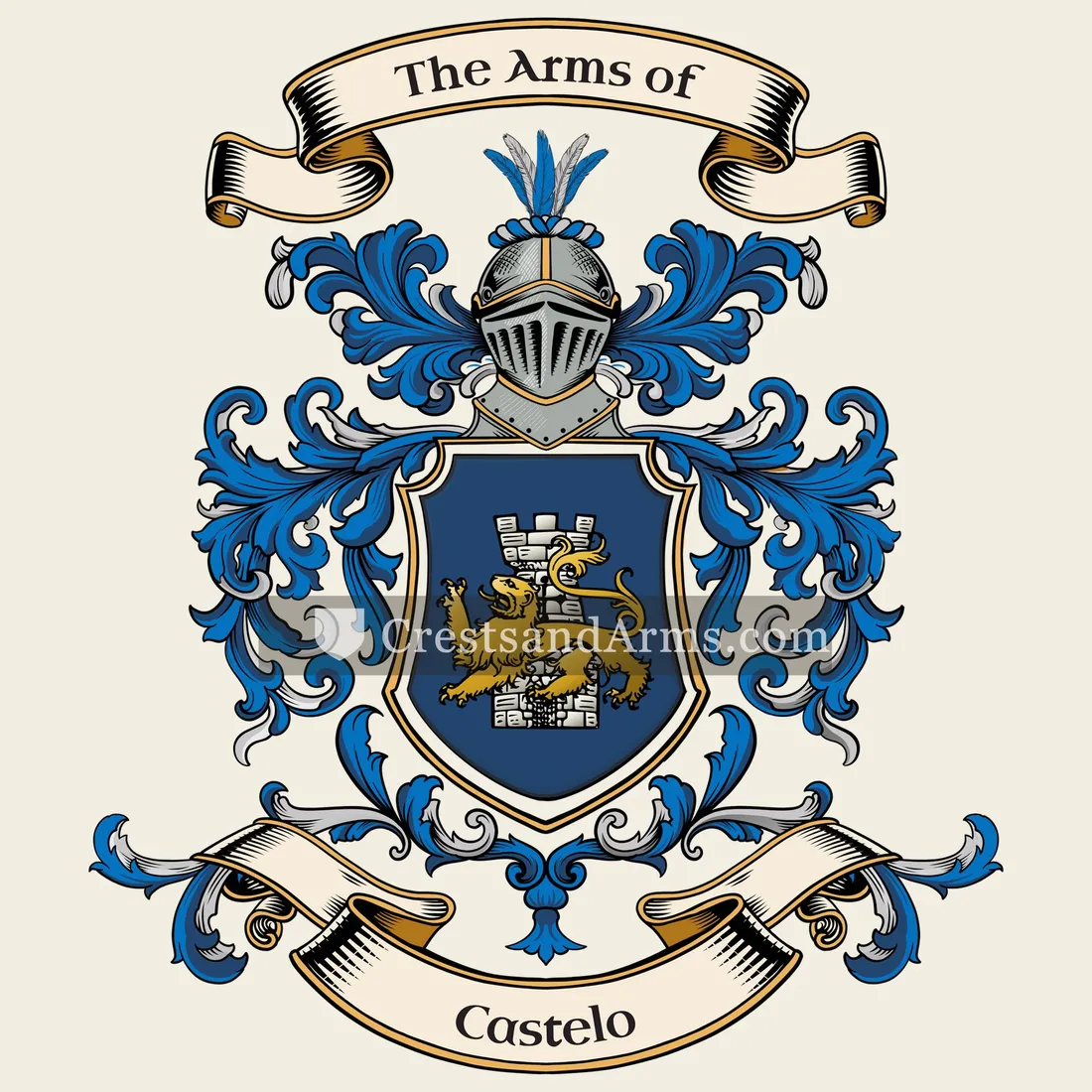
Symbols on this shield
towerGrandeur and solidity, and a stronghold defended
lionCourage, strength and royalty
Colours
Blue (Azure)Means: Loyalty and truth
Silver (Argent)Means: Peace and sincerity
Gold (Or)Means: Generosity
Historical info
Source
J. B. Rietstap, Armorial Général, Gouda: G. B. van Goor Zonen, 1884–87
Blazon (the actual original written record)
“Parti: au 1 d'azur à une tour d'arg.; au 2 d'azur au lion d'or.”
CataloniaCatalonia, c. 1722
Digital archive packCoat of arms PNG, gold border print PDF, vector SVG and the certificate of authenticity. Sent to your email in minutes.
Map of Spain showing where the Castelo arms are recorded
The Castelo arms were recorded in Catalonia, c. 1722.
Catalonia lived by sea trade, and its merchant houses were as powerful as its landowners. Both sorts of family took arms, and Barcelona kept records of the houses entitled to bear them.
This is where the arms were entered in the register. Families often moved to other parts of the country, so the same name can turn up in more than one region.
The body that granted and recorded arms in Spain in this period.
Philip V of Spain
Sovereign of the period
Philip V of Spain
1714–1724
Reigning in France when the Castelo arms are first recorded.
How Arms Worked in Spain
In Spain, a coat of arms was considered a form of property that belonged to the entire family line. These arms were passed down from a father to all his children equally. Younger branches of the family usually kept the original design without needing to add any special marks to distinguish their specific line.
Granting authority
The Cronista Rey de Armas was the official body that regulated and granted coats of arms throughout Spain.
How they got arms
Families often obtained their arms through royal grants or by proving their noble status to the official heraldic authority.
Where arms were recorded
Coats of arms were officially recorded in the registers of the Cronista Rey de Armas starting in 1496.
The family's standing
Recorded among the armigerous families of Catalonia.
Origin & History of the Castelo Family in Spain
The surname Castelo is a topographic name that originated in the Iberian Peninsula, specifically derived from the Latin word *castellum*, which refers to a castle or a fortified settlement. During the Middle Ages, families often adopted this name to signify that they lived near or served at a local stronghold. By the early 18th century, the family had established a documented presence in the Catalonia region of Spain. At this time, Catalonia was a center of agricultural and mercantile activity, and families with this name were often integrated into the local rural communities or involved in the governance of small fortified towns. Because the name was tied to the physical landscape, it likely emerged independently in different areas where defensive structures were common. The presence of the family in Catalonia by 1722 suggests they were part of the stable population that helped rebuild and maintain the region following the significant political shifts of the early 1700s.
Meaning of the Castelo family crest colors & symbols
Colours
Silver (Argent)Means: Peace and sincerity
Black (Sable)Means: Constancy
Historical info
Source
J. B. Rietstap, Armorial Général, Gouda: G. B. van Goor Zonen, 1884–87
Blazon (the actual original written record)
“Parti d'arg. et de sa.”
ItalyTrévise, c. 1775
Digital archive packCoat of arms PNG, gold border print PDF, vector SVG and the certificate of authenticity. Sent to your email in minutes.
Map of Italy showing where the Castelo arms are recorded
The Castelo arms were recorded in Trévise, c. 1775.
This is where the arms were entered in the register. Families often moved to other parts of the country, so the same name can turn up in more than one region.
The body that granted and recorded arms in Italy in this period.
Alvise Giovanni Mocenigo
Sovereign of the period
Alvise Giovanni Mocenigo
1763–1778
Reigning in France when the Castelo arms are first recorded.
How Arms Worked in Italy
In the Italian states, coats of arms were often used by noble families to show their status and history. These symbols were passed down through the generations to all legitimate male descendants. Younger branches of a family usually kept the original design but sometimes added small changes to distinguish their specific line from the main branch.
Granting authority
Various local rulers and city governments controlled the use of coats of arms across the different Italian states.
How they got arms
Families often assumed their own arms or received them as official grants from local lords, popes, or city councils.
Where arms were recorded
Arms were recorded in local city archives or private family books rather than in one single national register.
The family's standing
Recorded among the armigerous families of Italy.
Origin & History of the Castelo Family in Italy
The surname Castelo finds its roots in the Latin word *castellum*, which refers to a fortified place or a small castle. In the context of Italian history, families adopting this name often lived near or served as guardians of local defensive structures during the Middle Ages. By the time the name appeared in records within the city of Treviso in 1775, it was already well-established among families who held roles in local administration or land management. During this period, Treviso was a significant hub within the Republic of Venice, and families like the Castelos were often integrated into the social fabric of the Venetian mainland. These early ancestors likely navigated the complex economic shifts of the late eighteenth century, moving between urban life in the city and the agricultural estates that defined the surrounding Veneto region. Their presence in the historical registers of Treviso highlights a long-standing connection to the administrative and social life of Northern Italy.
Castelo Meaning & Related Branches
Root word
castellum
A small fort or fortified place in Latin.
This name
CasteloRefers to a person who lived near or worked at a castle or fortified structure.
also spelled
Castelli
Castella
Castell
Kastelo
Documented Sources
J. B. Rietstap, Armorial Général, Gouda: G. B. van Goor Zonen, 1884–87
Beauchet-Filleau, Henri, Dictionnaire historique et généalogique des familles du Poitou, 1891
Archives départementales de la Vienne, Registres paroissiaux et d'état civil, 1663
Digital archive packCoat of arms PNG, gold border print PDF, vector SVG and the certificate of authenticity. Sent to your email in minutes.


 eagleNobility, strength and a keen mind
 eagleNobility, strength and a keen mind
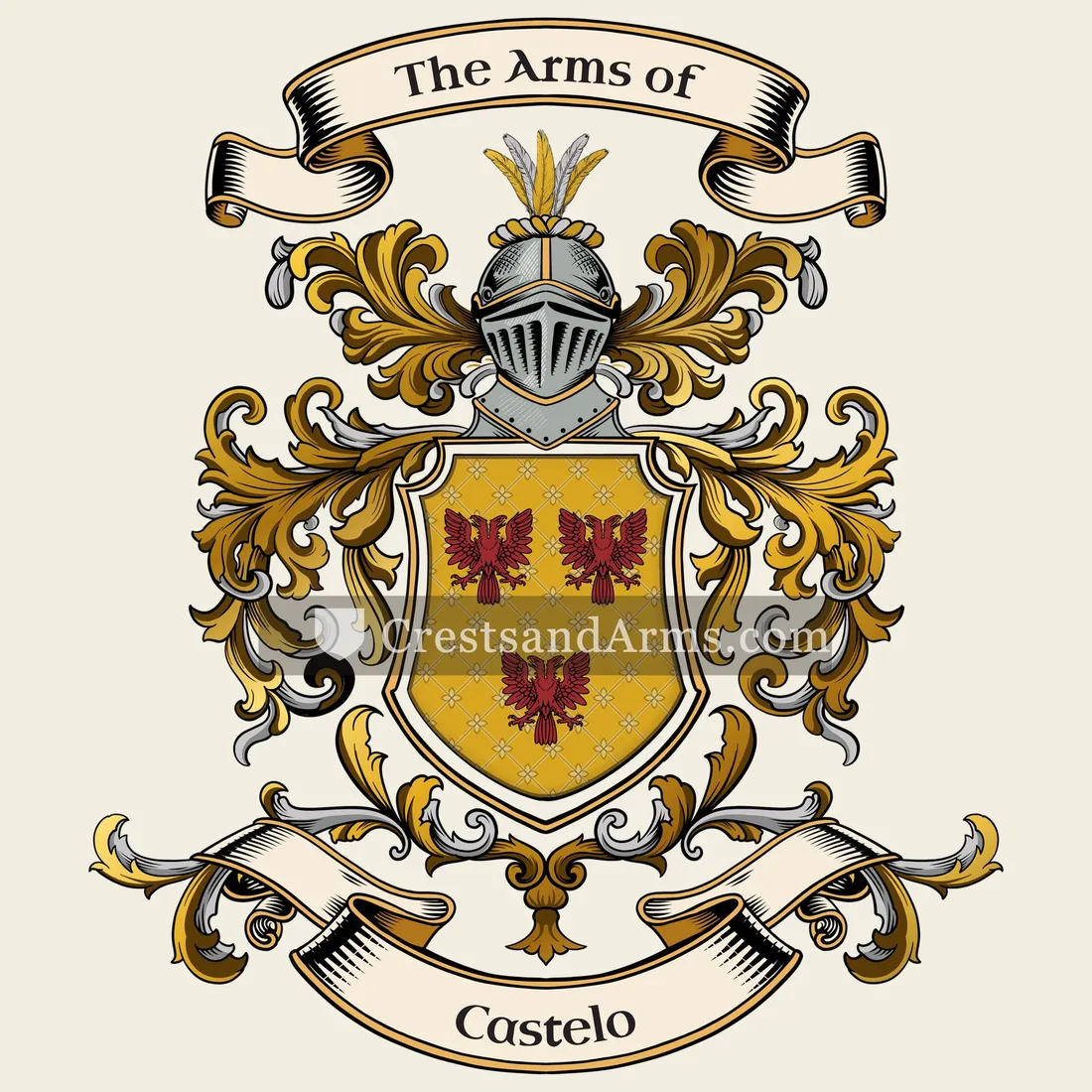


 towerGrandeur and solidity, and a stronghold defended
 lionCourage, strength and royalty