Map of Italy showing where the Catena arms are recorded
The Catena arms were recorded in Dalmatia, c. 1775.
Dalmatia was a string of walled towns along the Adriatic coast, each with its own leading families. Sea trade made them wealthy, and the towns kept lists of the houses entitled to arms.
This is where the arms were entered in the register. Families often moved to other parts of the country, so the same name can turn up in more than one region.
The body that granted and recorded arms in Italy in this period.
Alvise Giovanni Mocenigo
Sovereign of the period
Alvise Giovanni Mocenigo
1763–1778
Reigning in Italy when the Catena arms are first recorded.
How Arms Worked in Italy
In the Italian states, coats of arms were often used by noble families to show their status and history. These symbols were passed down through the generations to all legitimate male descendants. Younger branches of a family usually kept the original design but sometimes added small changes to distinguish their specific line from the main branch.
Granting authority
Various local rulers and city governments controlled the use of coats of arms across the different Italian states.
How they got arms
Families often assumed their own arms or received them as official grants from local lords, popes, or city councils.
Where arms were recorded
Arms were recorded in local city archives or private family books rather than in one single national register.
The family's standing
Recorded among the armigerous families of Dalmatia.
Origin & History of the Catena Family in Italy
The surname Catena finds its roots in the linguistic landscape of medieval Italy, where it originated as a descriptive name likely referring to a person who lived near a chain or a specific landmark. While the name is firmly established in Italian history, the family also maintained a significant presence across the Adriatic Sea in Dalmatia by the late eighteenth century. Historical records confirm that members of the Catena family were settled in this coastal region by 1775, suggesting a long history of maritime movement and trade between the Italian peninsula and the Balkan coast. This migration was common for families living in port cities, as the Adriatic served as a bridge for cultural and economic exchange rather than a barrier. By moving between these regions, the family became part of the broader Mediterranean network that defined the social structure of the era.
Coat of Arms & Family Crest Details
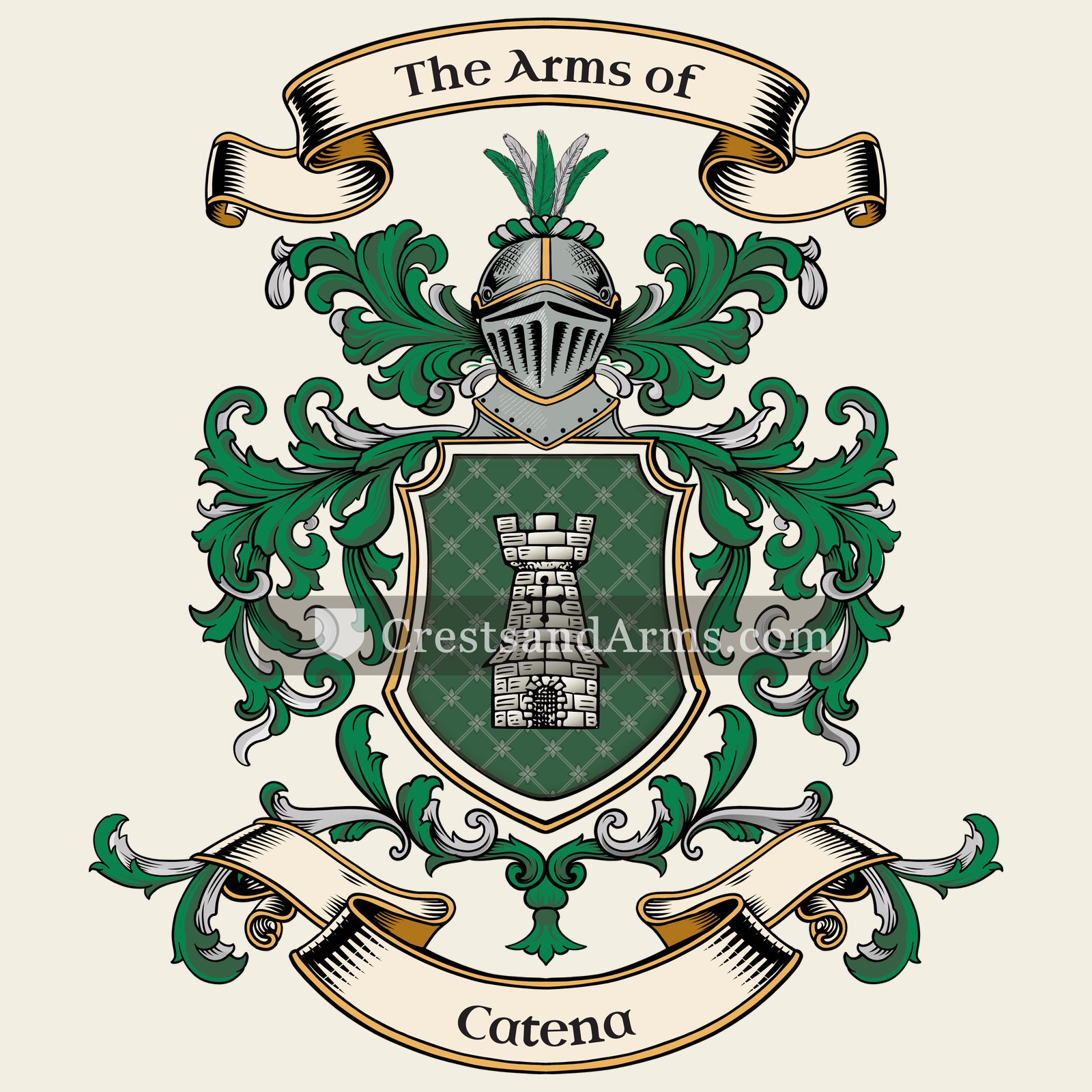
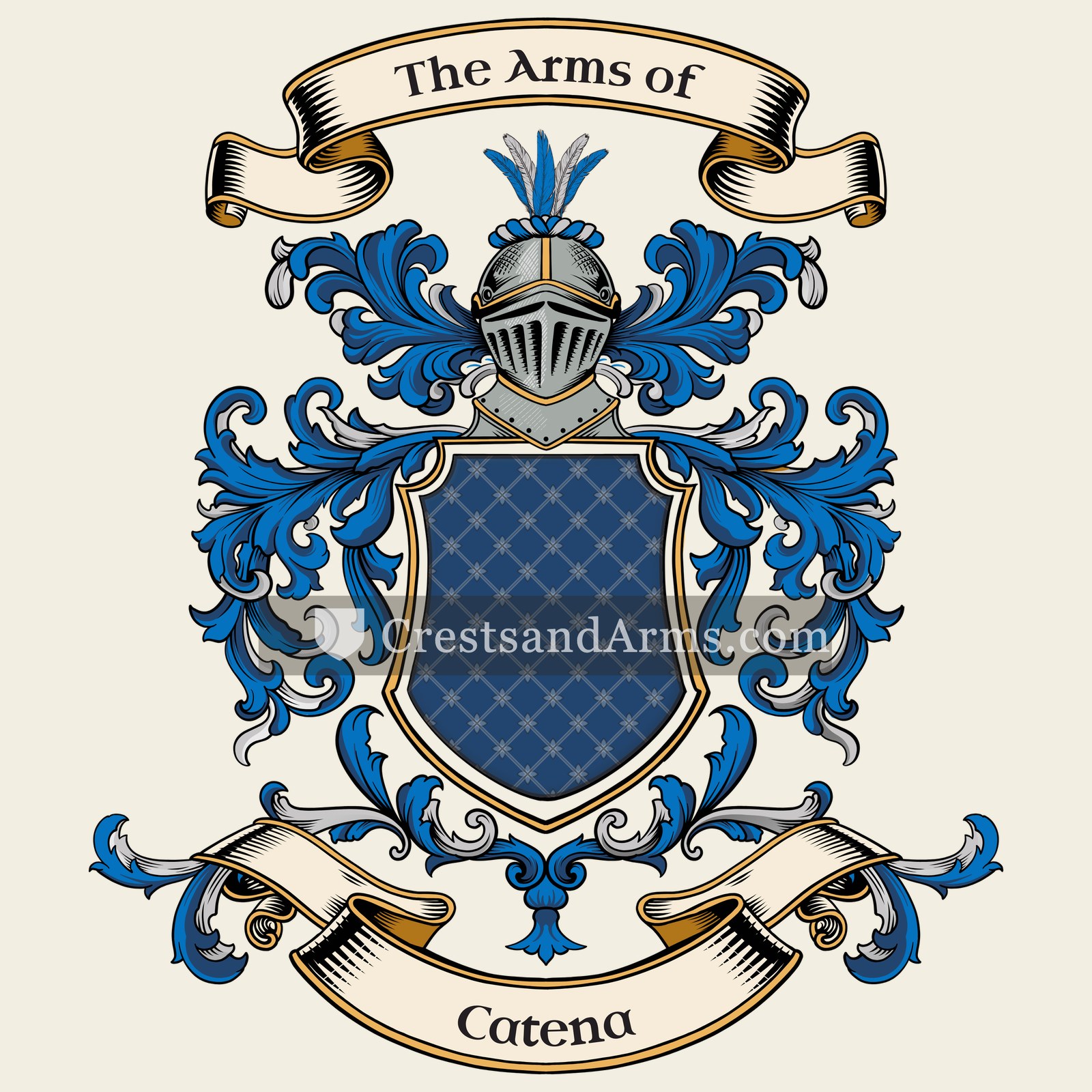
Symbols on this shield
towerGrandeur and solidity, and a stronghold defended
Colours
Green (Vert)Means: Hope
Silver (Argent)Means: Peace and sincerity
Historical info
Source
J. B. Rietstap, Armorial Général, Gouda: G. B. van Goor Zonen, 1884–87
Blazon (the actual original written record)
“De sin. à une tour d'arg.; et une chaîne du même, posée en bande, br. sur la tour.”
Spainc. 1722
Digital archive packCoat of arms PNG, gold border print PDF, vector SVG and the certificate of authenticity. Sent to your email in minutes.
Map of Spain showing where the Catena arms are recorded
The Catena arms were recorded in Spain, c. 1722.
Arms such as these were typically recorded in Castile.
Castile was the heart of Spain and the source of most of its noble families. Land won in the long wars against the Moors was granted out to fighting men, and a man granted land was granted arms along with it.
This is where the arms were entered in the register. Families often moved to other parts of the country, so the same name can turn up in more than one region.
The body that granted and recorded arms in Spain in this period.
Philip V of Spain
Sovereign of the period
Philip V of Spain
1714–1724
Reigning in Italy when the Catena arms are first recorded.
How Arms Worked in Spain
In Spain, a coat of arms was considered a form of property that belonged to the entire family line. These arms were passed down from a father to all his children equally. Younger branches of the family usually kept the original design without needing to add any special marks to distinguish their specific line.
Granting authority
The Cronista Rey de Armas was the official body that regulated and granted coats of arms throughout Spain.
How they got arms
Families often obtained their arms through royal grants or by proving their noble status to the official heraldic authority.
Where arms were recorded
Coats of arms were officially recorded in the registers of the Cronista Rey de Armas starting in 1496.
The family's standing
Recorded among the armigerous families of Spain.
Origin & History of the Catena Family in Spain
The name Catena carries a rich history rooted in the social and geographic landscape of early modern Spain. By the year 1722, records confirm that members of the Catena family were well-established within the region of Castile. During this period, the name was closely tied to the agrarian traditions of the Spanish heartland, where families often lived in small, tightly knit communities centered around local parishes. The name itself is derived from the Latin word for chain, which likely served as a descriptive nickname for an ancestor who worked as a metalworker or lived near a specific landmark. As these early family members navigated the shifting political climate of the eighteenth century, they contributed to the local economy and social fabric of the Castilian provinces. Their presence in official documentation from this era highlights a lineage that was deeply integrated into the daily life and administrative structures of the Spanish kingdom.
Catena Meaning & Related Branches
Root word
Catena
Derived from the Latin word catena meaning chain or series.
This name
CatenaRefers to a person who lived near a chain-like structure or worked as a chain maker.
also spelled
Katena
Catenna
Catenne
Documented Sources
J. B. Rietstap, Armorial Général, Gouda: G. B. van Goor Zonen, 1884–87
De Felice, Emidio. Dizionario dei cognomi italiani. 1978
State Archives of Zadar (Državni arhiv u Zadru). Statuta et leges civitatis Iadrae. 1775
Digital archive packCoat of arms PNG, gold border print PDF, vector SVG and the certificate of authenticity. Sent to your email in minutes.




 towerGrandeur and solidity, and a stronghold defended