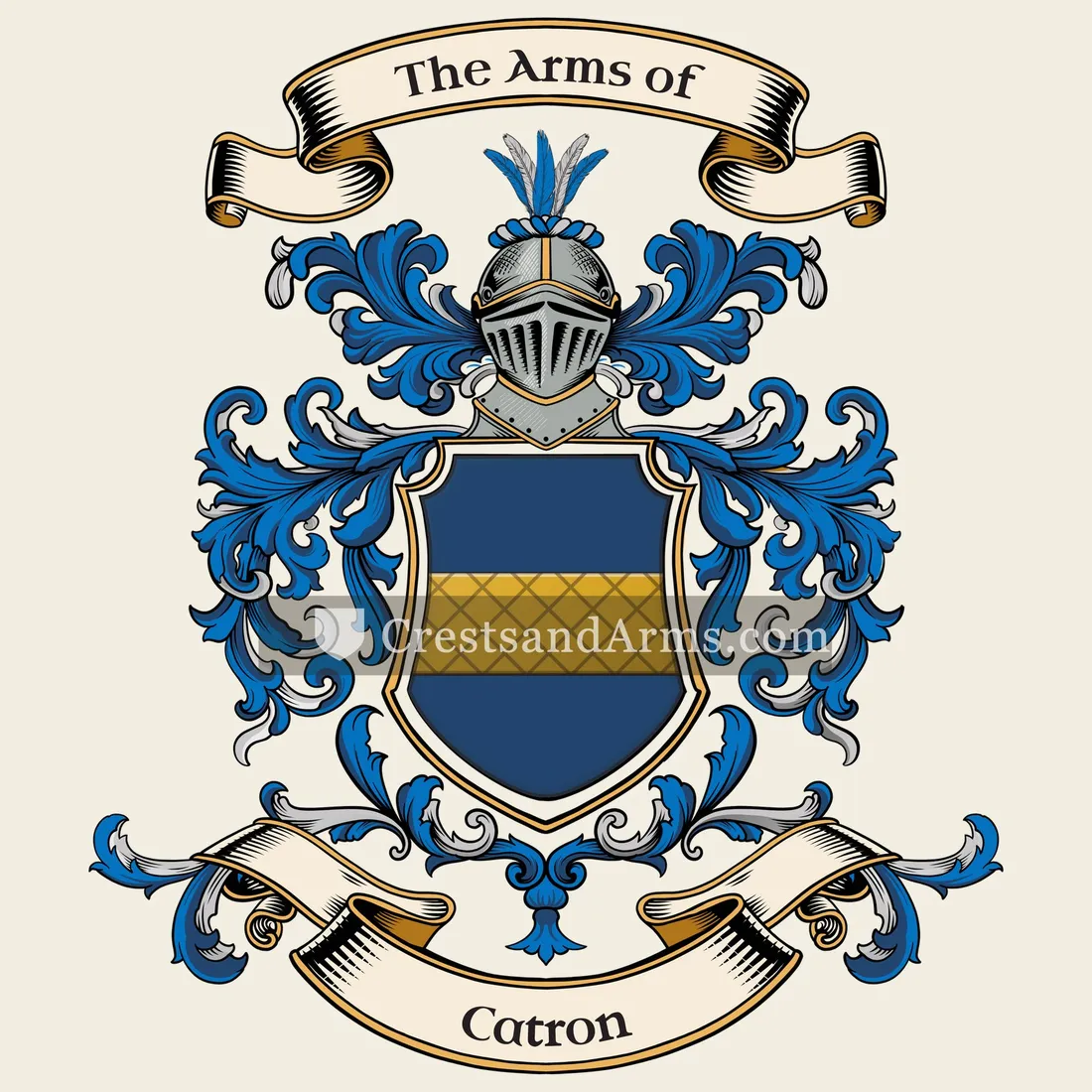
Map of France showing where the Catron arms are recorded
The Catron arms were recorded in France, c. 1663.
Arms such as these were typically recorded in Bretagne.
More families held coats of arms in Bretagne than anywhere else in France. The land was divided into many small estates rather than a few large ones, so far more households counted as gentry, and each needed a shield of its own to be told apart.
This is where the arms were entered in the register. Families often moved to other parts of the country, so the same name can turn up in more than one region.
The body that granted and recorded arms in France in this period.
Louis XIV of France
Sovereign of the period
Louis XIV of France
1643–1715
Reigning in France when the Catron arms are first recorded.
How Arms Worked in France
In France, a coat of arms was a mark of honor that passed down through the male line to all legitimate descendants. Families often used the same shield without changes to show their shared heritage. If a branch wanted to stand out, they could add a small mark to their shield to show their specific place in the family tree.
Granting authority
The Juge d'armes de France acted as the official authority that regulated and verified coats of arms across the country.
How they got arms
Families typically inherited their arms from ancestors, though they could also receive them through royal grants or by proving their noble status.
Where arms were recorded
Coats of arms were officially recorded in the Armorial Général de France, which began its main collection in the year 1696.
The family's standing
Recorded among the armigerous families of France.
Origin & History of the Catron Family in France
The surname Catron finds its early roots in the Brittany region of France, where records confirm the presence of the family as far back as 1663. The name likely originated as a descriptive term or a nickname linked to the local Gallo or Breton dialects spoken in the area during the seventeenth century. Families in this coastal province often lived in small, tight-knit rural communities where surnames were used to distinguish between different households in the same village. Over time, members of the family moved from these traditional agricultural settings, eventually spreading the name across different regions and eventually across the Atlantic. This migration pattern was common for families from Brittany who sought new opportunities in trade and land ownership during the late colonial period.
Catron Meaning & Related Branches
Root word
Quatre
The French word for the number four.
This name
CatronA topographic name for someone living near a crossroads or a four-way junction.
also spelled
Shadron
Documented Sources
J. B. Rietstap, Armorial Général, Gouda: G. B. van Goor Zonen, 1884–87
Archives départementales d'Ille-et-Vilaine, Registres paroissiaux et d'état civil
Dauzat, Albert, Dictionnaire étymologique des noms de famille et prénoms de France, 1951
Morlet, Marie-Thérèse, Dictionnaire étymologique des noms de famille, 1991
Digital archive packCoat of arms PNG, gold border print PDF, vector SVG and the certificate of authenticity. Sent to your email in minutes.


 fessThe military belt, and readiness to serve
 fessThe military belt, and readiness to serve