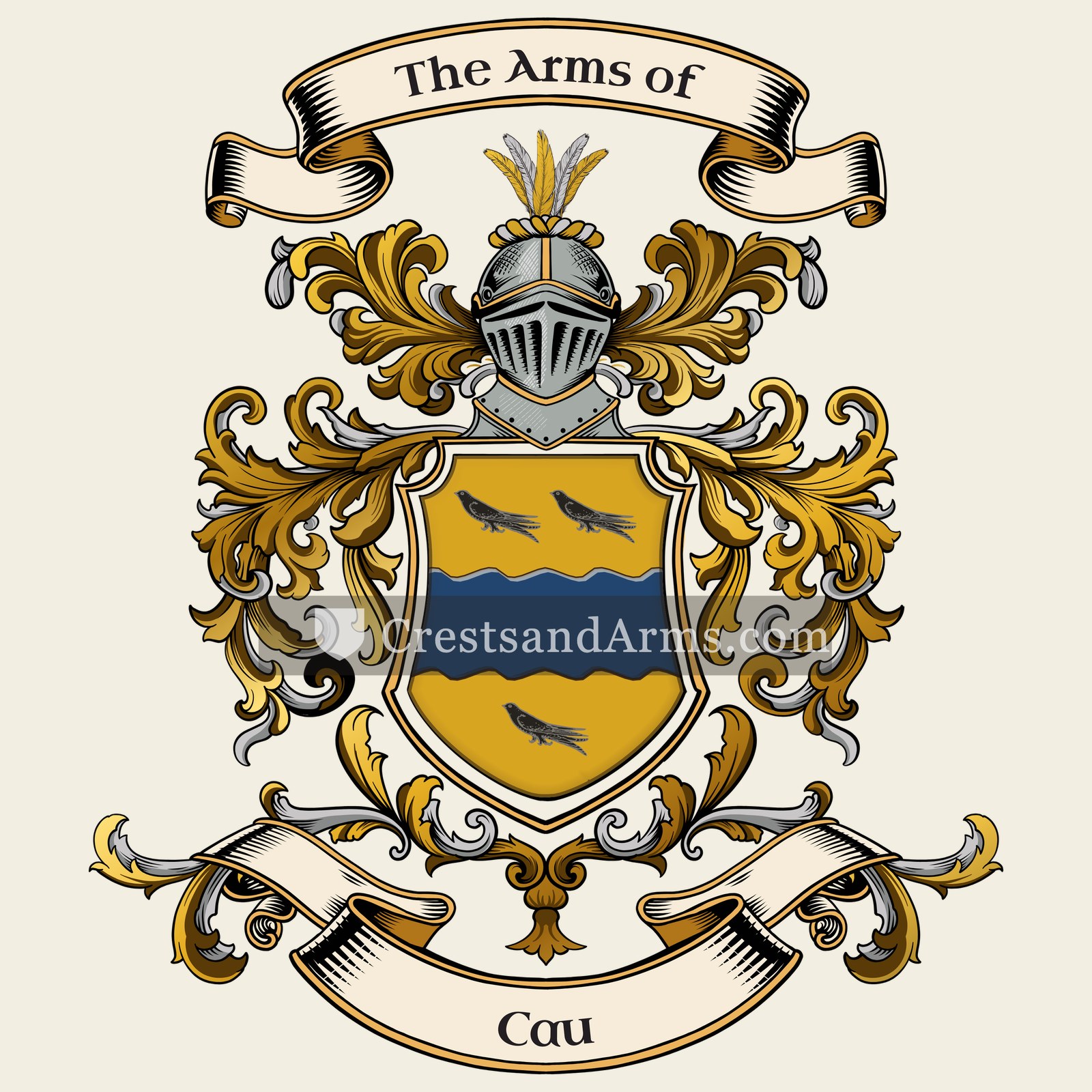
A record of documented arms, meaning and origin, researched for the Cau family of Netherlands.
Reg. 9789 · Dutch, A–C
Coat of Arms & Family Crest Details
Symbols on this shield
fessThe military belt, and readiness to serve
martletA younger son, who must win his own land
Colours
Gold (Or)Means: Generosity
Blue (Azure)Means: Loyalty and truth
Black (Sable)Means: Constancy
Historical info
Source
J. B. Rietstap, Armorial Général, Gouda: G. B. van Goor Zonen, 1884–87
Blazon (the actual original written record)
“D'or à la fasce ondée d'azur, acc. de trois choucas de sa. Brl. d'or et de sa. C.: un choucas de sa., entre un vol d'or et de sa. L.: de sa. et d'or. S.: à dextre un lion d'arg., à sen. une licorne d'arg. D.: SEMPER IDEM.”
ZeelandZeeland, c. 1815
Digital archive packCoat of arms PNG, gold border print PDF, vector SVG and the certificate of authenticity. Sent to your email in minutes.
Map of Netherlands showing where the Cau arms are recorded
The Cau arms were recorded in Zeeland, c. 1815.
Zeeland was a scatter of islands in the south-west of the Netherlands, living on the sea and on land reclaimed from it. Families who drained and held that land were counted among the gentry, and gentry carried arms.
This is where the arms were entered in the register. Families often moved to other parts of the country, so the same name can turn up in more than one region.
Region
Zeeland
First recorded
1815
Granting Authority for the Cau Arms
Hoge Raad van Adel
Photograph made by me · CC BY-SA 3.0
The body that granted and recorded arms in Netherlands in this period.
William I of the Netherlands
Sovereign of the period
William I of the Netherlands
1815–1840
Reigning in Netherlands when the Cau arms are first recorded.
How Arms Worked in Netherlands
In the Netherlands, coats of arms were often used by noble families and those who held specific public offices. These arms were passed down through the generations to legitimate descendants. Younger branches of a family usually kept the original design without needing to add special marks. This system ensured that the family identity remained clear and consistent over many years.
Granting authority
The Hoge Raad van Adel is the official body that regulates and manages noble titles and coats of arms in the Netherlands.
How they got arms
Families typically obtained their coats of arms through official royal grants or by proving their long-standing historical use of the symbols.
Where arms were recorded
Coats of arms are officially recorded in the registers held by the Hoge Raad van Adel, which began its work in 1814.
The family's standing
Recorded among the armigerous families of Zeeland.
Origin & History of the Cau Family in Netherlands
The surname Cau has deep roots in the coastal province of Zeeland, where the family established a notable presence by the early nineteenth century. During this period, the region was defined by its unique geography of islands and polders, which shaped the lives of families living along the North Sea. The name itself is thought to be a shortened form or a regional variant of older Germanic names, reflecting the linguistic evolution common in the Low Countries. As the family settled into the local communities of Zeeland, they became part of the area’s long history of maritime trade and agricultural development. By 1815, when the modern Kingdom of the Netherlands was formed, the Cau family was already well-integrated into the social and economic fabric of the province, contributing to the local culture that defined this resilient coastal population.
Cau Meaning & Related Branches
Root word
Calvus
Latin word meaning bald or hairless.
This name
CauA nickname originally used to describe a person who was bald.
also spelled
Kau
Caux
Caue
Co
Ko
Documented Sources
J. B. Rietstap, Armorial Général, Gouda: G. B. van Goor Zonen, 1884–87
Centraal Bureau voor Genealogie, Nederland’s Patriciaat, 1910
Zeeuws Archief, Burgerlijke Stand Zeeland, 1811–1950
P.J. Meertens, De Zeeuwse familienamen, 1947
Digital archive packCoat of arms PNG, gold border print PDF, vector SVG and the certificate of authenticity. Sent to your email in minutes.


 fessThe military belt, and readiness to serve
 martletA younger son, who must win his own land
 fessThe military belt, and readiness to serve
 martletA younger son, who must win his own land