Map of Italy showing where the Cavalcanti arms are recorded
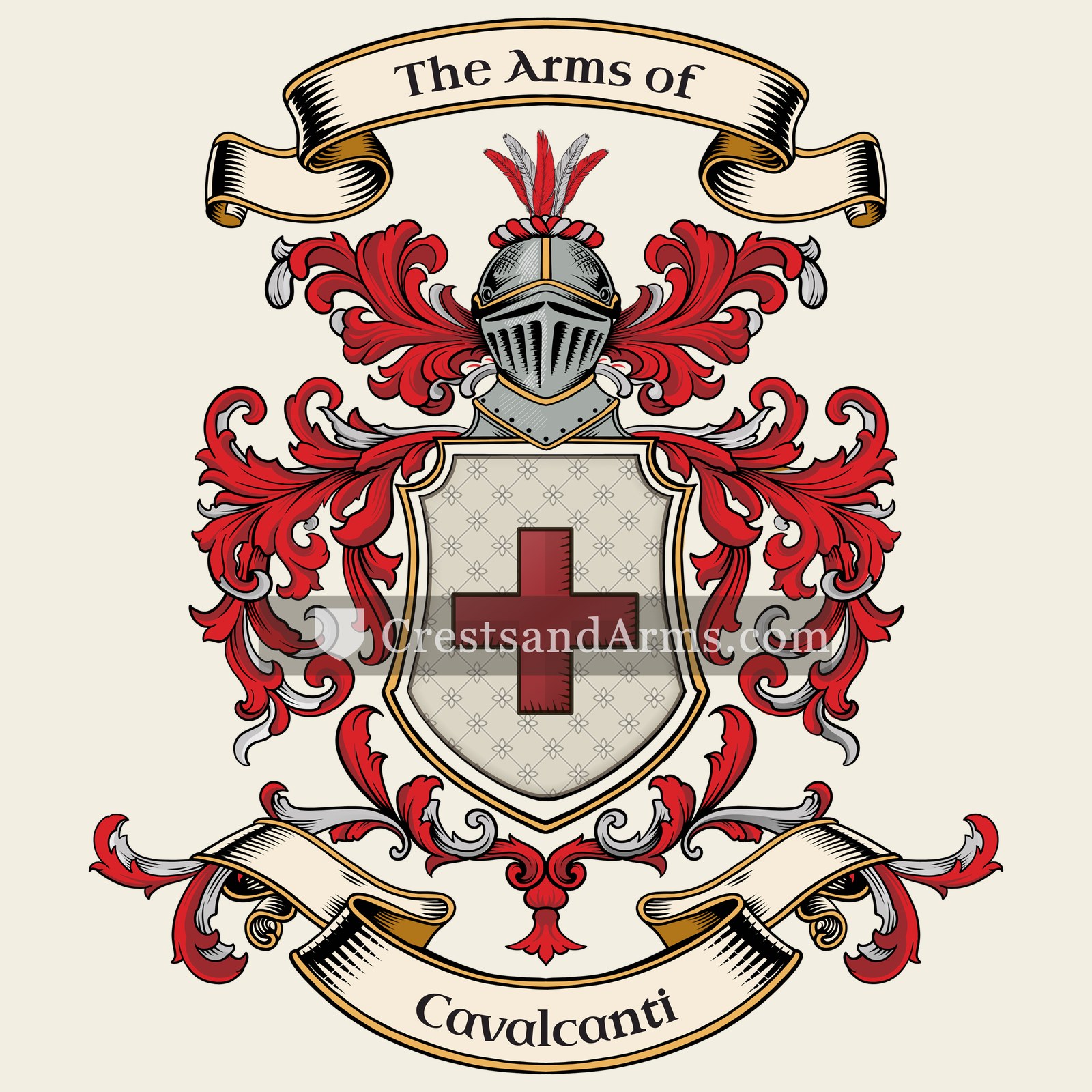
The Cavalcanti arms were recorded in Florence, c. 1775.
This is where the arms were entered in the register. Families often moved to other parts of the country, so the same name can turn up in more than one region.
The body that granted and recorded arms in Italy in this period.
Alvise Giovanni Mocenigo
Sovereign of the period
Alvise Giovanni Mocenigo
1763–1778
Reigning in Italy when the Cavalcanti arms are first recorded.
How Arms Worked in Italy
In the Italian states, coats of arms were often used by noble families to show their status and history. These symbols were passed down through the generations to all legitimate male descendants. Younger branches of a family usually kept the original design but sometimes added small changes to distinguish their specific line from the main branch.
Granting authority
Various local rulers and city governments controlled the use of coats of arms across the different Italian states.
How they got arms
Families often assumed their own arms or received them as official grants from local lords, popes, or city councils.
Where arms were recorded
Arms were recorded in local city archives or private family books rather than in one single national register.
The family's standing
Recorded among the armigerous families of Italy.
Origin & History of the Cavalcanti Family in Italy
The Cavalcanti family stands as one of the most prominent noble lineages in the history of Florence, Italy. Their influence in the city dates back to the early Middle Ages, long before the eighteenth century, as they were deeply involved in the political and social life of the Florentine Republic. The family gained significant power as members of the Guelph faction, which supported the authority of the Pope against the Holy Roman Emperor. Because of their status, they were heavily involved in the intense urban conflicts that defined medieval Florence, often clashing with rival families like the Uberti. Over the centuries, the family produced many notable figures, including the famous poet Guido Cavalcanti, who was a close friend of Dante Alighieri. By the time the family records show their continued presence in the city during the late 1700s, they had already cemented their reputation as a central pillar of Florentine history and culture.
Cavalcanti Meaning & Related Branches
Root word
Cavalcare
To ride a horse or mount.
This name
CavalcantiRefers to a family of horsemen or those who served as mounted knights.
also spelled
Kavalcanti
Cavalcanty
Cavalcante
Kavalkanti
Documented Sources
J. B. Rietstap, Armorial Général, Gouda: G. B. van Goor Zonen, 1884–87
Davidsohn, Robert. Forschungen zur Geschichte von Florenz. 1896
Villani, Giovanni. Nuova Cronica. 1348
Archivio di Stato di Firenze, Carte Strozziane, serie V
Digital archive packCoat of arms PNG, gold border print PDF, vector SVG and the certificate of authenticity. Sent to your email in minutes.


 cross symbolChristian faith and service
 cross symbolChristian faith and service