Map of Ireland showing where the Cavanagh arms are recorded
The Cavanagh arms were recorded in Ireland, c. 1642.
Arms such as these were typically recorded in Dublin.
Dublin was the seat of government in Ireland and the place where grants were sought and recorded. Families with business at the castle or the courts settled nearby, and settling there put their arms on record.
This is where the arms were entered in the register. Families often moved to other parts of the country, so the same name can turn up in more than one region.
The body that granted and recorded arms in Ireland in this period.
Charles I of England
Sovereign of the period
Charles I of England
1625–1649
Reigning in Ireland when the Cavanagh arms are first recorded.
How Arms Worked in Ireland
The Ulster King of Arms granted coats of arms to individuals who proved their social standing and good character. These symbols were typically inherited by all legitimate descendants of the original holder. If a family branch wanted a unique look, they could apply for a specific change to their design through the office to ensure their identity remained distinct.
Granting authority
The Ulster King of Arms acted as the official body that regulated and issued all coats of arms throughout Ireland.
How they got arms
Families obtained their arms through formal grants issued by the office after proving their eligibility and paying the required fees.
Where arms were recorded
All official grants were recorded in the registers held by the Ulster King of Arms starting from the year 1552.
The family's standing
Recorded among the armigerous families of Ireland.
Origin & History of the Cavanagh Family in Ireland
The surname Cavanagh originates from the Irish Gaelic name Caomhánach, which translates to a follower of Saint Caomhán. Historically, the family was most prominent in the province of Leinster, where they held significant power as a branch of the MacMurrough dynasty. By the time the family was recorded in Dublin in 1642, they had already established a long legacy as influential landowners and political figures in eastern Ireland. During this turbulent period of the seventeenth century, the family faced many challenges as the political landscape of the country shifted under colonial rule. Despite these pressures, the Cavanagh name remained deeply connected to its Irish roots and continued to play a role in the social life of the capital city.
Cavanagh Meaning & Related Branches
Root word
Caomhanach
Derived from the Irish word caomh meaning gentle, comely, or handsome.
This name
CavanaghRefers to a follower or devotee of Saint Caomhan.
also spelled
Cavenagh
Kavanagh
Kavenagh
Related arms
Cavenaghvariant spelling
Kavanaghvariant spelling
Documented Sources
Sir Bernard Burke, The General Armory of England, Scotland, Ireland and Wales, London: Harrison & Sons, 1884
Curtis, Edmund. A History of Medieval Ireland. 1938
Moody, T.W., Martin, F.X., and Byrne, F.J. A New History of Ireland, Volume II: Medieval Ireland 1169–1534. 1987
National Archives of Ireland, Civil Survey of the County of Dublin. 1654–1656
Digital archive packCoat of arms PNG, gold border print PDF, vector SVG and the certificate of authenticity. Sent to your email in minutes.


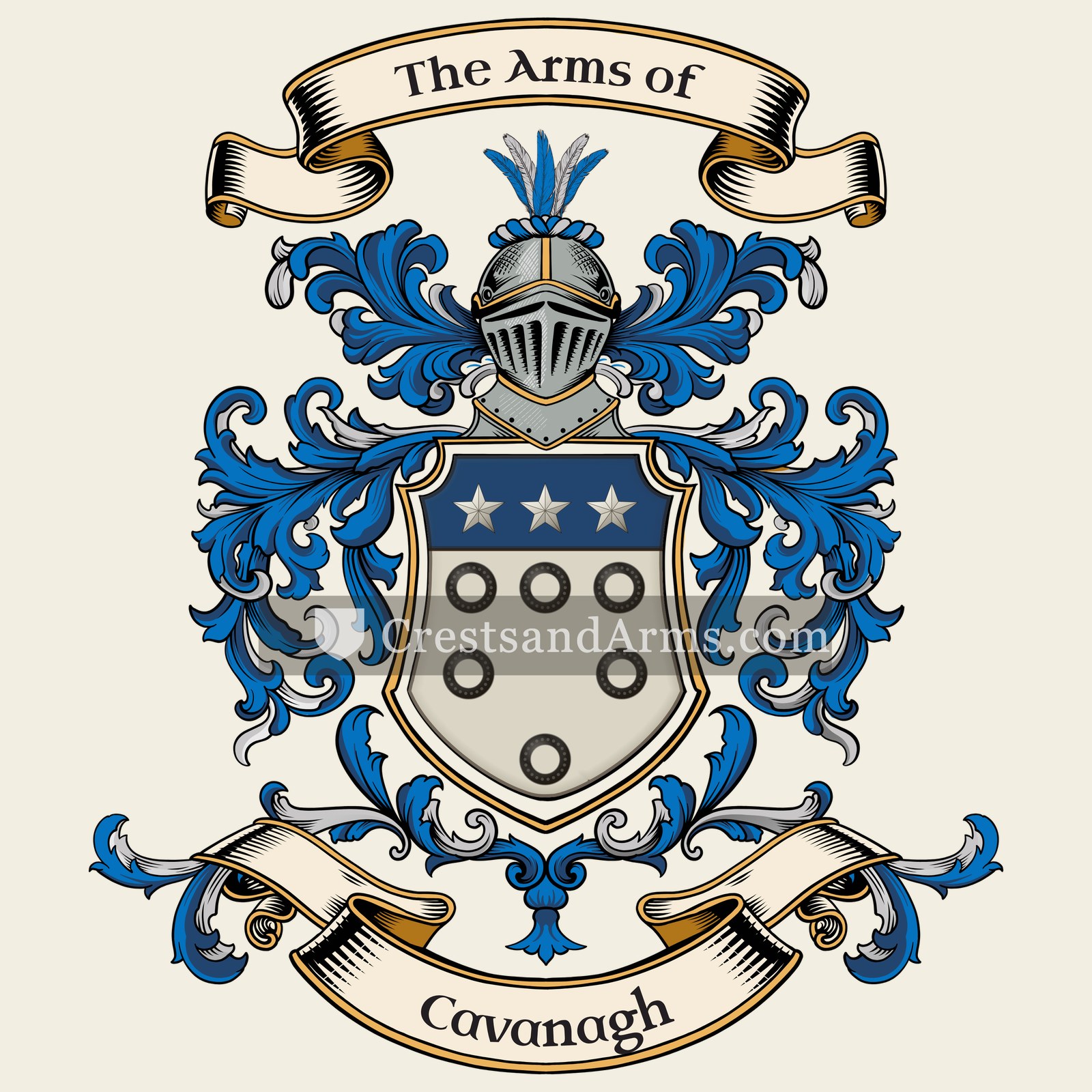
 chiefAuthority, wisdom and dominion
 ringFidelity, and a promise kept
 mulletThe third son, and a divine quality from above
 chiefAuthority, wisdom and dominion
 ringFidelity, and a promise kept
 mulletThe third son, and a divine quality from above