A record of documented arms, meaning and origin, researched for the Cavendish family lines. Documented in 2 countries.
Reg. 9388 · French, A–C
Meaning of the Cavendish family crest colors & symbols
Symbols on this shield
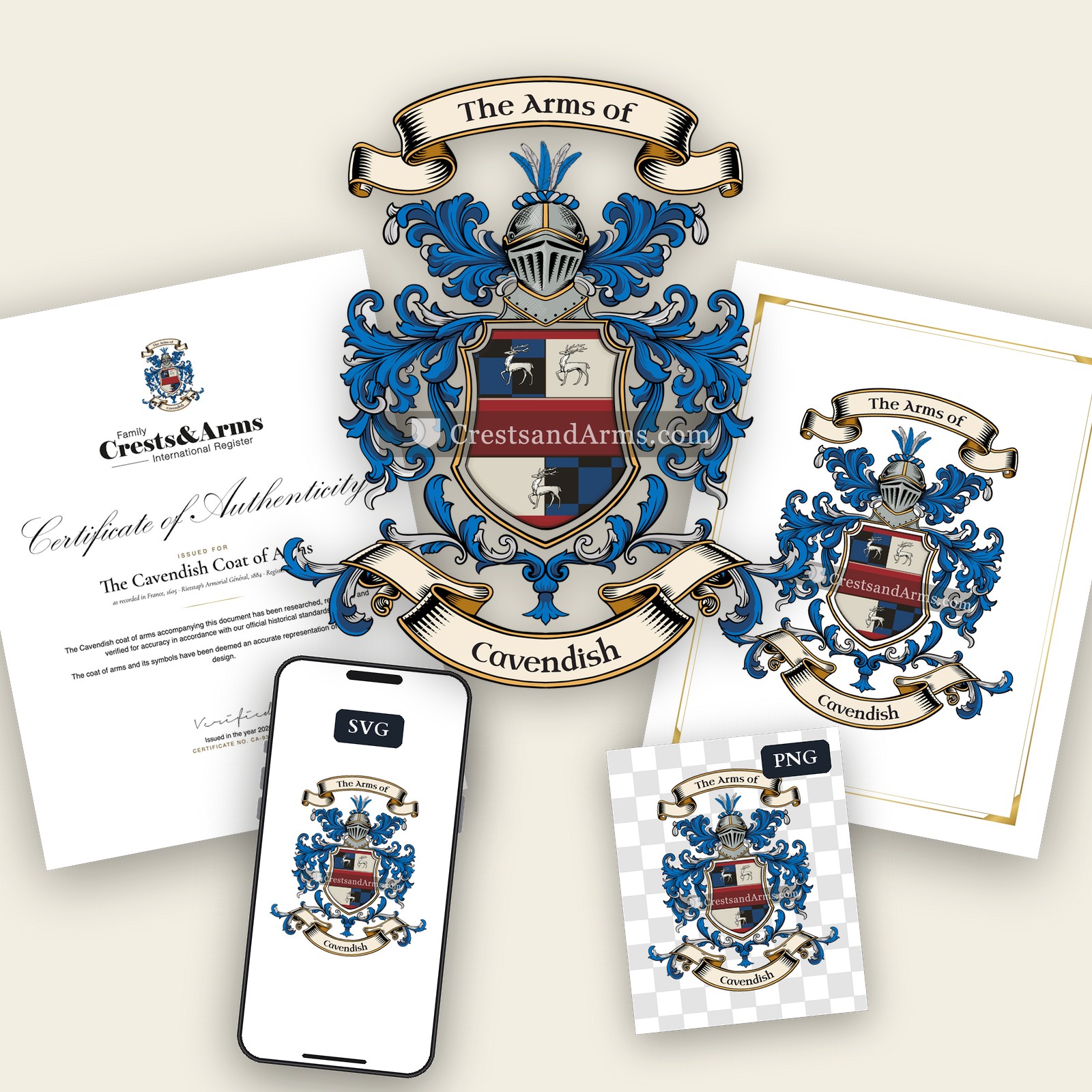
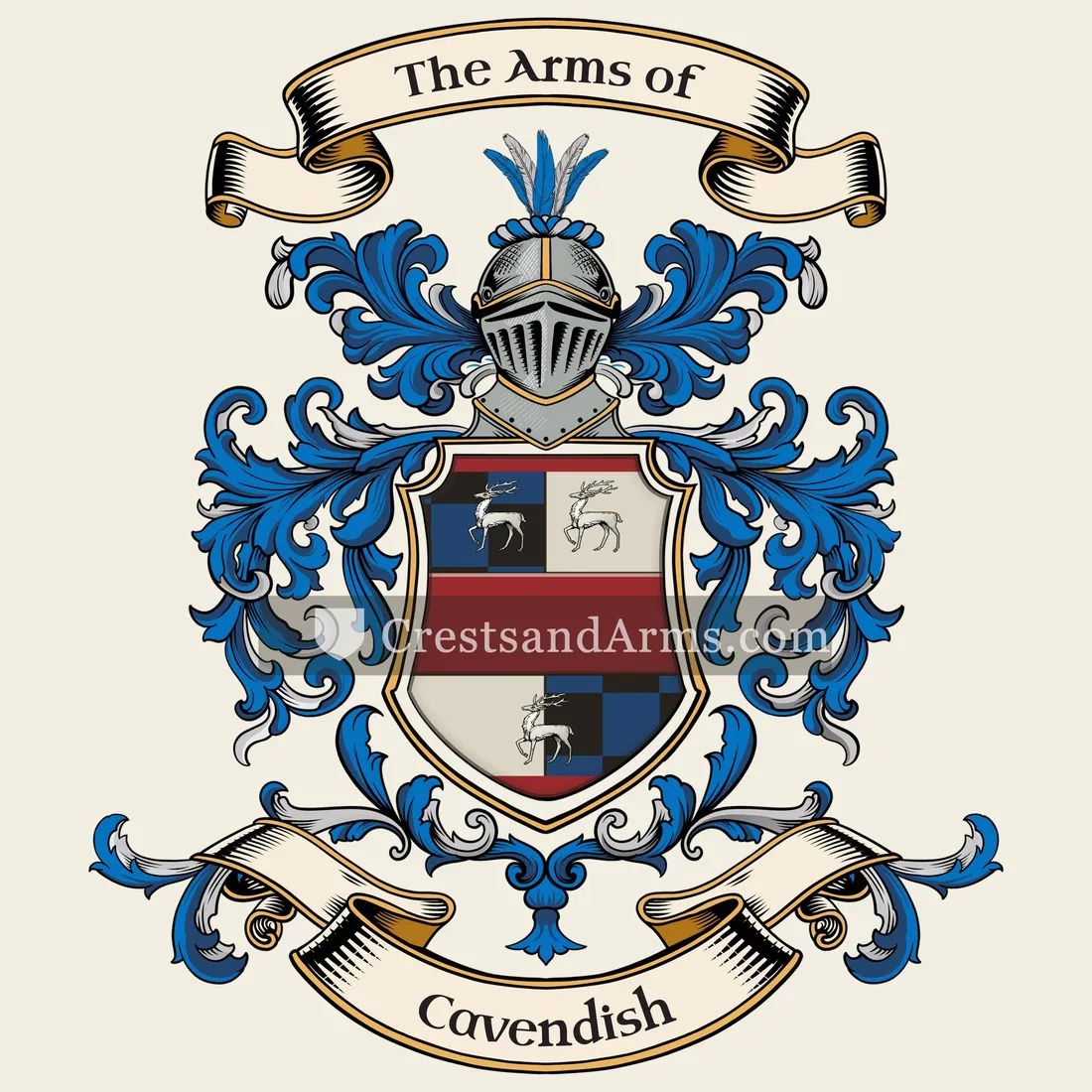
chequyConstancy, and the counting-board
fessThe military belt, and readiness to serve
stagPeace and harmony, and one who will not fight unprovoked
Colours
Black (Sable)Means: Constancy
Silver (Argent)Means: Peace and sincerity
Red (Gules)Means: Military strength
Blue (Azure)Means: Loyalty and truth
Historical info
Source
J. B. Rietstap, Armorial Général, Gouda: G. B. van Goor Zonen, 1884–87
Blazon (the actual original written record)
“Ec.: aux 1 et 4 de sa. à trois rencontres de cerf d'arg., ramés d'or (Cavendish); au 2 tranché-crén. d'arg. sur gu. (Boyle); au 3 échiq. d'azur et d'azur, à la fasce de gu., br. sur l'échiqueté (Clifford). C.: un serpent couché, noué en double saut. S.: deux cerfs au nat., ramés et onglés d'azur. D.: CAVENDO TUTUS.”
Francec. 1605
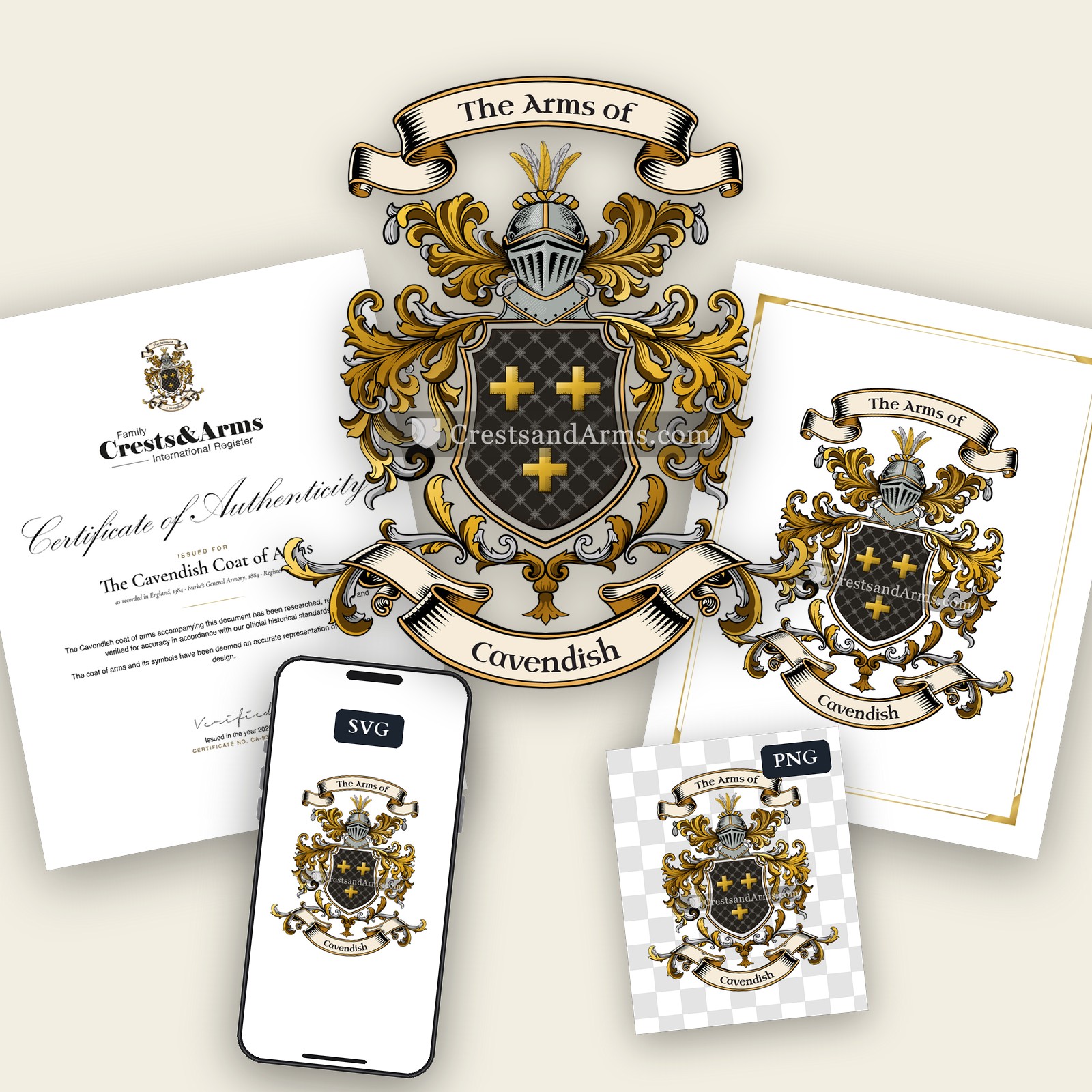
Digital archive packCoat of arms PNG, gold border print PDF, vector SVG and the certificate of authenticity. Sent to your email in minutes.
Map of France showing where the Cavendish arms are recorded
The Cavendish arms were recorded in France, c. 1605.
Arms such as these were typically recorded in Bretagne.
More families held coats of arms in Bretagne than anywhere else in France. The land was divided into many small estates rather than a few large ones, so far more households counted as gentry, and each needed a shield of its own to be told apart.
This is where the arms were entered in the register. Families often moved to other parts of the country, so the same name can turn up in more than one region.
The body that granted and recorded arms in France in this period.
Henry IV of France
Sovereign of the period
Henry IV of France
1589–1610
Reigning in France when the Cavendish arms are first recorded.
How Arms Worked in France
In France, a coat of arms was a mark of honor that passed down through the male line to all legitimate descendants. Families often used the same shield without changes to show their shared heritage. If a branch wanted to stand out, they could add a small mark to their shield to show their specific place in the family tree.
Granting authority
The Juge d'armes de France acted as the official authority that regulated and verified coats of arms across the country.
How they got arms
Families typically inherited their arms from ancestors, though they could also receive them through royal grants or by proving their noble status.
Where arms were recorded
Coats of arms were officially recorded in the Armorial Général de France, which began its main collection in the year 1696.
The family's standing
Recorded among the armigerous families of France.
Origin & History of the Cavendish Family in France
The history of the Cavendish name in France is deeply tied to the movement of families across the English Channel during the early seventeenth century. While the name is famously associated with English nobility, records confirm that members of the family were established in the region of Bretagne by 1605. During this period, the family likely navigated the complex social and political landscape of a France that was transitioning under the rule of King Henry IV. Their presence in Bretagne suggests they were part of a network of families who maintained connections between the British Isles and the French coast for trade or religious reasons. By settling in this specific province, these early family members integrated into a local culture known for its distinct maritime identity and strong regional autonomy. This early chapter of their history highlights how the family name was not confined to one country but was instead part of a broader European experience during the Renaissance.
Meaning of the Cavendish family crest colors & symbols
Symbols on this shield
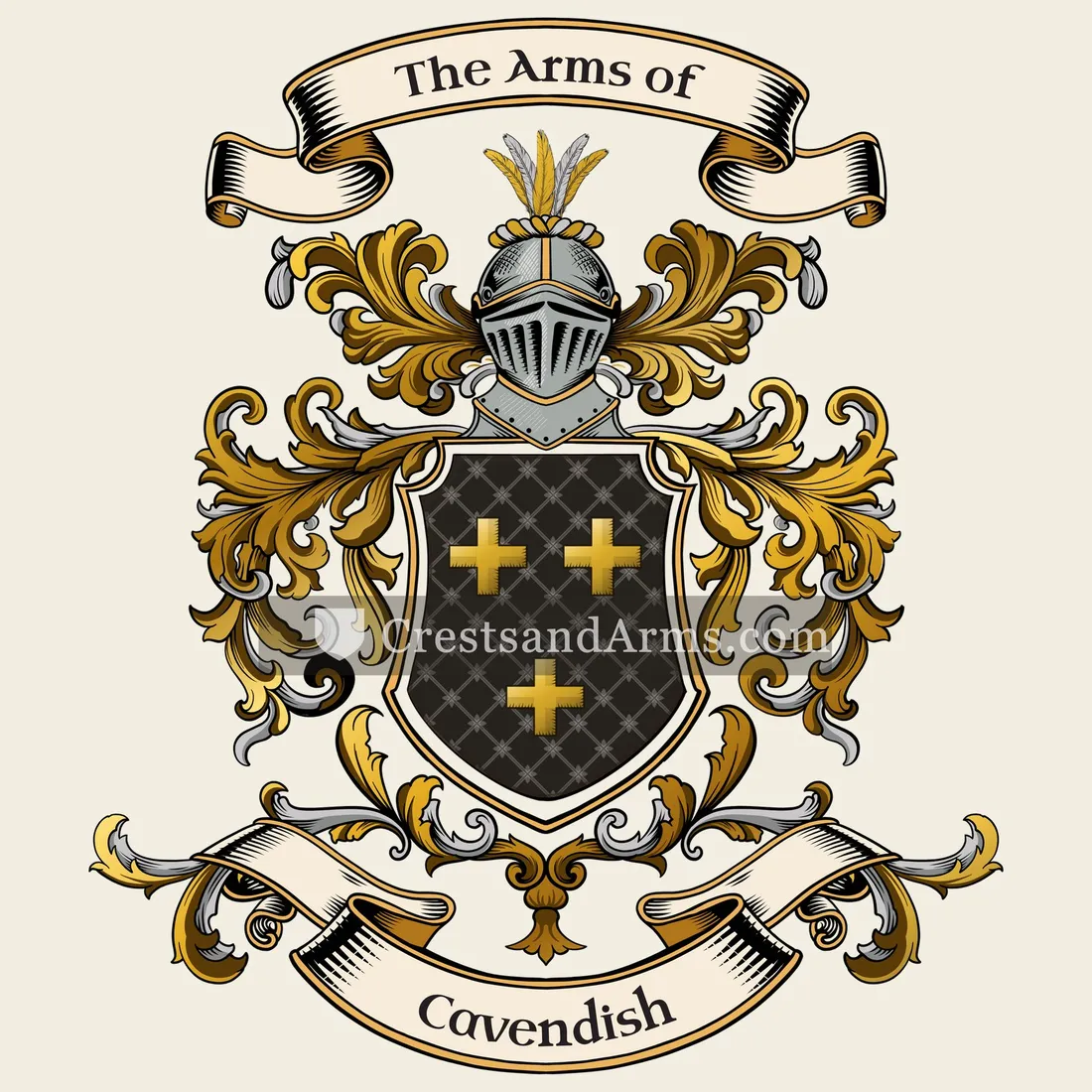
cross symbolChristian faith and service
Colours
Black (Sable)Means: Constancy
Gold (Or)Means: Generosity
Historical info
Source
Sir Bernard Burke, The General Armory of England, Scotland, Ireland and Wales, London: Harrison & Sons, 1884
Blazon (the actual original written record)
“Sa. three crosses botonée fitchée or, two and one”
NorfolkAndrew Cavendish · Norfolk, c. 1384
Digital archive packCoat of arms PNG, gold border print PDF, vector SVG and the certificate of authenticity. Sent to your email in minutes.
Map of England showing where the Cavendish arms are recorded
The Cavendish arms were recorded in Norfolk, c. 1384.
Norfolk grew rich on wool and grain, and its wealth was spread among many middling families rather than a few great ones. Households of that kind bought land and took arms, and the county holds a large share of English names.
This is where the arms were entered in the register. Families often moved to other parts of the country, so the same name can turn up in more than one region.
The body that granted and recorded arms in England in this period.
Richard II of England
Sovereign of the period
Richard II of England
1377–1399
Reigning in France when the Cavendish arms are first recorded.
How Arms Worked in England
English heraldry allowed arms to be shared by all legitimate descendants of the original owner. These symbols were treated as personal property that moved through the generations to all children. While the eldest son kept the original design, other family members could use the same shield without needing to change it or register their own unique versions.
Granting authority
The College of Arms in London has regulated the use of coats of arms throughout England and Wales since 1484.
How they got arms
Families typically obtained their coats of arms through a formal grant from the Crown or by proving their ancient right to them.
Where arms were recorded
All official coats of arms are recorded in the registers kept at the College of Arms, which date back to the fifteenth century.
The family's standing
Recorded among the armigerous families of Norfolk.
Origin & History of the Cavendish Family in England
The Cavendish family name originates from a small village in the county of Suffolk, but the family’s rise to prominence began with their migration and establishment in Norfolk by the late fourteenth century. The name itself is a locative surname, meaning it was derived from the place where the family first resided. Historical records confirm that members of the family were active in Norfolk by 1384, where they began to build influence through legal service and local administration. During this period, the family transitioned from being local landowners to becoming key figures in the English political landscape. This shift was largely driven by their strategic marriages and their ability to secure positions within the royal court. By moving away from their modest rural roots, the early Cavendish family successfully transformed their name from a simple geographic label into a symbol of significant social and political power in medieval England.
Cavendish Meaning & Related Branches
Root word
Cavendish
Derived from the Old English words for cave and pasture.
This name
CavendishA locational surname referring to a settlement situated near a cave or hollow.
also spelled
Cavendysh
Cavendisch
Cavendiss
Kavendish
Cavendische
Related arms
Garnonrecorded with Cavendish, same area
Documented Sources
J. B. Rietstap, Armorial Général, Gouda: G. B. van Goor Zonen, 1884–87
Archives départementales d’Ille-et-Vilaine, Série B: Cours et juridictions
Archives départementales du Finistère, Série E: Familles et seigneuries
Bourde de la Rogerie, Henri, Les Bretons aux îles de l'Amérique, 1929
Le Moyne de La Borderie, Arthur, Histoire de Bretagne, 1896
Digital archive packCoat of arms PNG, gold border print PDF, vector SVG and the certificate of authenticity. Sent to your email in minutes.


 chequyConstancy, and the counting-board
 fessThe military belt, and readiness to serve
 stagPeace and harmony, and one who will not fight unprovoked
 chequyConstancy, and the counting-board
 fessThe military belt, and readiness to serve
 stagPeace and harmony, and one who will not fight unprovoked


 cross symbolChristian faith and service