A record of documented arms, meaning and origin, researched for the Cazer family lines. Documented in 2 countries.
Reg. 0654 · Belgian, A–C
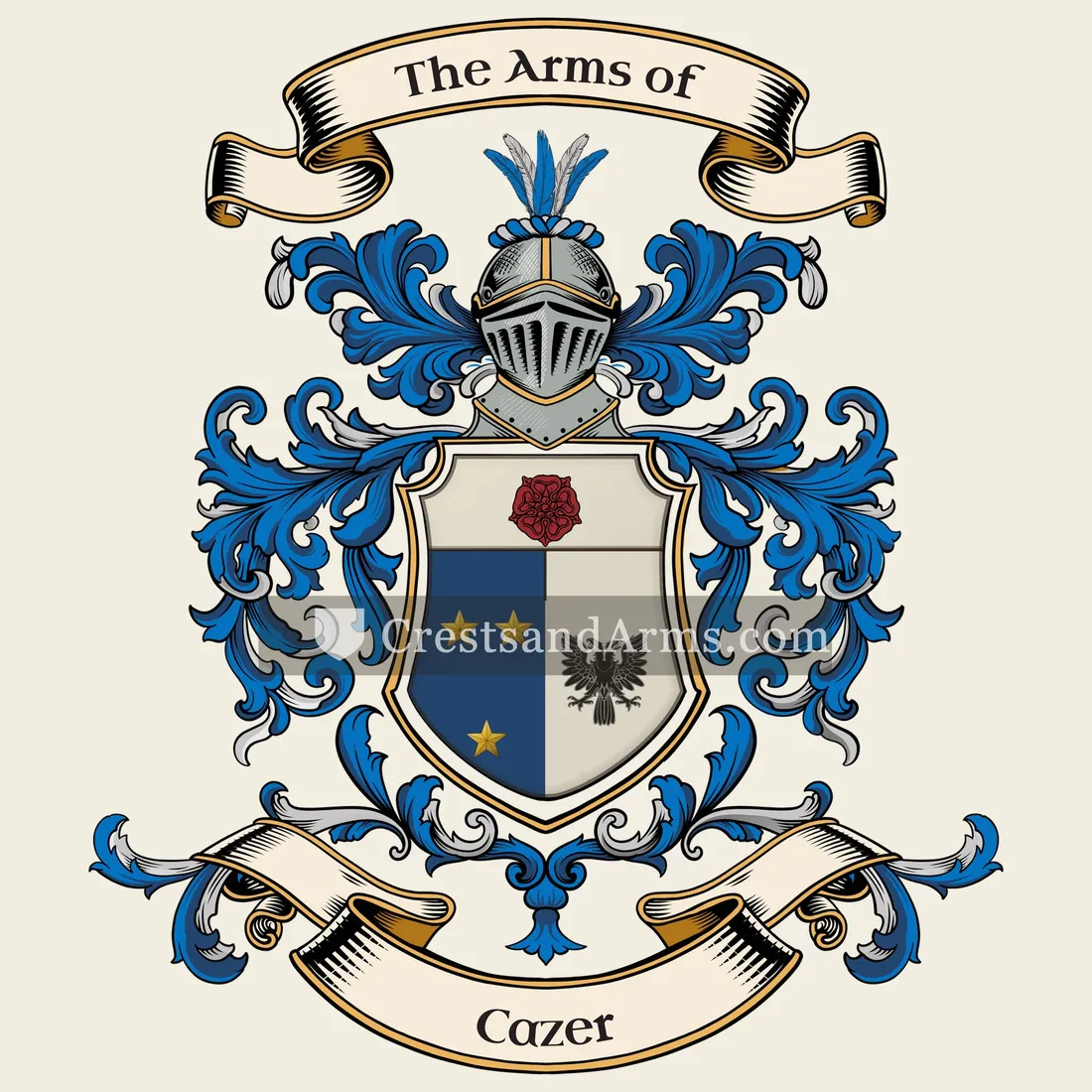
Meaning of the Cazer family crest colors & symbols
Symbols on this shield
chiefAuthority, wisdom and dominion
roseThe seventh son, and beauty with grace
mulletThe third son, and a divine quality from above
eagleNobility, strength and a keen mind
Colours
Blue (Azure)Means: Loyalty and truth
Silver (Argent)Means: Peace and sincerity
Red (Gules)Means: Military strength
Gold (Or)Means: Generosity
Black (Sable)Means: Constancy
Historical info
Source
J. B. Rietstap, Armorial Général, Gouda: G. B. van Goor Zonen, 1884–87
Blazon (the actual original written record)
“Parti: au 1 d'azur à trois étoiles (8) d'or; au chef d'arg., ch. d'une rose de gu.; au 2 d'arg. à une demi-aigle de sa., bq. et m. de gu., mouv du parti. C.: une aigle ép. de sa. S.: deux griffons d'or.”
BelgiumTournaisis, c. 1729
Digital archive packCoat of arms PNG, gold border print PDF, vector SVG and the certificate of authenticity. Sent to your email in minutes.
Map of Belgium showing where the Cazer arms are recorded
The Cazer arms were recorded in Tournaisis, c. 1729.
This is where the arms were entered in the register. Families often moved to other parts of the country, so the same name can turn up in more than one region.
The body that granted and recorded arms in Belgium in this period.
Charles VI, Holy Roman Emperor
Sovereign of the period
Charles VI, Holy Roman Emperor
1711–1740
Reigning in Belgium when the Cazer arms are first recorded.
How Arms Worked in Belgium
In Belgium, a coat of arms is considered personal property that is passed down through the male line to legitimate descendants. Families often use the same shield design across generations to show their shared heritage. If a branch of the family wants to change the design, they must apply for an official update to their specific version of the arms.
Granting authority
The Conseil héraldique is the official body that regulates and approves all coats of arms in Belgium.
How they got arms
Families obtain their coats of arms through formal royal grants or by confirming their historical right to use existing designs.
Where arms were recorded
All approved coats of arms are officially recorded in the public registers of the Conseil héraldique since 1844.
The family's standing
Recorded among the armigerous families of Belgium.
Origin & History of the Cazer Family in Belgium
The history of the Cazer family in Belgium is deeply rooted in the region of Tournaisis, where records confirm their presence as early as 1729. During the eighteenth century, this area was a vibrant crossroads of agricultural and industrial activity under the influence of the Austrian Netherlands. Families like the Cazers often lived in small rural communities where they contributed to the local economy through farming or skilled craftsmanship. The name itself likely evolved from regional dialects spoken in the borderlands between modern-day Belgium and France. As the family established their roots in the villages surrounding Tournai, they became part of the local social fabric, navigating the challenges of changing political regimes and shifting borders. By maintaining their presence in the Tournaisis region, the early members of the family helped shape the local heritage that defines this historic part of the country today.
Meaning of the Cazer family crest colors & symbols
Symbols on this shield
saltireResolution, and St Andrew's cross
Colours
Black (Sable)Means: Constancy
Gold (Or)Means: Generosity
Historical info
Source
J. B. Rietstap, Armorial Général, Gouda: G. B. van Goor Zonen, 1884–87
Blazon (the actual original written record)
“De sa. au saut. d'or.”
Francec. 1663
Digital archive packCoat of arms PNG, gold border print PDF, vector SVG and the certificate of authenticity. Sent to your email in minutes.
Map of France showing where the Cazer arms are recorded
The Cazer arms were recorded in France, c. 1663.
Arms such as these were typically recorded in Bretagne.
More families held coats of arms in Bretagne than anywhere else in France. The land was divided into many small estates rather than a few large ones, so far more households counted as gentry, and each needed a shield of its own to be told apart.
This is where the arms were entered in the register. Families often moved to other parts of the country, so the same name can turn up in more than one region.
The body that granted and recorded arms in France in this period.
Louis XIV of France
Sovereign of the period
Louis XIV of France
1643–1715
Reigning in Belgium when the Cazer arms are first recorded.
How Arms Worked in France
In France, a coat of arms was a mark of honor that passed down through the male line to all legitimate descendants. Families often used the same shield without changes to show their shared heritage. If a branch wanted to stand out, they could add a small mark to their shield to show their specific place in the family tree.
Granting authority
The Juge d'armes de France acted as the official authority that regulated and verified coats of arms across the country.
How they got arms
Families typically inherited their arms from ancestors, though they could also receive them through royal grants or by proving their noble status.
Where arms were recorded
Coats of arms were officially recorded in the Armorial Général de France, which began its main collection in the year 1696.
The family's standing
Recorded among the armigerous families of France.
Origin & History of the Cazer Family in France
The history of the Cazer family in France is deeply rooted in the rugged landscape of Bretagne, where records confirm their presence as early as 1663. During this period, the region was a distinct cultural hub characterized by its unique maritime traditions and strong local autonomy. Families like the Cazers often lived in small, tight-knit rural parishes where life revolved around the agricultural cycles and the local Catholic church. Because the name is closely tied to this specific geographic area, it likely evolved from a local nickname or a description of a family’s trade within the Breton community. As the 17th century progressed, the family would have navigated the complex social structures of the Ancien Régime, likely working as skilled laborers or farmers who contributed to the local economy of western France. Their survival and growth in this region reflect the resilience of families who maintained deep ties to their ancestral lands for generations.
Cazer Meaning & Related Branches
Root word
Casarius
Derived from the Latin word for a small cottage or hut.
This name
CazerAn occupational or habitational name referring to someone who lived in or managed a small farmstead.
also spelled
Cazyer
Kazye
Documented Sources
J. B. Rietstap, Armorial Général, Gouda: G. B. van Goor Zonen, 1884–87
Archives de l'État à Tournai, Registres paroissiaux de l'ancien régime, 1729
De Moreau, Edouard, Histoire de l'Église en Belgique, 1945
Roland, Charles-Gustave, Histoire de Tournai, 1900
Digital archive packCoat of arms PNG, gold border print PDF, vector SVG and the certificate of authenticity. Sent to your email in minutes.


 chiefAuthority, wisdom and dominion
 roseThe seventh son, and beauty with grace
 mulletThe third son, and a divine quality from above
 eagleNobility, strength and a keen mind
 chiefAuthority, wisdom and dominion
 roseThe seventh son, and beauty with grace
 mulletThe third son, and a divine quality from above
 eagleNobility, strength and a keen mind


 saltireResolution, and St Andrew's cross


