Map of England showing where the Cearns arms are recorded
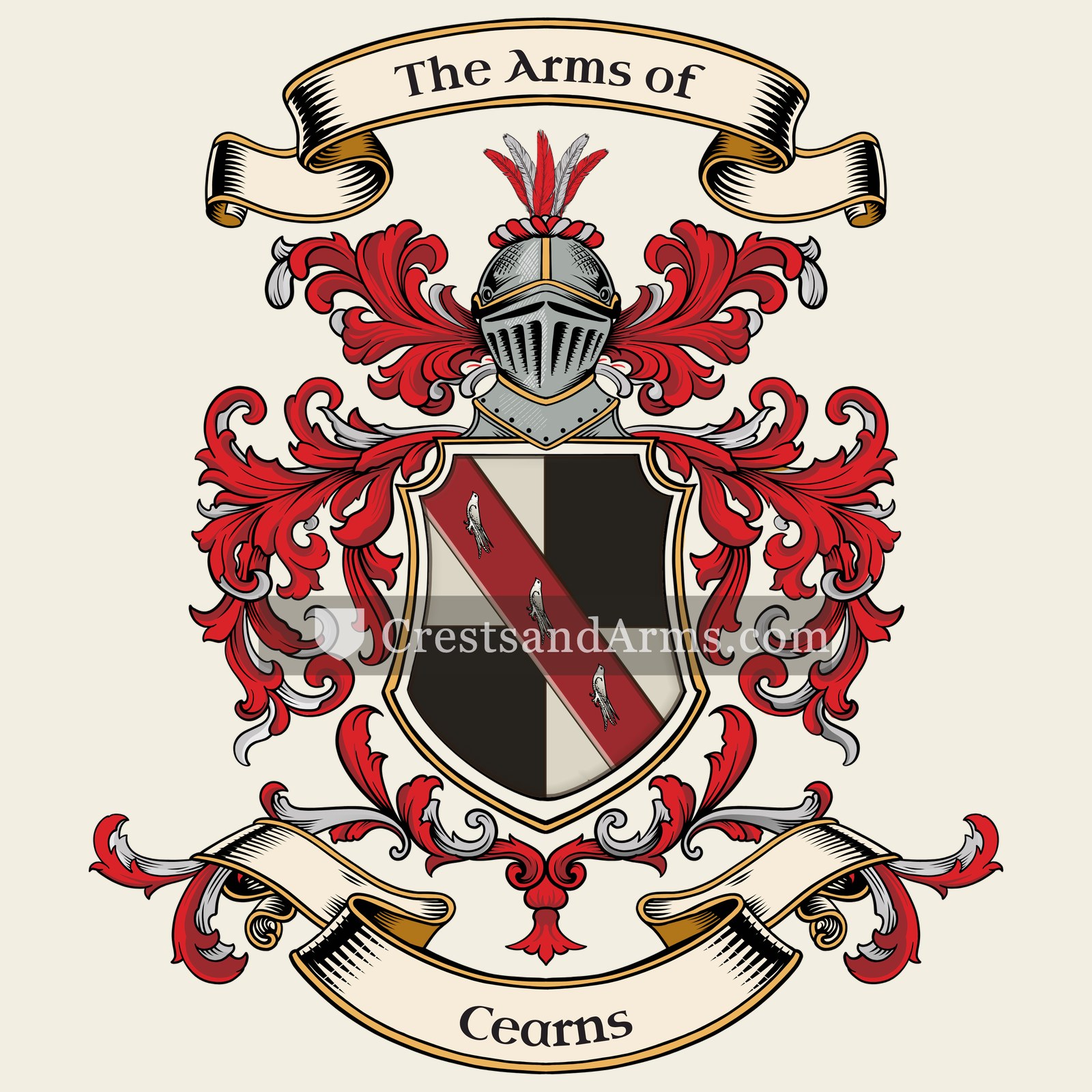
The Cearns arms were recorded in Westmoreland, c. 1620.
Westmorland was fell country in the north-west, farmed in small holdings by families who stayed put. Land changed hands rarely there, and families who held on for generations ended up with arms.
This is where the arms were entered in the register. Families often moved to other parts of the country, so the same name can turn up in more than one region.
The body that granted and recorded arms in England in this period.
James VI and I
Sovereign of the period
James VI and I
1603–1625
Reigning in England when the Cearns arms are first recorded.
How Arms Worked in England
English heraldry allowed arms to be shared by all legitimate descendants of the original owner. These symbols were treated as personal property that moved through the generations to all children. While the eldest son kept the original design, other family members could use the same shield without needing to change it or register their own unique versions.
Granting authority
The College of Arms in London has regulated the use of coats of arms throughout England and Wales since 1484.
How they got arms
Families typically obtained their coats of arms through a formal grant from the Crown or by proving their ancient right to them.
Where arms were recorded
All official coats of arms are recorded in the registers kept at the College of Arms, which date back to the fifteenth century.
The family's standing
Recorded among the armigerous families of Westmoreland.
Origin & History of the Cearns Family in England
The family name Cearns has deep roots in the rugged landscape of Westmoreland, England, where records confirm the family was established by at least 1620. During the early seventeenth century, this region was a rural area defined by farming and the influence of local landowners. Families like the Cearns often lived in small, tight-knit communities where they were closely tied to the seasonal cycles of the land. Because the name appears in local parish registers from this period, it is likely that the family were yeomen or tenant farmers who played an active role in the daily life of their village. Over time, the spelling of the name may have shifted slightly as it was recorded by local clerks, but the family remained a steady part of the social fabric of Northern England for generations.
Related Branches & Arms
Root word
Cairn
A mound of rough stones built as a memorial or landmark.
This name
CearnsA topographic name for someone who lived near a prominent stone landmark or burial mound.
also spelled
Carnusse
Documented Sources
Sir Bernard Burke, The General Armory of England, Scotland, Ireland and Wales, London: Harrison & Sons, 1884


 bendDefence, and the scarf of a commander
 martletA younger son, who must win his own land
 bendDefence, and the scarf of a commander
 martletA younger son, who must win his own land