Map of France showing where the Cenac arms are recorded
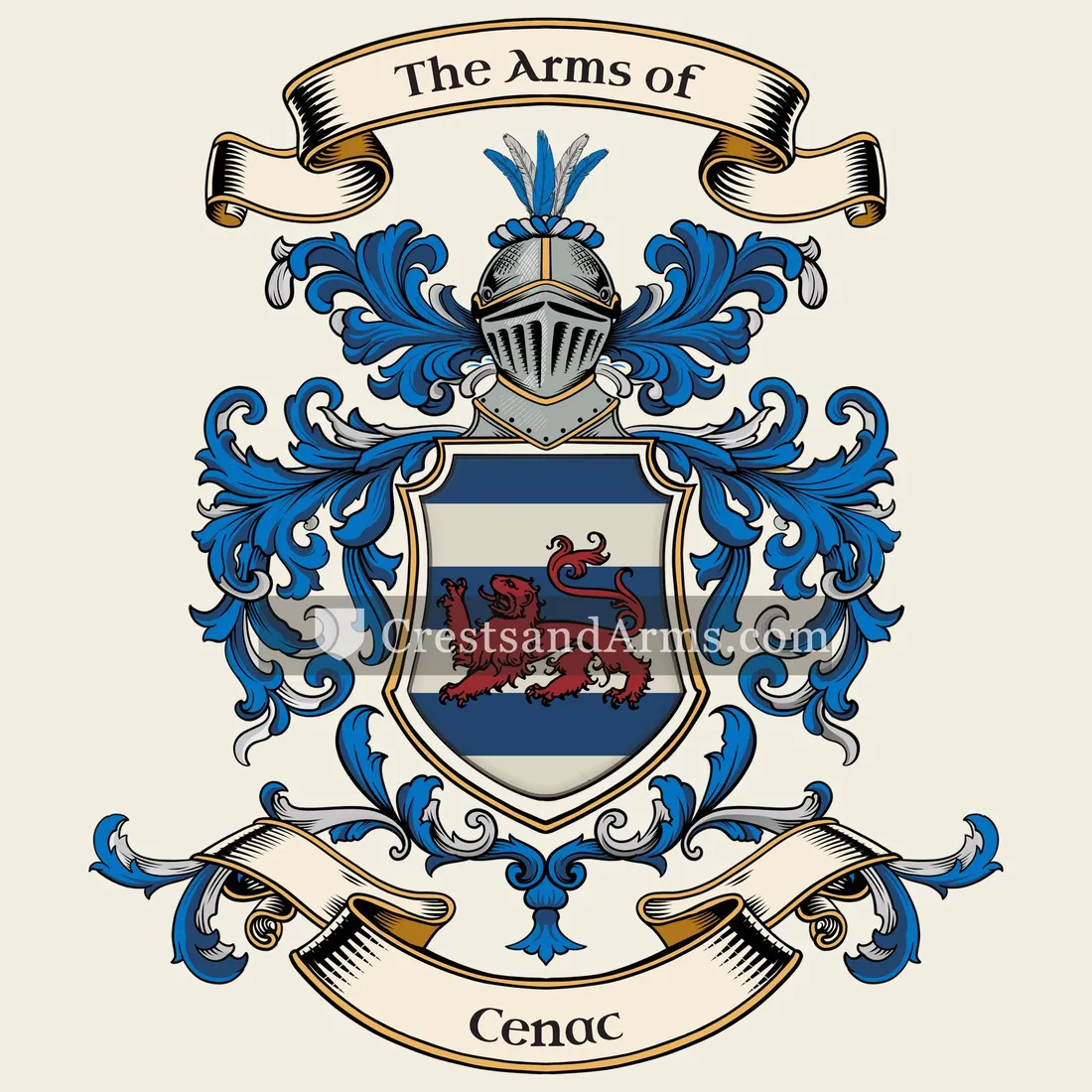
The Cenac arms were recorded in France, c. 1663.
Arms such as these were typically recorded in Bretagne.
More families held coats of arms in Bretagne than anywhere else in France. The land was divided into many small estates rather than a few large ones, so far more households counted as gentry, and each needed a shield of its own to be told apart.
This is where the arms were entered in the register. Families often moved to other parts of the country, so the same name can turn up in more than one region.
The body that granted and recorded arms in France in this period.
Louis XIV of France
Sovereign of the period
Louis XIV of France
1643–1715
Reigning in France when the Cenac arms are first recorded.
How Arms Worked in France
In France, a coat of arms was a mark of honor that passed down through the male line to all legitimate descendants. Families often used the same shield without changes to show their shared heritage. If a branch wanted to stand out, they could add a small mark to their shield to show their specific place in the family tree.
Granting authority
The Juge d'armes de France acted as the official authority that regulated and verified coats of arms across the country.
How they got arms
Families typically inherited their arms from ancestors, though they could also receive them through royal grants or by proving their noble status.
Where arms were recorded
Coats of arms were officially recorded in the Armorial Général de France, which began its main collection in the year 1696.
The family's standing
Recorded among the armigerous families of France.
Origin & History of the Cenac Family in France
The family name Cenac finds its roots in the historical region of Brittany, France, where records confirm the presence of family members as early as 1663. The name is likely topographic in origin, meaning it was used to identify people who lived near a specific landmark or a place known as Cenac. During the seventeenth century, Brittany was a distinct province with its own unique cultural identity and social structure. Families living in this region often worked in agriculture or maritime trades, which helped shape their local influence. As the family grew, members moved through the rural parishes of the area, leaving behind traces in local church registers and land documents. These early ancestors were part of a tight-knit society that relied on community ties to survive and prosper in the coastal environment of western France.
Cenac Meaning & Related Branches
Root word
Cenaculum
Latin term for a dining room or an upper chamber.
This name
CenacRefers to a person who lived in or near an upper room or a specific dining location.
also spelled
Chenat
Chenack
Chenach
Shenak
Documented Sources
J. B. Rietstap, Armorial Général, Gouda: G. B. van Goor Zonen, 1884–87
Archives départementales du Morbihan, Registres paroissiaux et d'état civil
Archives départementales du Finistère, Fonds de l'intendance de Bretagne
Dauzat, Albert, Dictionnaire étymologique des noms et prénoms de France, 1951
Morvan, Françoise, La douce Bretagne, 2008
Digital archive packCoat of arms PNG, gold border print PDF, vector SVG and the certificate of authenticity. Sent to your email in minutes.


 lionCourage, strength and royalty
 lionCourage, strength and royalty