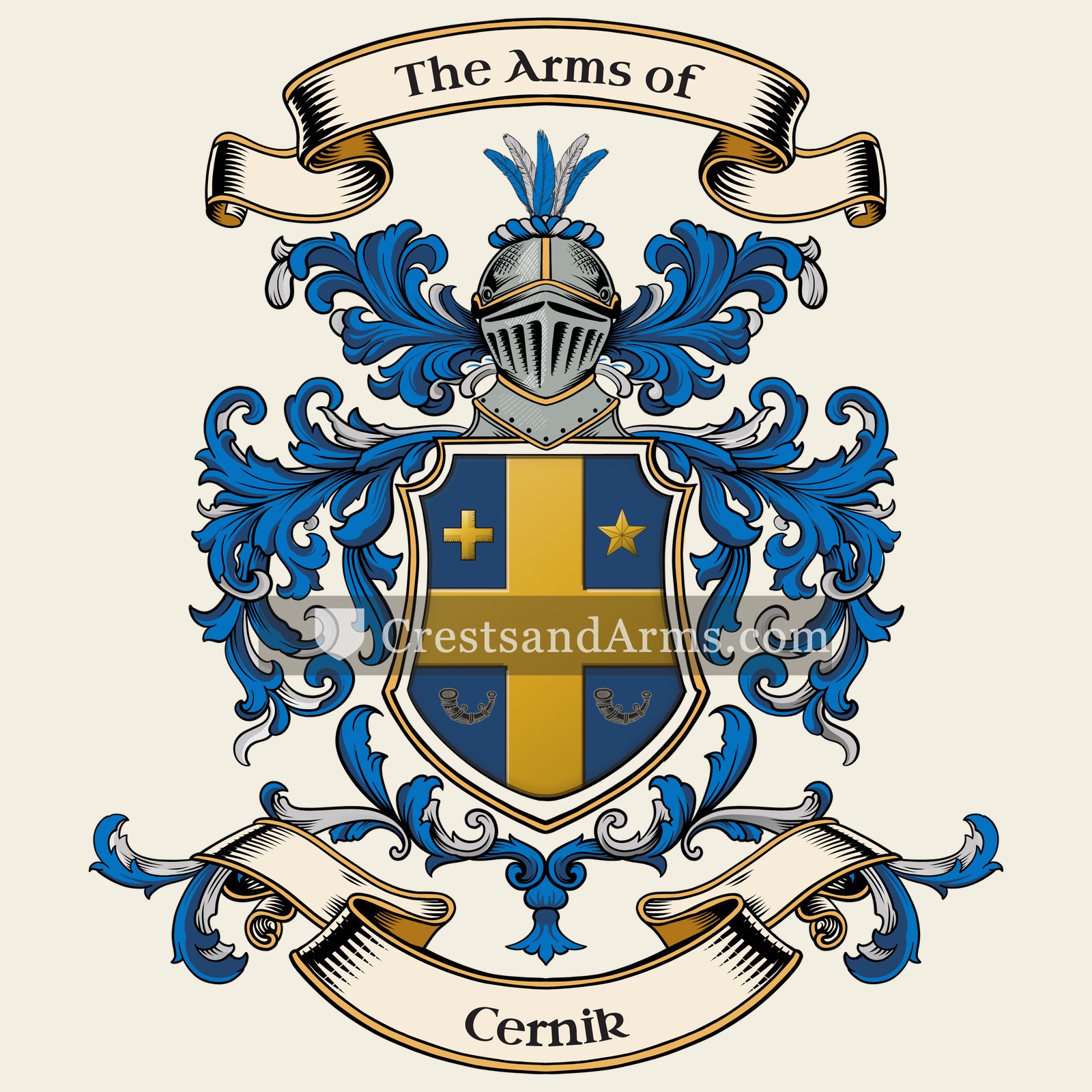
A record of documented arms, meaning and origin, researched for the Cernik family of Austria.
Reg. 9313 · Austrian, A–C
Coat of Arms & Family Crest Details
Symbols on this shield
cross symbolChristian faith and service
paleMilitary strength, and a fortified defence
mulletThe third son, and a divine quality from above
hunting horn stringedOne who delights in the chase
Colours
Blue (Azure)Means: Loyalty and truth
Gold (Or)Means: Generosity
Black (Sable)Means: Constancy
Historical info
Source
J. B. Rietstap, Armorial Général, Gouda: G. B. van Goor Zonen, 1884–87
Blazon (the actual original written record)
“D'azur à une croix pattée d'or, surm. d'une étoile du même, le tout accosté de deux huchets de sa., vir. et eng. d'or, posés en pals, affr., l'embouchure en haut. Cq. cour. C.: trois pl. d'aut. d'arg. L. d'or et d'azur.”
GaliciaGalicia, c. 1772
Digital archive packCoat of arms PNG, gold border print PDF, vector SVG and the certificate of authenticity. Sent to your email in minutes.
Map of Austria showing where the Cernik arms are recorded
The Cernik arms were recorded in Galicia, c. 1772.
Galicia was eastern country of large estates and small farming villages, held by families who had been there for a very long time. Land was what entitled a family to arms, and land there rarely changed hands.
This is where the arms were entered in the register. Families often moved to other parts of the country, so the same name can turn up in more than one region.
Region
Galicia
First recorded
1772
Granting Authority for the Cernik Arms
Imperial and Royal chancery
Sodacan · CC BY-SA 3.0
The body that granted and recorded arms in Austria in this period.
Joseph II, Holy Roman Emperor
Sovereign of the period
Joseph II, Holy Roman Emperor
1765–1790
Reigning in Austria when the Cernik arms are first recorded.
How Arms Worked in Austria
Austrian coats of arms were often linked directly to noble titles granted by the Emperor. These symbols belonged to the entire family line rather than just one individual. When a family grew, new branches kept the original design without needing to change it. This system allowed all members of a noble house to share the same identity across many generations.
Granting authority
The Imperial and Royal chancery managed all heraldic matters and controlled the official granting of arms throughout the Austrian lands.
How they got arms
Families typically received their arms through a formal imperial decree that often accompanied the elevation of a person to noble status.
Where arms were recorded
Official records of these grants were kept in the Imperial Register of Nobility which began its formal documentation process in 1453.
The family's standing
Recorded among the armigerous families of Galicia.
Origin & History of the Cernik Family in Austria
The surname Cernik is deeply rooted in the historical region of Galicia, which was a province of the Austrian Empire by 1772. The name is derived from the Slavic root "čern," meaning black, which was often used as a descriptive nickname for individuals with dark hair or a swarthy complexion. In the late 18th century, families bearing this name were typically part of the rural population living under the administration of the Habsburg monarchy. During this period, the Austrian government began formalizing census records and tax rolls to better track the diverse populations within their borders. This administrative shift helped solidify the Cernik name as a permanent family identifier across the villages of the Galician countryside. As these families lived through the changing political landscape of Central Europe, the name persisted as a marker of their specific regional heritage and ancestral ties to the land.
Related Branches & Arms
Root word
cerny
A Slavic adjective meaning black or dark in color.
This name
CernikA topographic or descriptive surname referring to someone with dark hair or a dark complexion.
also spelled
Czernik
Czernyk
Chernick
Documented Sources
J. B. Rietstap, Armorial Général, Gouda: G. B. van Goor Zonen, 1884–87
Himka, John-Paul. Galicia and the Bukovina: A Research Handbook about Western Ukraine, Late 19th and 20th Centuries. 1990
Magocsi, Paul R. Galicia: A Historical Survey and Bibliographic Guide. 1983
Wimmer, Jan. Historia piechoty polskiej do roku 1792. 1978
Central State Historical Archives of Ukraine in Lviv (Tsentralnyi derzhavnyi istorychnyi arkhiv Ukrainy u Lvovi), Fond 146 (Galician Viceroyalty)
Austrian State Archive (Österreichisches Staatsarchiv), Allgemeines Verwaltungsarchiv, Hofkanzlei records regarding the First Partition of Poland
Digital archive packCoat of arms PNG, gold border print PDF, vector SVG and the certificate of authenticity. Sent to your email in minutes.


 cross symbolChristian faith and service
 paleMilitary strength, and a fortified defence
 mulletThe third son, and a divine quality from above
 hunting horn stringedOne who delights in the chase
 cross symbolChristian faith and service
 paleMilitary strength, and a fortified defence
 mulletThe third son, and a divine quality from above
 hunting horn stringedOne who delights in the chase