Map of Italy showing where the Cerretani arms are recorded
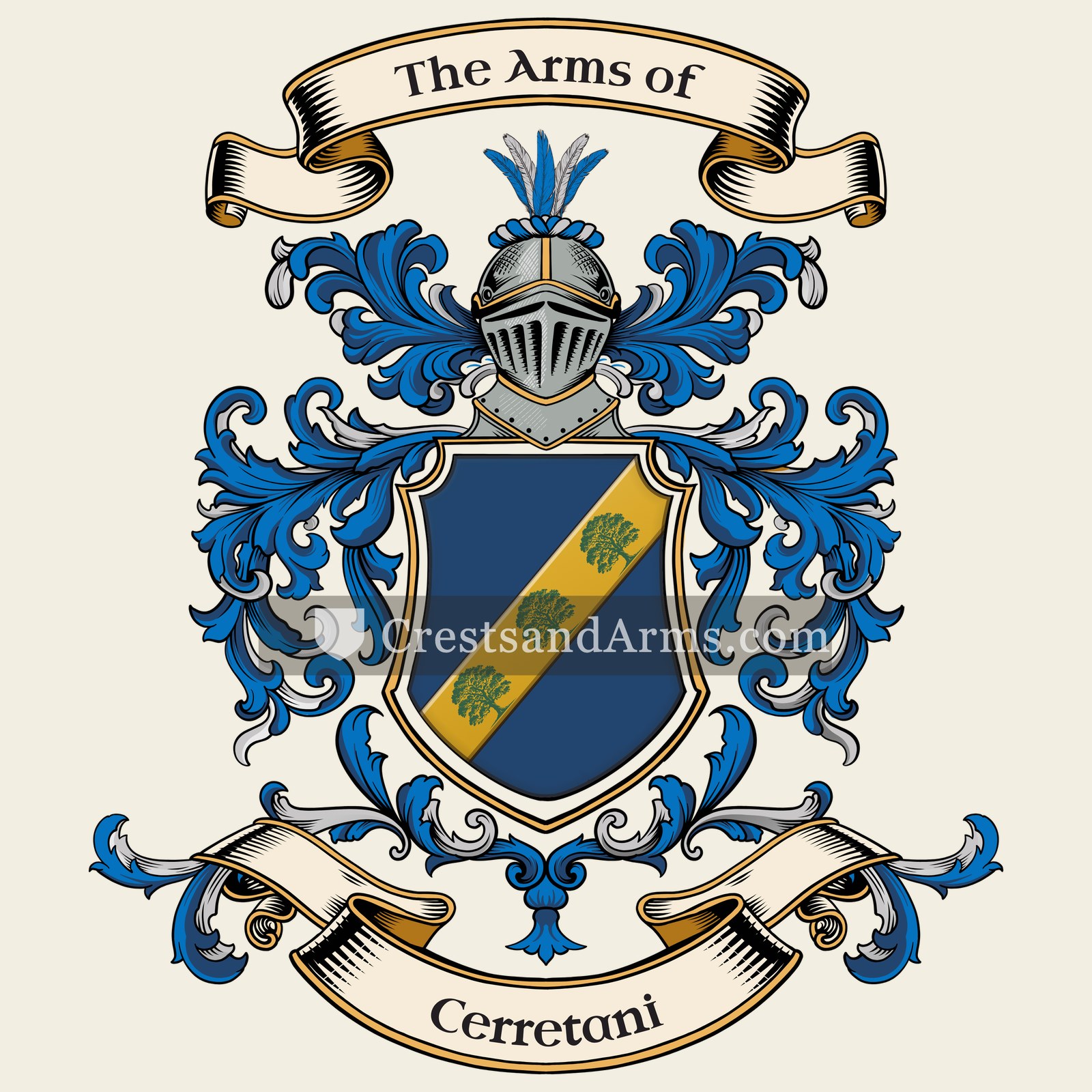
The Cerretani arms were recorded in Florence, c. 1775.
This is where the arms were entered in the register. Families often moved to other parts of the country, so the same name can turn up in more than one region.
The body that granted and recorded arms in Italy in this period.
Alvise Giovanni Mocenigo
Sovereign of the period
Alvise Giovanni Mocenigo
1763–1778
Reigning in Italy when the Cerretani arms are first recorded.
How Arms Worked in Italy
In the Italian states, coats of arms were often used by noble families to show their status and history. These symbols were passed down through the generations to all legitimate male descendants. Younger branches of a family usually kept the original design but sometimes added small changes to distinguish their specific line from the main branch.
Granting authority
Various local rulers and city governments controlled the use of coats of arms across the different Italian states.
How they got arms
Families often assumed their own arms or received them as official grants from local lords, popes, or city councils.
Where arms were recorded
Arms were recorded in local city archives or private family books rather than in one single national register.
The family's standing
Recorded among the armigerous families of Italy.
Origin & History of the Cerretani Family in Italy
The Cerretani family holds a deep connection to the historic city of Florence, where they established themselves as prominent residents by the late 18th century. The name itself is likely derived from the Italian word "cerro," which refers to a specific type of oak tree common in the Tuscan landscape. This suggests that the family’s earliest ancestors may have lived near a prominent grove or a landmark defined by these trees. By 1775, the family was well-integrated into the social and economic fabric of Florence, participating in the vibrant urban life that defined the city during the late Renaissance and Enlightenment periods. Members of the family were often involved in the professional and civic guilds that governed Florentine trade, helping to solidify their status as respected citizens within the community. Over time, the name became synonymous with the local identity of the region, reflecting the enduring ties between the family and the development of the city.
Cerretani Meaning & Related Branches
Root word
cerro
A type of oak tree native to southern Europe.
This name
CerretaniRefers to a person who lived near or worked with oak trees.
also spelled
Cerretan
Serretanee
Documented Sources
J. B. Rietstap, Armorial Général, Gouda: G. B. van Goor Zonen, 1884–87
Archivio di Stato di Firenze, Stato Civile della Restaurazione
Bargellini, Piero, Firenze nelle sue strade, 1977
Crollalanza, Giovan Battista di, Dizionario storico-blasonico delle famiglie nobili e notabili italiane, 1886
Digital archive packCoat of arms PNG, gold border print PDF, vector SVG and the certificate of authenticity. Sent to your email in minutes.


 bendDefence, and the scarf of a commander
 treeLife, endurance and deep roots
 bendDefence, and the scarf of a commander
 treeLife, endurance and deep roots