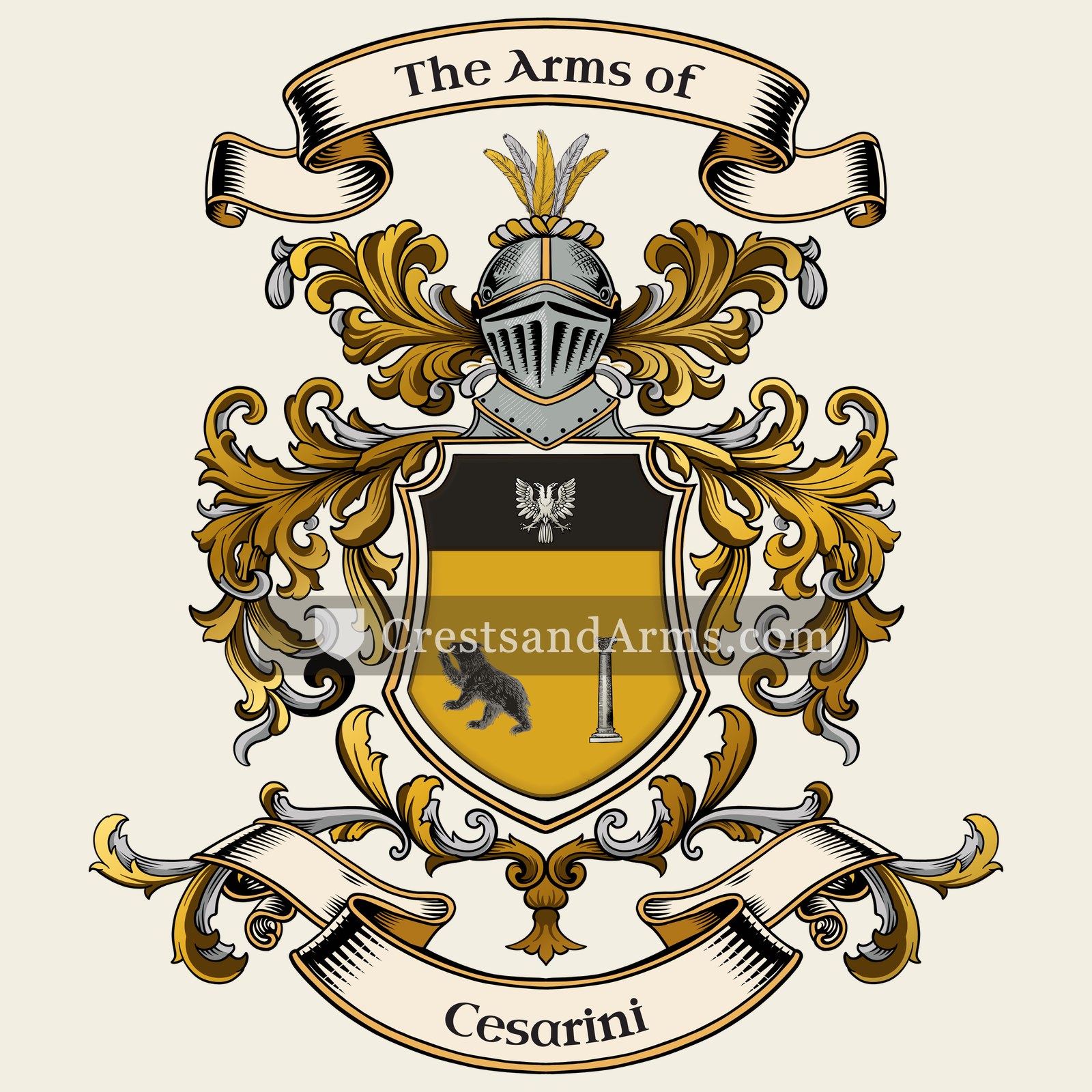
A record of documented arms, meaning and origin, researched for the Cesarini family of Italy.
Reg. 5365 · Italian, A–C
Coat of Arms & Family Crest Details
Symbols on this shield
chiefAuthority, wisdom and dominion
bearStrength, cunning and protection of kin
columnFortitude and constancy
eagleNobility, strength and a keen mind
Colours
Gold (Or)Means: Generosity
Black (Sable)Means: Constancy
Silver (Argent)Means: Peace and sincerity
Historical info
Source
J. B. Rietstap, Armorial Général, Gouda: G. B. van Goor Zonen, 1884–87
Blazon (the actual original written record)
“D'or à un ours courant de sa., derrière une colonne sur un socle carré d'arg. cour. d'or, le fût accolé d'un rameau de laurier de sin. qui fait trois tours; au chef du premier, ch. d'une aigle de sa., cour. d'or.”
ItalyRome, c. 1775
Digital archive packCoat of arms PNG, gold border print PDF, vector SVG and the certificate of authenticity. Sent to your email in minutes.
Map of Italy showing where the Cesarini arms are recorded
The Cesarini arms were recorded in Rome, c. 1775.
This is where the arms were entered in the register. Families often moved to other parts of the country, so the same name can turn up in more than one region.
The body that granted and recorded arms in Italy in this period.
Alvise Giovanni Mocenigo
Sovereign of the period
Alvise Giovanni Mocenigo
1763–1778
Reigning in Italy when the Cesarini arms are first recorded.
How Arms Worked in Italy
In the Italian states, coats of arms were often used by noble families to show their status and history. These symbols were passed down through the generations to all legitimate male descendants. Younger branches of a family usually kept the original design but sometimes added small changes to distinguish their specific line from the main branch.
Granting authority
Various local rulers and city governments controlled the use of coats of arms across the different Italian states.
How they got arms
Families often assumed their own arms or received them as official grants from local lords, popes, or city councils.
Where arms were recorded
Arms were recorded in local city archives or private family books rather than in one single national register.
The family's standing
Recorded among the armigerous families of Italy.
Origin & History of the Cesarini Family in Italy
The Cesarini family name is deeply rooted in the history of Rome, where members of the lineage were well-established as prominent citizens by the late eighteenth century. The name itself is derived from the Latin term *caesareus*, which relates to the Roman emperor Julius Caesar. During the 1700s, the family was deeply integrated into the social and administrative fabric of the city, often participating in the complex political life of the Papal States. They were known for their influence within Roman society, frequently holding positions that allowed them to shape the cultural and religious landscape of the capital. By 1775, the family had solidified its reputation as a respected Roman dynasty, maintaining strong connections to the city’s historic institutions and its evolving urban identity.
Cesarini Meaning & Related Branches
Root word
Caesar
Derived from the Latin term for a severed or cut child.
This name
CesariniRefers to a descendant or follower of the Caesar family lineage.
also spelled
Sesarini
Cesariny
Sezarinee
Documented Sources
J. B. Rietstap, Armorial Général, Gouda: G. B. van Goor Zonen, 1884–87
Gigli, Laura, Guide rionali di Roma: Rione X Campitelli, 1982
Pietrangeli, Carlo, Guide rionali di Roma: Rione II Trevi, 1980
Archivio di Stato di Roma, Stato Civile della Restaurazione
Archivio Storico Capitolino, Archivio della Famiglia Cesarini
Digital archive packCoat of arms PNG, gold border print PDF, vector SVG and the certificate of authenticity. Sent to your email in minutes.


 chiefAuthority, wisdom and dominion
 bearStrength, cunning and protection of kin
 columnFortitude and constancy
 eagleNobility, strength and a keen mind
 chiefAuthority, wisdom and dominion
 bearStrength, cunning and protection of kin
 columnFortitude and constancy
 eagleNobility, strength and a keen mind