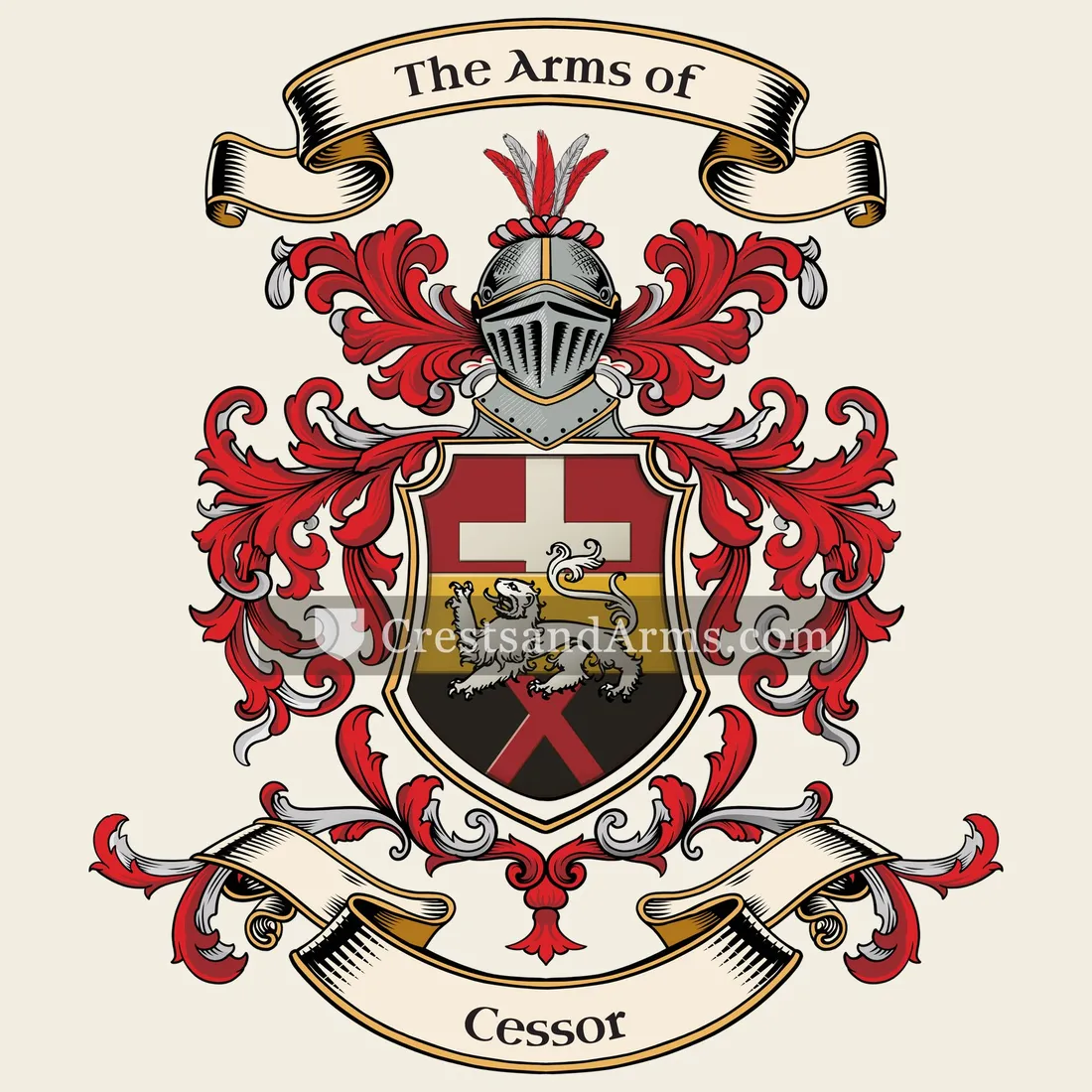
A record of documented arms, meaning and origin, researched for the Cessor family of Belgium.
Reg. 6563 · Belgian, A–C
Meaning of the Cessor family crest colors & symbols
Symbols on this shield
cross symbolChristian faith and service
saltireResolution, and St Andrew's cross
fessThe military belt, and readiness to serve
lionCourage, strength and royalty
Colours
Red (Gules)Means: Military strength
Black (Sable)Means: Constancy
Gold (Or)Means: Generosity
Silver (Argent)Means: Peace and sincerity
Historical info
Source
J. B. Rietstap, Armorial Général, Gouda: G. B. van Goor Zonen, 1884–87
Blazon (the actual original written record)
“Coupé: au 1 parti: a. de gu. à la croix d'arg.; b. d'arg. au saut. de gu.; au 2 de sa. au lion d'arg. A la fasce d'or. br. sur le coupé. C.: une fleur-de-lis d'arg.; entre un vol, d'arg. et de gu.”
BelgiumGand, c. 1737
Digital archive packCoat of arms PNG, gold border print PDF, vector SVG and the certificate of authenticity. Sent to your email in minutes.
Map of Belgium showing where the Cessor arms are recorded
The Cessor arms were recorded in Gand, c. 1737.
This is where the arms were entered in the register. Families often moved to other parts of the country, so the same name can turn up in more than one region.
The body that granted and recorded arms in Belgium in this period.
Charles VI, Holy Roman Emperor
Sovereign of the period
Charles VI, Holy Roman Emperor
1711–1740
Reigning in Belgium when the Cessor arms are first recorded.
How Arms Worked in Belgium
In Belgium, a coat of arms is considered personal property that is passed down through the male line to legitimate descendants. Families often use the same shield design across generations to show their shared heritage. If a branch of the family wants to change the design, they must apply for an official update to their specific version of the arms.
Granting authority
The Conseil héraldique is the official body that regulates and approves all coats of arms in Belgium.
How they got arms
Families obtain their coats of arms through formal royal grants or by confirming their historical right to use existing designs.
Where arms were recorded
All approved coats of arms are officially recorded in the public registers of the Conseil héraldique since 1844.
The family's standing
Recorded among the armigerous families of Belgium.
Origin & History of the Cessor Family in Belgium
The family name Cessor has deep roots tied to the historic city of Ghent, which was known as Gand in French during the eighteenth century. Records confirm that members of the family were established residents in this region by 1737. During this period, Ghent served as a major center for trade and textile manufacturing in the Austrian Netherlands. Families living in the city often worked in these thriving industries or participated in the local guild systems that defined social life. Because the name appears in regional documents from this era, it is likely that the ancestors of the Cessor line were part of the hardworking urban population that helped shape the city’s economy. Over time, the family name became a part of the local history of the Flanders region as members moved through the changing political landscapes of the eighteenth and nineteenth centuries.
Cessor Meaning & Related Branches
Root word
Censor
A Roman magistrate responsible for the census and public morality.
This name
CessorAn occupational name for an official who recorded population data and enforced moral standards.
also spelled
Kussoir
Cuswar
Documented Sources
J. B. Rietstap, Armorial Général, Gouda: G. B. van Goor Zonen, 1884–87
Stadsarchief Gent, Parochieregisters: Dopen, Huwelijken en Begrafenissen, 1737
Pirenne, Henri, Histoire de Belgique, 1902
Digital archive packCoat of arms PNG, gold border print PDF, vector SVG and the certificate of authenticity. Sent to your email in minutes.


 cross symbolChristian faith and service
 saltireResolution, and St Andrew's cross
 fessThe military belt, and readiness to serve
 lionCourage, strength and royalty
 cross symbolChristian faith and service
 saltireResolution, and St Andrew's cross
 fessThe military belt, and readiness to serve
 lionCourage, strength and royalty