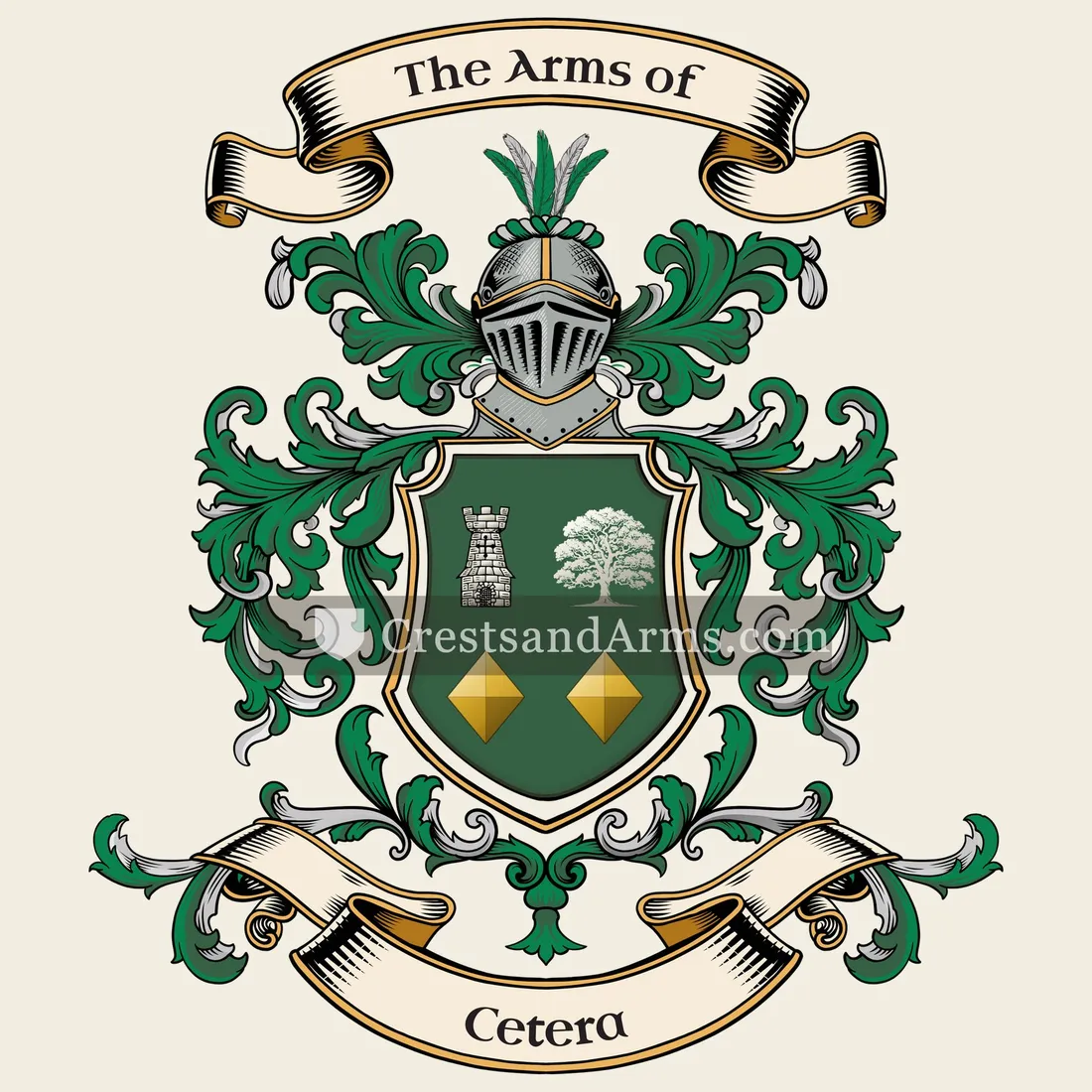
A record of documented arms, meaning and origin, researched for the Cetera family of Spain.
Reg. 3148 · Spanish, A–C
Meaning of the Cetera family crest colors & symbols
Symbols on this shield
towerGrandeur and solidity, and a stronghold defended
treeLife, endurance and deep roots
lozengeHonour and nobility, and the arms of a woman
Colours
Green (Vert)Means: Hope
Silver (Argent)Means: Peace and sincerity
Gold (Or)Means: Generosity
Historical info
Source
J. B. Rietstap, Armorial Général, Gouda: G. B. van Goor Zonen, 1884–87
Blazon (the actual original written record)
“Tiercé en pairle renv.: à dextre de sin. à une tour d'arg.; à sen. d'arg. à un arbre de sin.; en p. d'azur à deux los. accostées d'or, ch. chacune d'une fleur-de-lis d'azur.”
CastileCastile, c. 1722
Digital archive packCoat of arms PNG, gold border print PDF, vector SVG and the certificate of authenticity. Sent to your email in minutes.
Map of Spain showing where the Cetera arms are recorded
The Cetera arms were recorded in Castile, c. 1722.
Castile was the heart of Spain and the source of most of its noble families. Land won in the long wars against the Moors was granted out to fighting men, and a man granted land was granted arms along with it.
This is where the arms were entered in the register. Families often moved to other parts of the country, so the same name can turn up in more than one region.
The body that granted and recorded arms in Spain in this period.
Philip V of Spain
Sovereign of the period
Philip V of Spain
1714–1724
Reigning in Spain when the Cetera arms are first recorded.
How Arms Worked in Spain
In Spain, a coat of arms was considered a form of property that belonged to the entire family line. These arms were passed down from a father to all his children equally. Younger branches of the family usually kept the original design without needing to add any special marks to distinguish their specific line.
Granting authority
The Cronista Rey de Armas was the official body that regulated and granted coats of arms throughout Spain.
How they got arms
Families often obtained their arms through royal grants or by proving their noble status to the official heraldic authority.
Where arms were recorded
Coats of arms were officially recorded in the registers of the Cronista Rey de Armas starting in 1496.
The family's standing
Recorded among the armigerous families of Castile.
Origin & History of the Cetera Family in Spain
The family name Cetera has deep roots in the historical region of Castile, Spain, where members of the lineage were documented as early as 1722. During the eighteenth century, Castile was a central hub of Spanish culture and administration, and families living there were often tied to the local agricultural or merchant classes that supported the growing towns of the interior. The name likely evolved from regional linguistic patterns common to the Iberian Peninsula, reflecting the way families were identified in local parish registers and tax documents of the time. As these early ancestors navigated the social landscape of the Spanish heartland, they contributed to the local community through their trades and civic participation. By maintaining a presence in Castile, the family became part of the long history of a region that served as the foundation for the modern Spanish state.
Cetera Meaning & Related Branches
Root word
Caetera
Latin term meaning the rest or the others.
This name
CeteraA topographic or descriptive surname likely referring to someone residing in the remaining or additional lands.
also spelled
Kotera
Coterae
Documented Sources
J. B. Rietstap, Armorial Général, Gouda: G. B. van Goor Zonen, 1884–87
Archivo Histórico Nacional, Sección Nobleza, Protocolos Notariales de Castilla (1722)
Archivo de la Real Chancillería de Valladolid, Registro de Ejecutorias (1722)
Digital archive packCoat of arms PNG, gold border print PDF, vector SVG and the certificate of authenticity. Sent to your email in minutes.


 towerGrandeur and solidity, and a stronghold defended
 treeLife, endurance and deep roots
 lozengeHonour and nobility, and the arms of a woman
 towerGrandeur and solidity, and a stronghold defended
 treeLife, endurance and deep roots
 lozengeHonour and nobility, and the arms of a woman