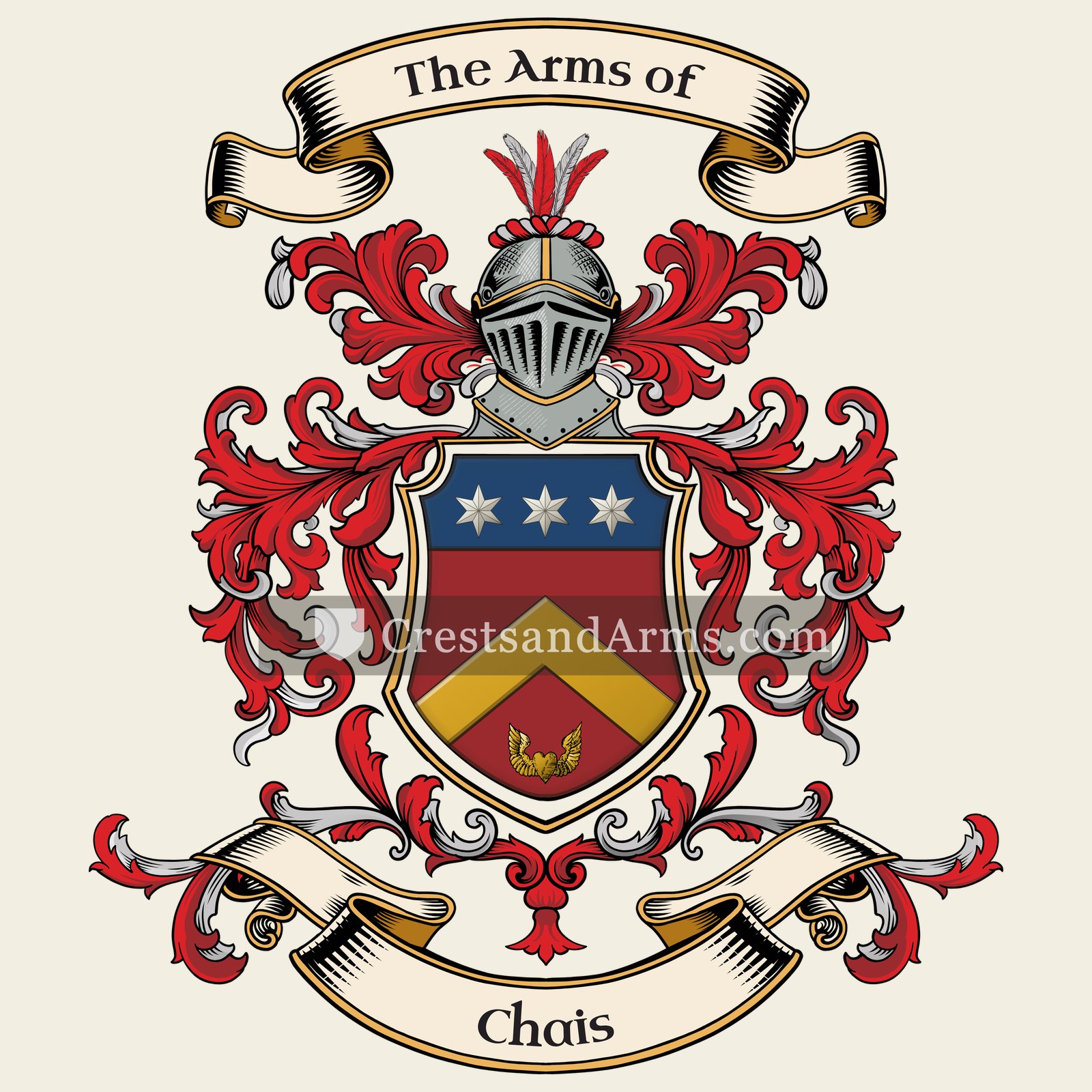
A record of documented arms, meaning and origin, researched for the Chais family of Netherlands.
Reg. 5574 · Dutch, A–C
Coat of Arms & Family Crest Details
Symbols on this shield
chevronProtection, and faithful service completed
chiefAuthority, wisdom and dominion
heartSincerity, charity and true affection
starThe celestial goddess, and nobility
Colours
Red (Gules)Means: Military strength
Gold (Or)Means: Generosity
Blue (Azure)Means: Loyalty and truth
Silver (Argent)Means: Peace and sincerity
Historical info
Source
J. B. Rietstap, Armorial Général, Gouda: G. B. van Goor Zonen, 1884–87
Blazon (the actual original written record)
“De gu. au chev. d'or, acc. en p. d'un coeur du même; au chef d'azur, ch. de trois étoiles (5) d'arg. C.: une étoile (5) d'arg., entre un vol du même.”
NetherlandsAmsterdam, c. 1815
Digital archive packCoat of arms PNG, gold border print PDF, vector SVG and the certificate of authenticity. Sent to your email in minutes.
Map of Netherlands showing where the Chais arms are recorded
The Chais arms were recorded in Amsterdam, c. 1815.
This is where the arms were entered in the register. Families often moved to other parts of the country, so the same name can turn up in more than one region.
Region
Amsterdam
Town
Amsterdam
First recorded
1815
Granting Authority for the Chais Arms
Hoge Raad van Adel
Photograph made by me · CC BY-SA 3.0
The body that granted and recorded arms in Netherlands in this period.
William I of the Netherlands
Sovereign of the period
William I of the Netherlands
1815–1840
Reigning in Netherlands when the Chais arms are first recorded.
How Arms Worked in Netherlands
In the Netherlands, coats of arms were often used by noble families and those who held specific public offices. These arms were passed down through the generations to legitimate descendants. Younger branches of a family usually kept the original design without needing to add special marks. This system ensured that the family identity remained clear and consistent over many years.
Granting authority
The Hoge Raad van Adel is the official body that regulates and manages noble titles and coats of arms in the Netherlands.
How they got arms
Families typically obtained their coats of arms through official royal grants or by proving their long-standing historical use of the symbols.
Where arms were recorded
Coats of arms are officially recorded in the registers held by the Hoge Raad van Adel, which began its work in 1814.
The family's standing
Recorded among the armigerous families of Netherlands.
Origin & History of the Chais Family in Netherlands
The family name Chais carries a history deeply connected to the movement of people across Europe during the eighteenth and nineteenth centuries. While the name appears in records from Amsterdam as early as 1815, its linguistic roots suggest a connection to the French language, where the term was often used to describe a carriage or a specific type of chair. Many families bearing this name were part of the Huguenot diaspora, a group of French Protestants who fled their homeland to escape religious persecution. These individuals often settled in major trading hubs like Amsterdam, where they integrated into the local merchant classes and contributed to the city’s vibrant economic life. By the time the family was firmly established in the Netherlands in the early 1800s, they had become part of the diverse social fabric of a city known for welcoming those seeking new opportunities.
Chais Meaning & Related Branches
Root word
Gaius
A Latin praenomen of uncertain etymology, possibly meaning to rejoice.
This name
ChaisA patronymic or variant form derived from the personal name Gaius.
also spelled
Chay
Chays
Chaise
Shay
Chase
Related arms
Chaixvariant spelling
Chaix de Lavarènevariant spelling
Documented Sources
J. B. Rietstap, Armorial Général, Gouda: G. B. van Goor Zonen, 1884–87
Gwynn, Robin D., The Huguenots of London and their French Background, 1998
Van Eeghen, Isabella Henriëtte, De Amsterdamse boekhandel 1680-1725, 1960


 chevronProtection, and faithful service completed
 chiefAuthority, wisdom and dominion
 heartSincerity, charity and true affection
 starThe celestial goddess, and nobility
 chevronProtection, and faithful service completed
 chiefAuthority, wisdom and dominion
 heartSincerity, charity and true affection
 starThe celestial goddess, and nobility