Map of Britain showing where the Chalmers arms are recorded
The Chalmers arms were recorded in Britain, c. 1700.
Arms such as these were typically recorded in Kent.
Kent sits between London and the short crossing to Europe, and the trade passing through made it wealthy. Merchant families bought land with that money, and it was landowners who took coats of arms.
This is where the arms were entered in the register. Families often moved to other parts of the country, so the same name can turn up in more than one region.
The body that granted and recorded arms in Britain in this period.
William III of England
Sovereign of the period
William III of England
1694–1702
Reigning in Britain when the Chalmers arms are first recorded.
How Arms Worked in Britain
English heraldry allowed arms to be shared by all legitimate descendants of the original owner. These symbols were treated as personal property that moved through the generations to all children. While the eldest son kept the original design, other family members could use the same shield without needing to change it or register their own unique versions.
Granting authority
The College of Arms in London has regulated the use of coats of arms throughout England and Wales since 1484.
How they got arms
Families typically obtained their coats of arms through a formal grant from the Crown or by proving their ancient right to them.
Where arms were recorded
All official coats of arms are recorded in the registers kept at the College of Arms, which date back to the fifteenth century.
The family's standing
Recorded among the armigerous families of Britain.
Origin & History of the Chalmers Family in Britain
The surname Chalmers has deep roots in the British Isles, primarily emerging as a locational name derived from the Old French term for a chamberlain. While the name is famously associated with Scottish history, it also established a firm presence in England by the turn of the eighteenth century. By 1700, members of the family were well-documented in the county of Kent, where they integrated into the local social and economic fabric of the region. During this era, families often moved to follow trade routes or agricultural opportunities, and the presence of the Chalmers name in Kent suggests a transition from their northern origins toward the bustling centers of southern England. This movement reflects the broader patterns of internal migration that helped shape the demographics of Britain during the early modern period.
Coat of Arms & Family Crest Details
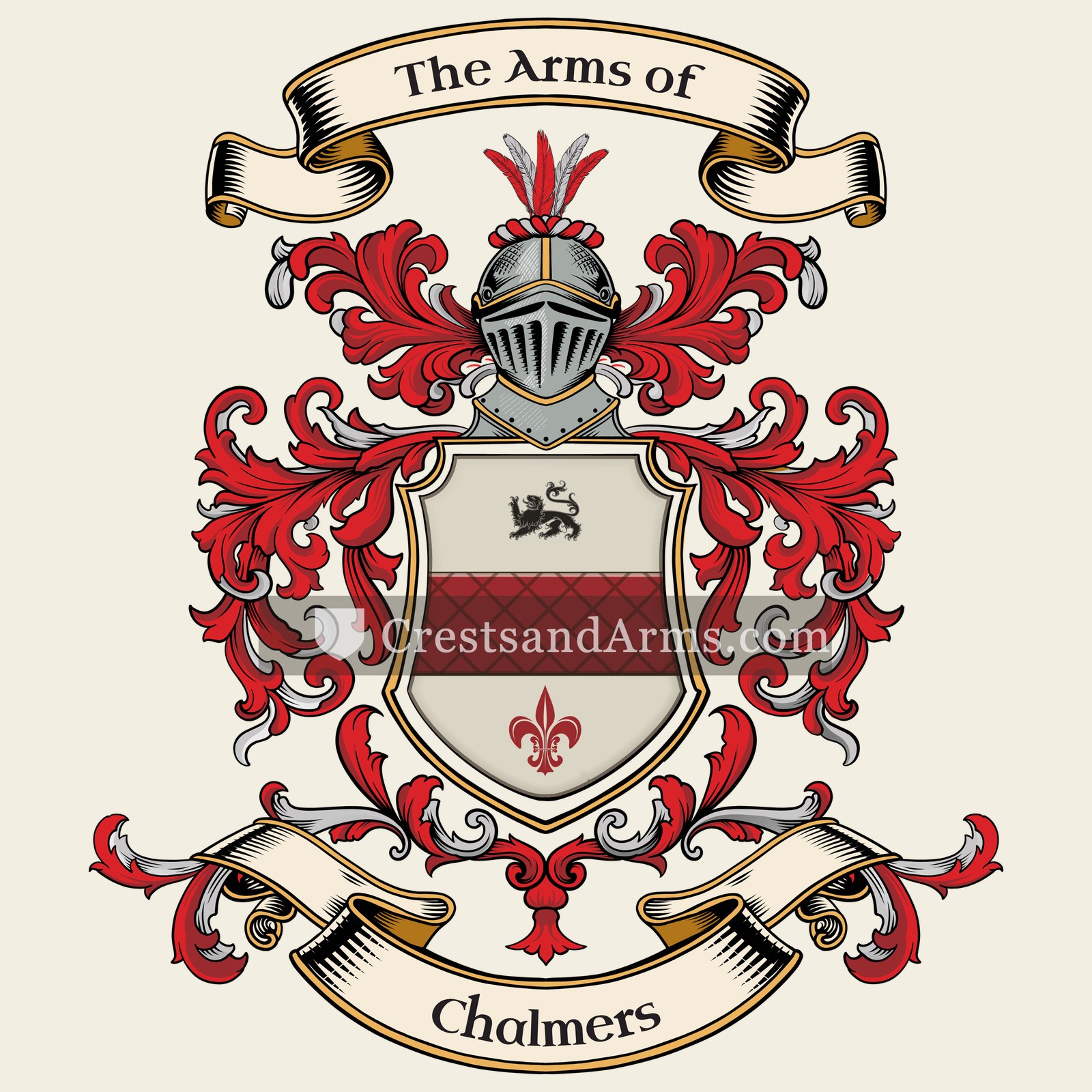
Symbols on this shield
fessThe military belt, and readiness to serve
lionCourage, strength and royalty
fleur de lisPurity, light, and the sixth son
Colours
Silver (Argent)Means: Peace and sincerity
Red (Gules)Means: Military strength
Black (Sable)Means: Constancy
Historical info
Source
J. B. Rietstap, Armorial Général, Gouda: G. B. van Goor Zonen, 1884–87
Blazon (the actual original written record)
“de gu., acc. en chef d'un lion naiss. de sa., arm. et lamp. du sec., mouv. de la fasce, et en p. d'une fleur-de-lis de gu.* (Silver with a red fess, accompanied in chief by a black lion issuant from the fess, armed and langued in silver, and in base by a red fleur-de-lis).”
Netherlandsc. 1815
Digital archive packCoat of arms PNG, gold border print PDF, vector SVG and the certificate of authenticity. Sent to your email in minutes.
Map of Netherlands showing where the Chalmers arms are recorded
The Chalmers arms were recorded in Netherlands, c. 1815.
Arms such as these were typically recorded in Friesland.
Friesland was low, wet country on the northern coast of the Netherlands, farmed by families who had held the same land for centuries. Free landholders were unusually common there, and a free landholder could carry arms.
This is where the arms were entered in the register. Families often moved to other parts of the country, so the same name can turn up in more than one region.
Region
Friesland
First recorded
1815
Granting Authority for the Chalmers Arms
Hoge Raad van Adel
Photograph made by me · CC BY-SA 3.0
The body that granted and recorded arms in Netherlands in this period.
William I of the Netherlands
Sovereign of the period
William I of the Netherlands
1815–1840
Reigning in Britain when the Chalmers arms are first recorded.
How Arms Worked in Netherlands
In the Netherlands, coats of arms were often used by noble families and those who held specific public offices. These arms were passed down through the generations to legitimate descendants. Younger branches of a family usually kept the original design without needing to add special marks. This system ensured that the family identity remained clear and consistent over many years.
Granting authority
The Hoge Raad van Adel is the official body that regulates and manages noble titles and coats of arms in the Netherlands.
How they got arms
Families typically obtained their coats of arms through official royal grants or by proving their long-standing historical use of the symbols.
Where arms were recorded
Coats of arms are officially recorded in the registers held by the Hoge Raad van Adel, which began its work in 1814.
The family's standing
Recorded among the armigerous families of Netherlands.
Origin & History of the Chalmers Family in Netherlands
The surname Chalmers is traditionally linked to Scottish origins, but its presence in the Netherlands reveals a fascinating chapter of migration and adaptation. By the year 1815, records confirm that members of the Chalmers family were established in the province of Friesland. During this period, the Netherlands was undergoing significant administrative changes following the Napoleonic Wars. Families moving into the region often had to register their names formally with local civil authorities for the first time. As these individuals integrated into Frisian society, the spelling of their name sometimes shifted to align with local linguistic patterns while maintaining its distinct phonetic roots. This migration likely occurred due to trade connections or military movements across the North Sea, marking the family as part of a small but notable group of international settlers who helped shape the diverse cultural landscape of the northern Dutch provinces.
Coat of Arms & Family Crest Details
Symbols on this shield
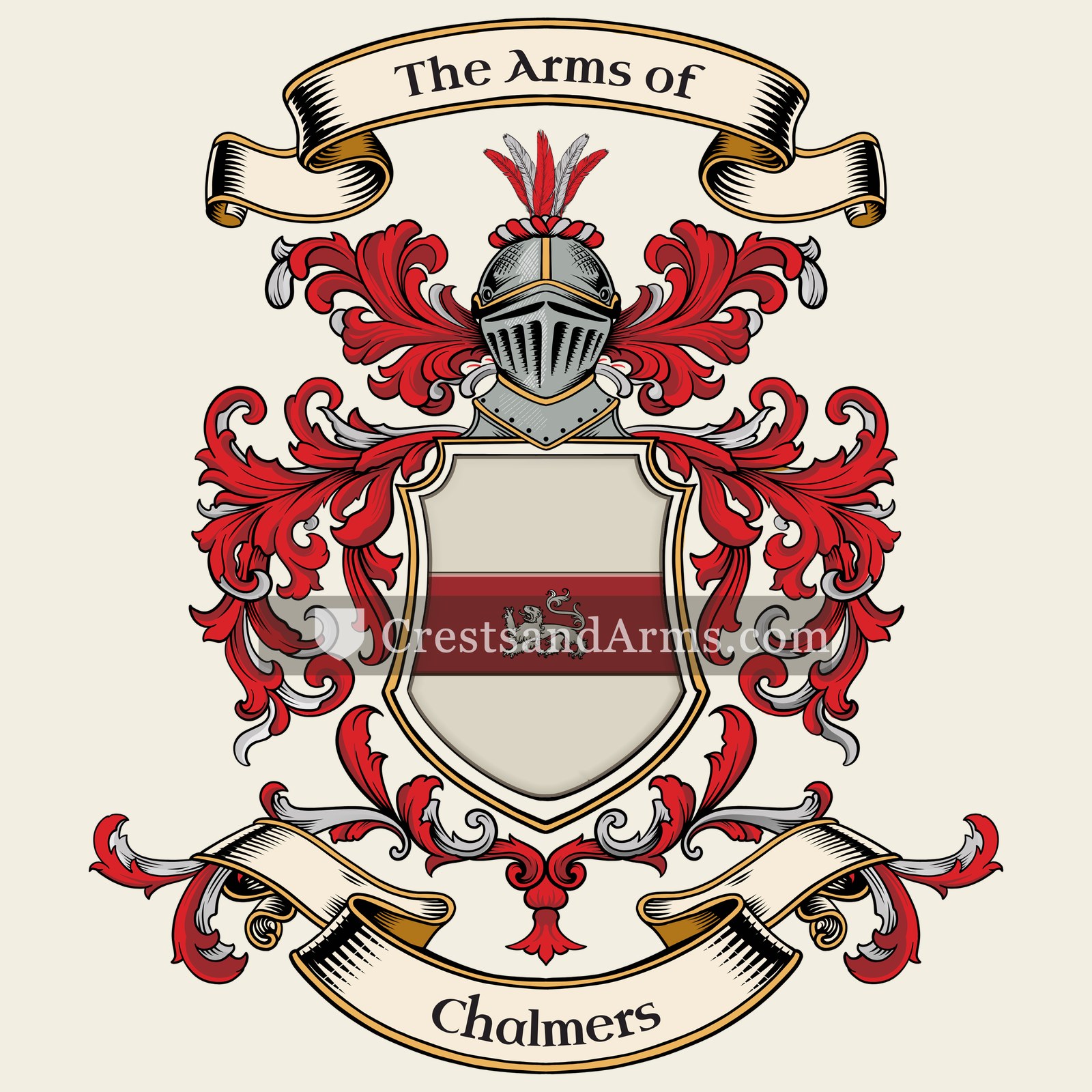
fessThe military belt, and readiness to serve
lionCourage, strength and royalty
Colours
Silver (Argent)Means: Peace and sincerity
Red (Gules)Means: Military strength
Historical info
Source
Sir Bernard Burke, The General Armory of England, Scotland, Ireland and Wales, London: Harrison & Sons, 1884
Blazon (the actual original written record)
“Ar. a demi lion ramp. issuing out of a fesse gu. with a fleur-de-lis in base of the last”
ForfarAldbar Castle · Forfar, c. 1748
Digital archive packCoat of arms PNG, gold border print PDF, vector SVG and the certificate of authenticity. Sent to your email in minutes.
Map of Scotland showing where the Chalmers arms are recorded
The Chalmers arms were recorded in Forfar, c. 1748.
Forfar, now called Angus, was farming country on Scotland's east coast between the hills and the sea. Its landed families were long-settled, and long settlement is exactly what fills a register of arms.
This is where the arms were entered in the register. Families often moved to other parts of the country, so the same name can turn up in more than one region.
The body that granted and recorded arms in Scotland in this period.
George II of Great Britain
Sovereign of the period
George II of Great Britain
1727–1760
Reigning in Britain when the Chalmers arms are first recorded.
How Arms Worked in Scotland
Scottish heraldry is unique because it treats a coat of arms as a piece of personal property protected by law. Only one person can own a specific design at any given time. When a family grows, the head keeps the original shield while other relatives must apply for their own distinct version with slight changes to prove their specific identity.
Granting authority
The Court of the Lord Lyon acts as the official body that regulates and controls all heraldic matters throughout Scotland.
How they got arms
Individuals obtain a legal right to their arms through a formal petition process that confirms their identity and family connection.
Where arms were recorded
All valid coats of arms are officially entered into the Public Register of All Arms and Bearings starting from 1672.
The family's standing
Recorded among the armigerous families of Forfar.
Origin & History of the Chalmers Family in Scotland
The surname Chalmers is a locative name that originated from the medieval Scottish term for a chamberlain, which was a high-ranking official responsible for managing a royal or noble household. Over time, the name evolved from the title of "de Camera" into the more familiar Scots form of Chalmers. By the mid-eighteenth century, the family had established a notable presence in the town of Forfar. Historical records from 1748 confirm that members of the family were active in this region, where they participated in the local social and economic life of the Scottish Lowlands. As the family grew, they became deeply integrated into the community, often serving in professional roles that helped shape the development of the burgh. Their history reflects the broader movement of Scottish families who transitioned from holding specific administrative titles to establishing permanent roots in localized areas.
Chalmers Meaning & Related Branches
Root word
Camera
A Latin term referring to a vaulted chamber or room.
This name
ChalmersAn occupational surname for a chamberlain or an official in charge of a lord's private chambers.
also spelled
Chalmer
Chalmerss
Chalmeres
Chamers
Shamers
Related arms
Chambersvariant spelling
Cochranerecorded with Chalmers, same area
Stirlingrecorded with Chalmers, same area
Documented Sources
J. B. Rietstap, Armorial Général, Gouda: G. B. van Goor Zonen, 1884–87
Black, George Fraser. The Surnames of Scotland: Their Origin, Meaning, and History. 1946
Reaney, Percy Hide. A Dictionary of British Surnames. 1958
The National Archives. Parish registers for the county of Kent. 1700
Digital archive packCoat of arms PNG, gold border print PDF, vector SVG and the certificate of authenticity. Sent to your email in minutes.


 fessThe military belt, and readiness to serve
 fessThe military belt, and readiness to serve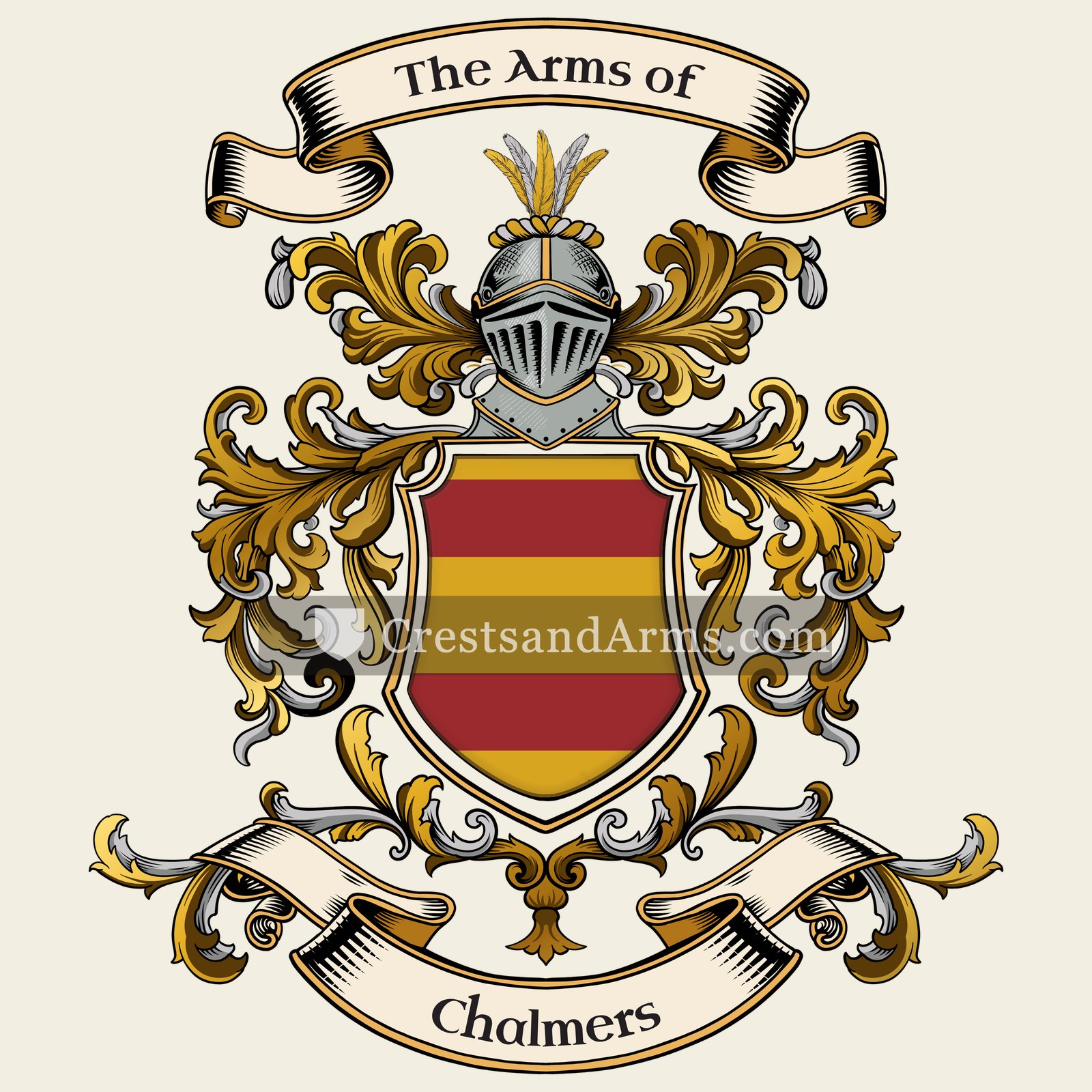


 lionCourage, strength and royalty
 fleur de lisPurity, light, and the sixth son