Map of France showing where the Chalus arms are recorded
The Chalus arms were recorded in Auvergne, c. 1663.
Auvergne was mountain country in the middle of France, poor in money but thick with old families. Estates were small and held for a very long time, and long tenure counted for more than wealth when it came to arms.
This is where the arms were entered in the register. Families often moved to other parts of the country, so the same name can turn up in more than one region.
The body that granted and recorded arms in France in this period.
Louis XIV of France
Sovereign of the period
Louis XIV of France
1643–1715
Reigning in France when the Chalus arms are first recorded.
How Arms Worked in France
In France, a coat of arms was a mark of honor that passed down through the male line to all legitimate descendants. Families often used the same shield without changes to show their shared heritage. If a branch wanted to stand out, they could add a small mark to their shield to show their specific place in the family tree.
Granting authority
The Juge d'armes de France acted as the official authority that regulated and verified coats of arms across the country.
How they got arms
Families typically inherited their arms from ancestors, though they could also receive them through royal grants or by proving their noble status.
Where arms were recorded
Coats of arms were officially recorded in the Armorial Général de France, which began its main collection in the year 1696.
The family's standing
Recorded among the armigerous families of Auvergne.
Origin & History of the Chalus Family in France
The family name Chalus originates from the rugged, mountainous region of Auvergne in central France. By the year 1663, records confirm that members of the family were well-established in this area, likely living as farmers or local tradespeople who relied on the volcanic soil and high pastures for their livelihood. The name itself is topographical, meaning it was likely given to people who lived near a specific landmark or a small settlement known as Chalus. Because Auvergne was historically isolated by its difficult terrain, families in this region often stayed in the same villages for many generations, creating deep roots in the local community. These early ancestors lived through a time of significant transition in rural France, where local customs and regional identities were far more important than national politics. By remaining in the heart of the Massif Central, the Chalus family became a permanent part of the social fabric of the Auvergne province.
Chalus Meaning & Related Branches
Root word
calx
Latin term meaning limestone, lime, or a stony heel.
This name
ChalusA topographic name for someone living near a limestone outcrop or a stony, chalky area.
also spelled
Chaluse
Chaluss
Shalu
Chalu
Documented Sources
J. B. Rietstap, Armorial Général, Gouda: G. B. van Goor Zonen, 1884–87
Archives départementales du Puy-de-Dôme, Registres paroissiaux et d'état civil, 1663
Dauzat, Albert, Dictionnaire étymologique des noms de famille et prénoms de France, 1951
Fournier, Gabriel, Le peuplement rural en Basse-Auvergne durant le haut Moyen Âge, 1962
Digital archive packCoat of arms PNG, gold border print PDF, vector SVG and the certificate of authenticity. Sent to your email in minutes.


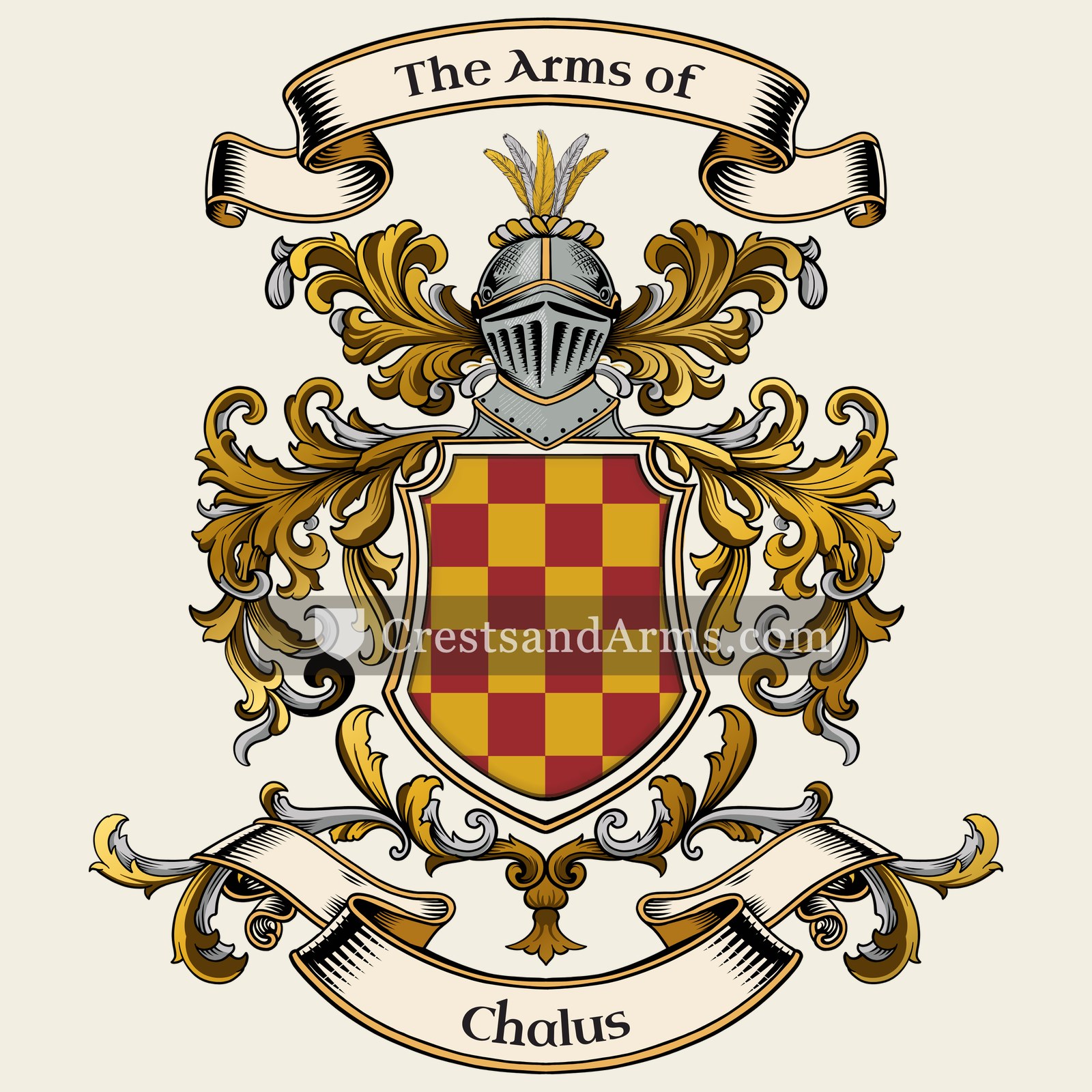
 chequyConstancy, and the counting-board
 chequyConstancy, and the counting-board