A record of documented arms, meaning and origin, researched for the Chambless family lines. Documented in 2 countries.
Reg. 7965 · French, A–C
Coat of Arms & Family Crest Details
Symbols on this shield
cross symbolChristian faith and service
eagleNobility, strength and a keen mind
fleur de lisPurity, light, and the sixth son
Colours
Gold (Or)Means: Generosity
Silver (Argent)Means: Peace and sincerity
Black (Sable)Means: Constancy
Historical info
Source
J. B. Rietstap, Armorial Général, Gouda: G. B. van Goor Zonen, 1884–87
Blazon (the actual original written record)
“Ec., d'or à une aigle de sa., cour. d'or, languée de gu., et d'azur à une fleur-de-lis d'arg.; à la croix d'arg., br. sur l'écartelé. Cq. cour. C.: une aigle de l'écu. L.: à dextre d'or et d'azur, à sen. d'arg. et de sa.”
BourgogneBourgogne, c. 1663
Digital archive packCoat of arms PNG, gold border print PDF, vector SVG and the certificate of authenticity. Sent to your email in minutes.
Map of France showing where the Chambless arms are recorded
The Chambless arms were recorded in Bourgogne, c. 1663.
Bourgogne was one of the richest parts of France, built on wine, wool and the roads that carried both. Wealth of that kind bought land, and land brought arms, so the region filled with armed families earlier than most of the country.
This is where the arms were entered in the register. Families often moved to other parts of the country, so the same name can turn up in more than one region.
The body that granted and recorded arms in France in this period.
Louis XIV of France
Sovereign of the period
Louis XIV of France
1643–1715
Reigning in France when the Chambless arms are first recorded.
How Arms Worked in France
In France, a coat of arms was a mark of honor that passed down through the male line to all legitimate descendants. Families often used the same shield without changes to show their shared heritage. If a branch wanted to stand out, they could add a small mark to their shield to show their specific place in the family tree.
Granting authority
The Juge d'armes de France acted as the official authority that regulated and verified coats of arms across the country.
How they got arms
Families typically inherited their arms from ancestors, though they could also receive them through royal grants or by proving their noble status.
Where arms were recorded
Coats of arms were officially recorded in the Armorial Général de France, which began its main collection in the year 1696.
The family's standing
Recorded among the armigerous families of Bourgogne.
Origin & History of the Chambless Family in France
The family name Chambless finds its historical roots in the Burgundy region of France, where records confirm the presence of family members as early as 1663. During this period, the name was closely tied to the rural landscapes and social structures of the French countryside. Families in this area often took their names from specific local landmarks or the nature of their agricultural work. Life in seventeenth-century Burgundy was defined by the rhythms of the seasons and the influence of local landholders. As the family established their presence in the region, they became part of the complex social fabric of village life. This era was a time of significant transition in France, and the ancestors of the Chambless line lived through the challenges and developments that shaped the local community. Their history reflects the broader experiences of families who built their lives in the heart of the French provinces during the reign of King Louis XIV.
Coat of Arms & Family Crest Details
Symbols on this shield
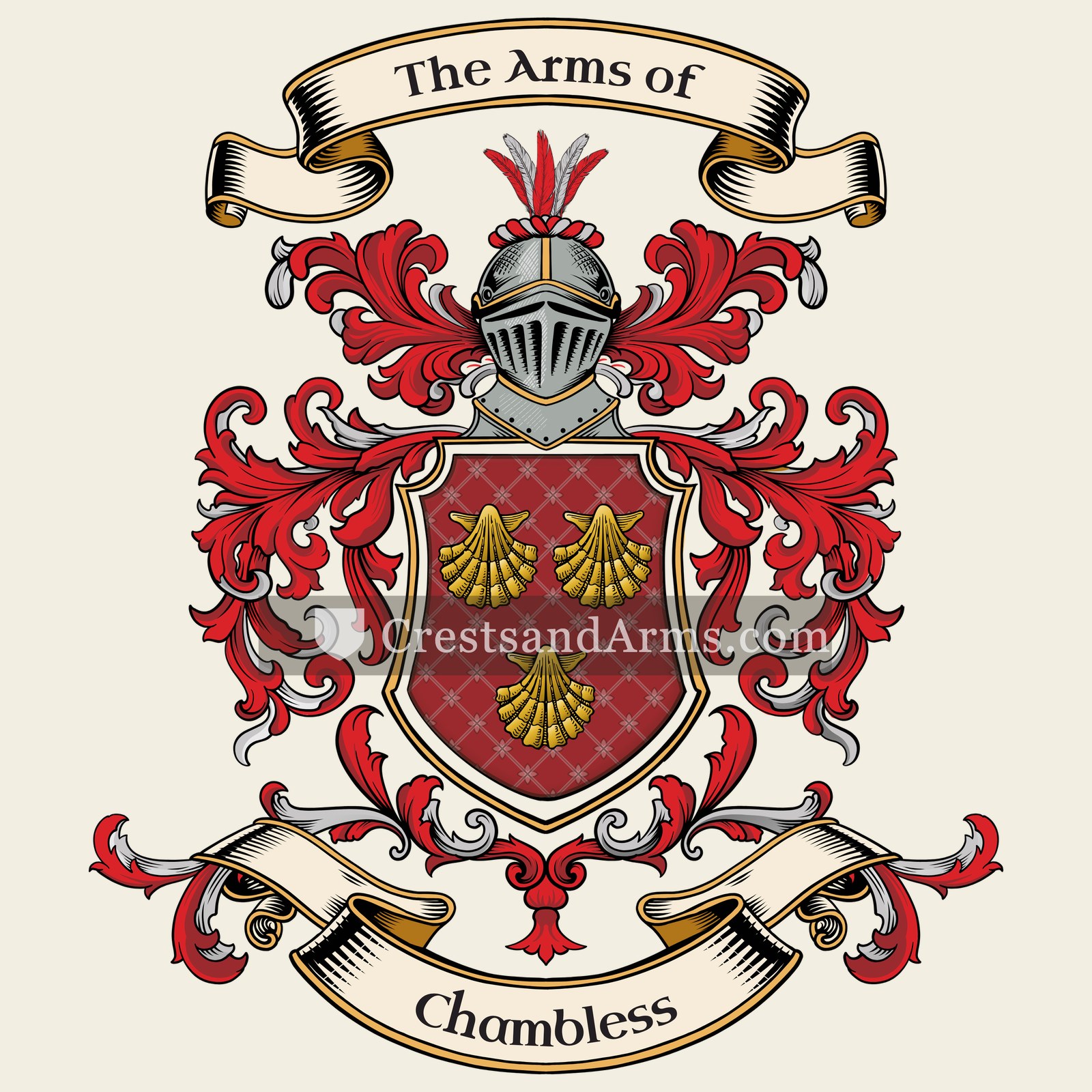
escallopThe pilgrim's shell, and a long journey made
Colours
Red (Gules)Means: Military strength
Gold (Or)Means: Generosity
Historical info
Source
Sir Bernard Burke, The General Armory of England, Scotland, Ireland and Wales, London: Harrison & Sons, 1884
Blazon (the actual original written record)
“Gu. three escallops or”
Englandc. 1620
Digital archive packCoat of arms PNG, gold border print PDF, vector SVG and the certificate of authenticity. Sent to your email in minutes.
Map of England showing where the Chambless arms are recorded
The Chambless arms were recorded in England, c. 1620.
Arms such as these were typically recorded in York.
Yorkshire is the largest of the English counties, and it held more gentry families than any other. Land there was split among a great many households rather than a few, so a great many of them carried arms.
This is where the arms were entered in the register. Families often moved to other parts of the country, so the same name can turn up in more than one region.
The body that granted and recorded arms in England in this period.
James VI and I
Sovereign of the period
James VI and I
1603–1625
Reigning in France when the Chambless arms are first recorded.
How Arms Worked in England
English heraldry allowed arms to be shared by all legitimate descendants of the original owner. These symbols were treated as personal property that moved through the generations to all children. While the eldest son kept the original design, other family members could use the same shield without needing to change it or register their own unique versions.
Granting authority
The College of Arms in London has regulated the use of coats of arms throughout England and Wales since 1484.
How they got arms
Families typically obtained their coats of arms through a formal grant from the Crown or by proving their ancient right to them.
Where arms were recorded
All official coats of arms are recorded in the registers kept at the College of Arms, which date back to the fifteenth century.
The family's standing
Recorded among the armigerous families of England.
Origin & History of the Chambless Family in England
The surname Chambless is believed to have originated in England as a descriptive name rooted in the medieval social structure. Etymologists often link the name to the Old French word "chambrier," which referred to a chamberlain or a servant who managed the private rooms of a noble household. By the time the family was recorded in York in 1620, the name had likely evolved from a professional title into a hereditary surname passed down through generations. Living in a major northern hub like York suggests that early members of the family were part of the growing urban middle class during the seventeenth century. During this period, the city served as a vital center for trade and administration, providing a stable environment for families to establish their roots and document their presence in local parish registers. This transition from a job title to a permanent family name reflects the broader shift in English society as surnames became necessary to identify individuals within expanding communities.
Related Branches & Arms
Root word
chambre
A room or chamber derived from the Latin camera.
This name
ChamblessAn occupational name for a servant who worked in the private chambers of a nobleman.
also spelled
Chamblay
Chambly
Shamblay
Chambleie
Chambelie
Documented Sources
J. B. Rietstap, Armorial Général, Gouda: G. B. van Goor Zonen, 1884–87
Archives départementales de la Côte-d'Or, Registres paroissiaux et d'état civil, 1663
Bouchard, Gérard, Quelques arpents d'Amérique: Population et économie du peuplement français, 1996
Garnier, Joseph, Chartes de communes et d'affranchissements en Bourgogne, 1867
Digital archive packCoat of arms PNG, gold border print PDF, vector SVG and the certificate of authenticity. Sent to your email in minutes.


 cross symbolChristian faith and service
 eagleNobility, strength and a keen mind
 fleur de lisPurity, light, and the sixth son
 cross symbolChristian faith and service
 eagleNobility, strength and a keen mind
 fleur de lisPurity, light, and the sixth son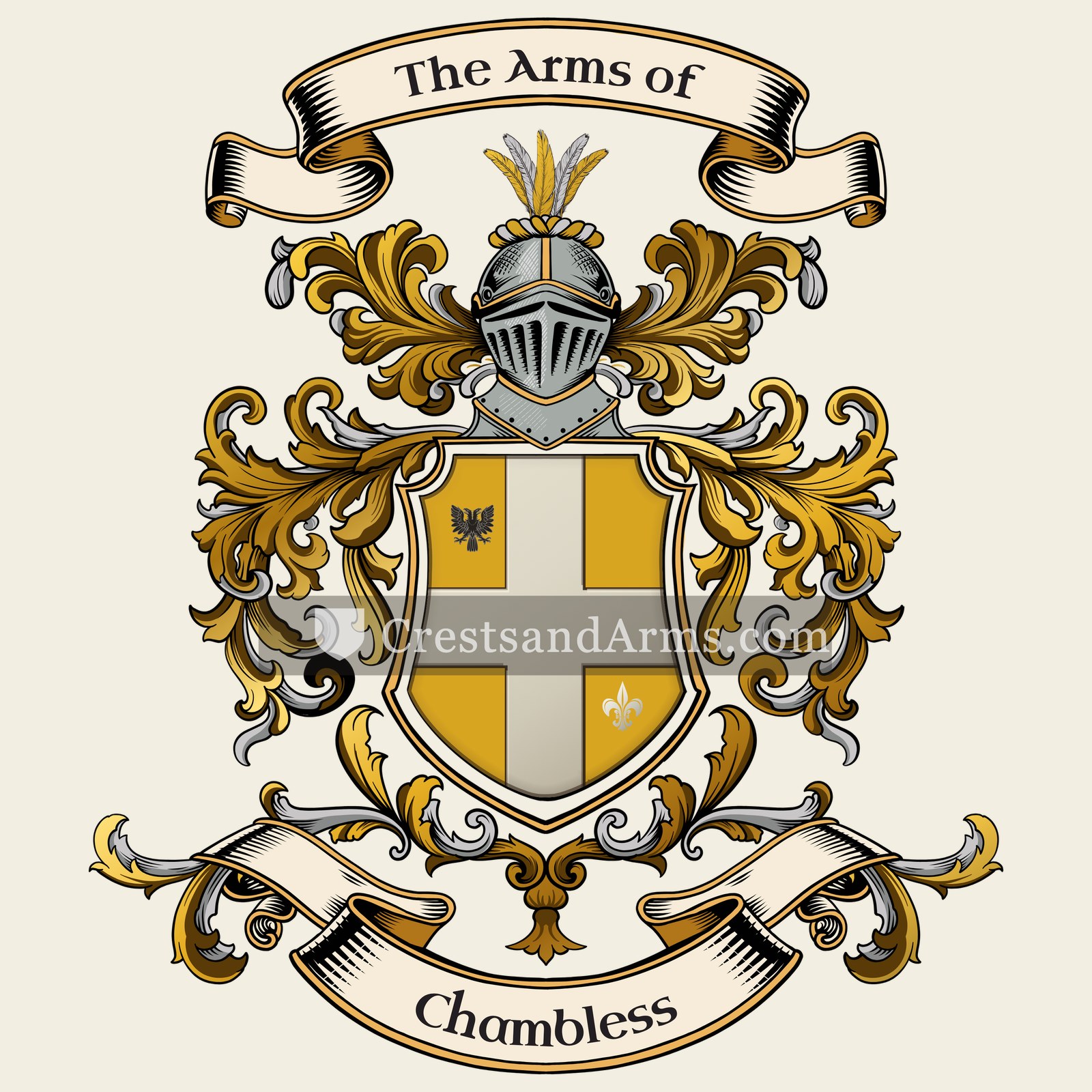


 escallopThe pilgrim's shell, and a long journey made