Map of France showing where the Chapa arms are recorded
The Chapa arms were recorded in Grenoble, c. 1663.
This is where the arms were entered in the register. Families often moved to other parts of the country, so the same name can turn up in more than one region.
The body that granted and recorded arms in France in this period.
Louis XIV of France
Sovereign of the period
Louis XIV of France
1643–1715
Reigning in France when the Chapa arms are first recorded.
How Arms Worked in France
In France, a coat of arms was a mark of honor that passed down through the male line to all legitimate descendants. Families often used the same shield without changes to show their shared heritage. If a branch wanted to stand out, they could add a small mark to their shield to show their specific place in the family tree.
Granting authority
The Juge d'armes de France acted as the official authority that regulated and verified coats of arms across the country.
How they got arms
Families typically inherited their arms from ancestors, though they could also receive them through royal grants or by proving their noble status.
Where arms were recorded
Coats of arms were officially recorded in the Armorial Général de France, which began its main collection in the year 1696.
The family's standing
Recorded among the armigerous families of France.
Origin & History of the Chapa Family in France
The family name Chapa has deep roots in the mountainous region of southeastern France, particularly within the city of Grenoble. By the year 1663, records confirm that members of the Chapa family were already established residents of this area. The name is likely derived from the Old French word "chape," which referred to a specific type of hooded cloak or cape worn during the medieval period. It is probable that the name began as a descriptive nickname for a person who either made these garments or was frequently seen wearing one. As the family grew in Grenoble, they became part of the local social fabric, living through the shifting political and religious landscapes of the seventeenth century. Their presence in the city suggests they were integrated into the trade and civic life of the Dauphiné province, contributing to the regional history of the French Alps.
Coat of Arms & Family Crest Details
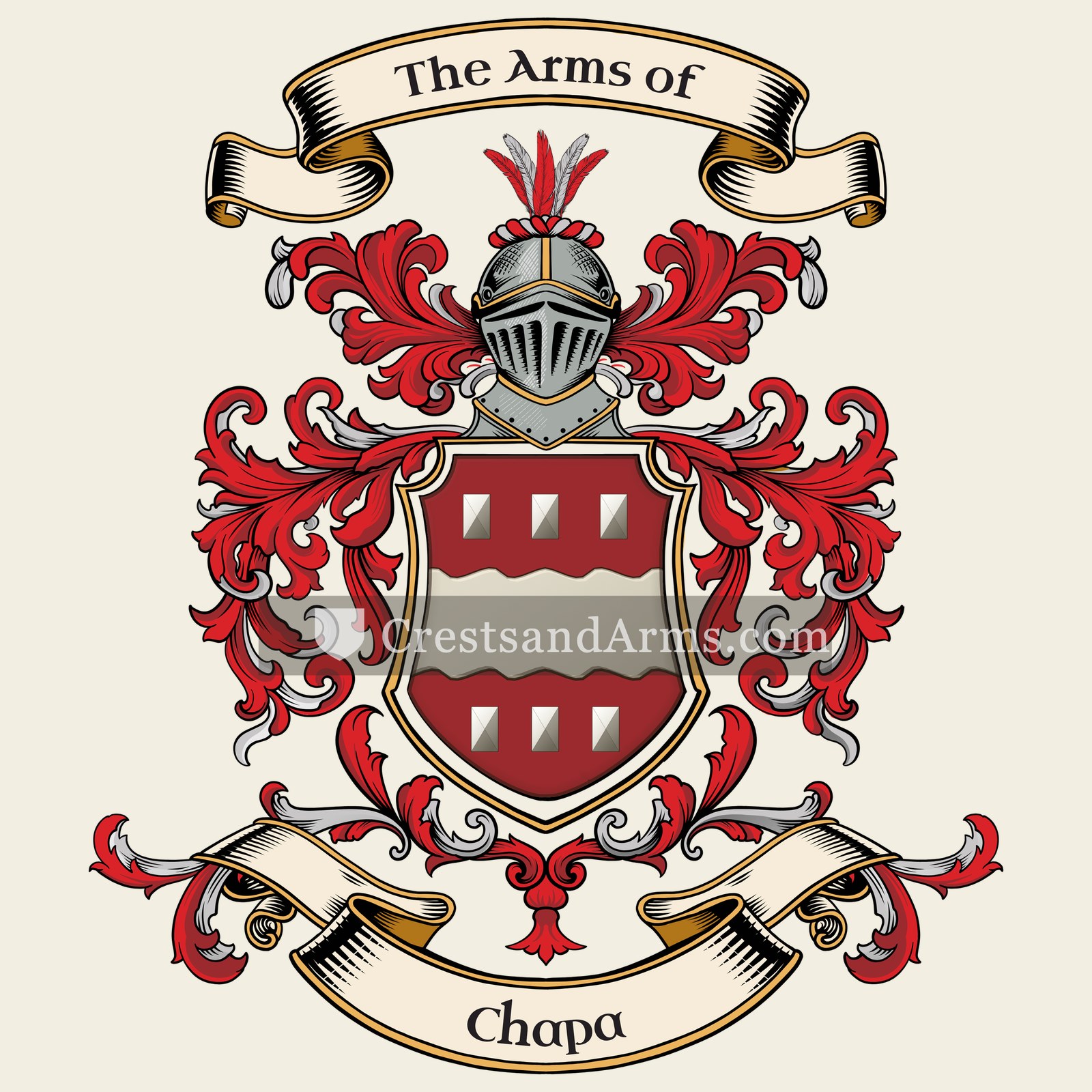
Symbols on this shield
fessThe military belt, and readiness to serve
billetThe sealed letter, and a message delivered
Colours
Red (Gules)Means: Military strength
Silver (Argent)Means: Peace and sincerity
Historical info
Source
Sir Bernard Burke, The General Armory of England, Scotland, Ireland and Wales, London: Harrison & Sons, 1884
Blazon (the actual original written record)
“Gu. a fesse wavy betw. six billets ar”
NorfolkNorfolk, c. 1620
Digital archive packCoat of arms PNG, gold border print PDF, vector SVG and the certificate of authenticity. Sent to your email in minutes.
Map of England showing where the Chapa arms are recorded
The Chapa arms were recorded in Norfolk, c. 1620.
Norfolk grew rich on wool and grain, and its wealth was spread among many middling families rather than a few great ones. Households of that kind bought land and took arms, and the county holds a large share of English names.
This is where the arms were entered in the register. Families often moved to other parts of the country, so the same name can turn up in more than one region.
The body that granted and recorded arms in England in this period.
James VI and I
Sovereign of the period
James VI and I
1603–1625
Reigning in France when the Chapa arms are first recorded.
How Arms Worked in England
English heraldry allowed arms to be shared by all legitimate descendants of the original owner. These symbols were treated as personal property that moved through the generations to all children. While the eldest son kept the original design, other family members could use the same shield without needing to change it or register their own unique versions.
Granting authority
The College of Arms in London has regulated the use of coats of arms throughout England and Wales since 1484.
How they got arms
Families typically obtained their coats of arms through a formal grant from the Crown or by proving their ancient right to them.
Where arms were recorded
All official coats of arms are recorded in the registers kept at the College of Arms, which date back to the fifteenth century.
The family's standing
Recorded among the armigerous families of Norfolk.
Origin & History of the Chapa Family in England
The family name Chapa holds a distinct place in the historical records of Norfolk, England, dating back to at least 1620. During this period, the region was a bustling center of trade and agriculture, and families like the Chapas were often deeply integrated into the local parish life. The name itself likely emerged from regional linguistic patterns, potentially linked to occupational or topographical identifiers common in East Anglia at the time. As residents of Norfolk, early family members lived through a time of significant social change, including the rise of local manufacturing and the expansion of maritime connections through nearby ports. By settling in this specific part of England, the family became part of the enduring fabric of Norfolk history, contributing to the local community long before the name spread to other parts of the world.
Chapa Meaning & Related Branches
Root word
cappa
Latin term for a hooded cloak or cape.
This name
ChapaAn occupational surname for a maker or seller of hooded cloaks.
also spelled
Chappe
Chapp
Shap
Chaps
Documented Sources
J. B. Rietstap, Armorial Général, Gouda: G. B. van Goor Zonen, 1884–87
Archives départementales de l'Isère, Registres paroissiaux de Grenoble (1663)
Dauzat, Albert, Dictionnaire étymologique des noms de famille et prénoms de France, 1951
Morlet, Marie-Thérèse, Dictionnaire étymologique des noms de famille, 1991
Digital archive packCoat of arms PNG, gold border print PDF, vector SVG and the certificate of authenticity. Sent to your email in minutes.


 savages head affrontyAn enemy overcome
 savages head affrontyAn enemy overcome
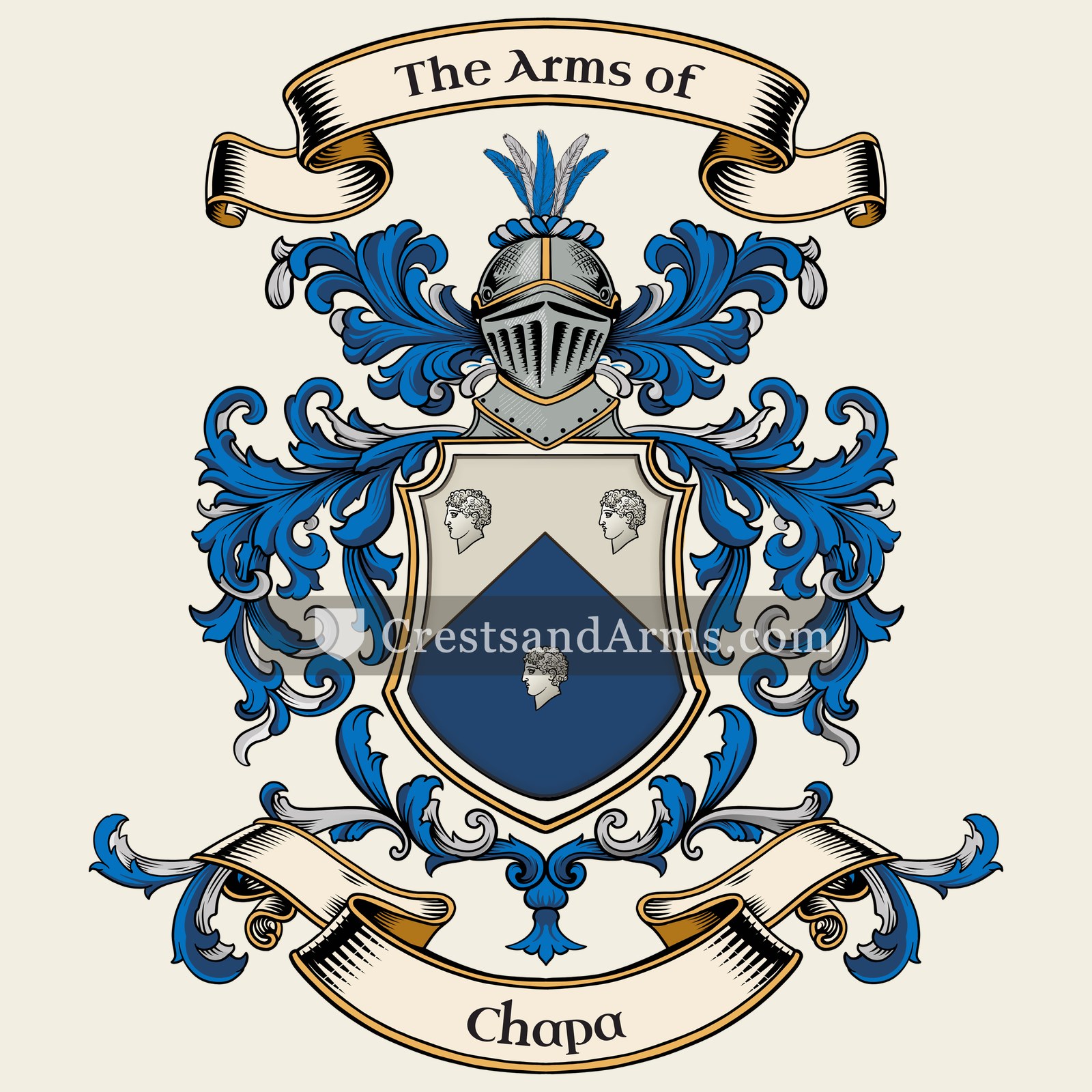


 fessThe military belt, and readiness to serve
 billetThe sealed letter, and a message delivered