Map of Belgium showing where the Chapelle arms are recorded
The Chapelle arms were recorded in Tournaisis, c. 1737.
This is where the arms were entered in the register. Families often moved to other parts of the country, so the same name can turn up in more than one region.
The body that granted and recorded arms in Belgium in this period.
Charles VI, Holy Roman Emperor
Sovereign of the period
Charles VI, Holy Roman Emperor
1711–1740
Reigning in Belgium when the Chapelle arms are first recorded.
How Arms Worked in Belgium
In Belgium, a coat of arms is considered personal property that is passed down through the male line to legitimate descendants. Families often use the same shield design across generations to show their shared heritage. If a branch of the family wants to change the design, they must apply for an official update to their specific version of the arms.
Granting authority
The Conseil héraldique is the official body that regulates and approves all coats of arms in Belgium.
How they got arms
Families obtain their coats of arms through formal royal grants or by confirming their historical right to use existing designs.
Where arms were recorded
All approved coats of arms are officially recorded in the public registers of the Conseil héraldique since 1844.
The family's standing
Recorded among the armigerous families of Belgium.
Origin & History of the Chapelle Family in Belgium
The family name Chapelle originates from the French word for a small church or sanctuary, suggesting that the earliest ancestors likely lived near or worked at a local chapel. By the early eighteenth century, the family established a firm presence in the region of Tournaisis, a historic area in modern-day Belgium known for its deep roots in agriculture and trade. Records from 1737 confirm that members of the family were active participants in the social and economic life of this borderland territory. During this period, the people of Tournaisis lived through complex shifts in power as the region transitioned between different European rulers. The Chapelle family likely adapted to these changes by maintaining their local ties and contributing to the development of their community through farming or skilled labor. Their endurance in this specific part of Belgium highlights a history defined by stability, local identity, and a long-standing connection to the landscape of the Scheldt river valley.
Coat of Arms & Family Crest Details
Symbols on this shield
churchFaith, and the endowment of a house of God
Colours
Blue (Azure)Means: Loyalty and truth
Gold (Or)Means: Generosity
Historical info
Source
J. B. Rietstap, Armorial Général, Gouda: G. B. van Goor Zonen, 1884–87
Blazon (the actual original written record)
“D'azur à une chapelle ou église d'or.”
Francec. 1597
Digital archive packCoat of arms PNG, gold border print PDF, vector SVG and the certificate of authenticity. Sent to your email in minutes.
Map of France showing where the Chapelle arms are recorded
The Chapelle arms were recorded in France, c. 1597.
Arms such as these were typically recorded in Bretagne.
More families held coats of arms in Bretagne than anywhere else in France. The land was divided into many small estates rather than a few large ones, so far more households counted as gentry, and each needed a shield of its own to be told apart.
This is where the arms were entered in the register. Families often moved to other parts of the country, so the same name can turn up in more than one region.
The body that granted and recorded arms in France in this period.
Henry IV of France
Sovereign of the period
Henry IV of France
1589–1610
Reigning in Belgium when the Chapelle arms are first recorded.
How Arms Worked in France
In France, a coat of arms was a mark of honor that passed down through the male line to all legitimate descendants. Families often used the same shield without changes to show their shared heritage. If a branch wanted to stand out, they could add a small mark to their shield to show their specific place in the family tree.
Granting authority
The Juge d'armes de France acted as the official authority that regulated and verified coats of arms across the country.
How they got arms
Families typically inherited their arms from ancestors, though they could also receive them through royal grants or by proving their noble status.
Where arms were recorded
Coats of arms were officially recorded in the Armorial Général de France, which began its main collection in the year 1696.
The family's standing
Recorded among the armigerous families of France.
Origin & History of the Chapelle Family in France
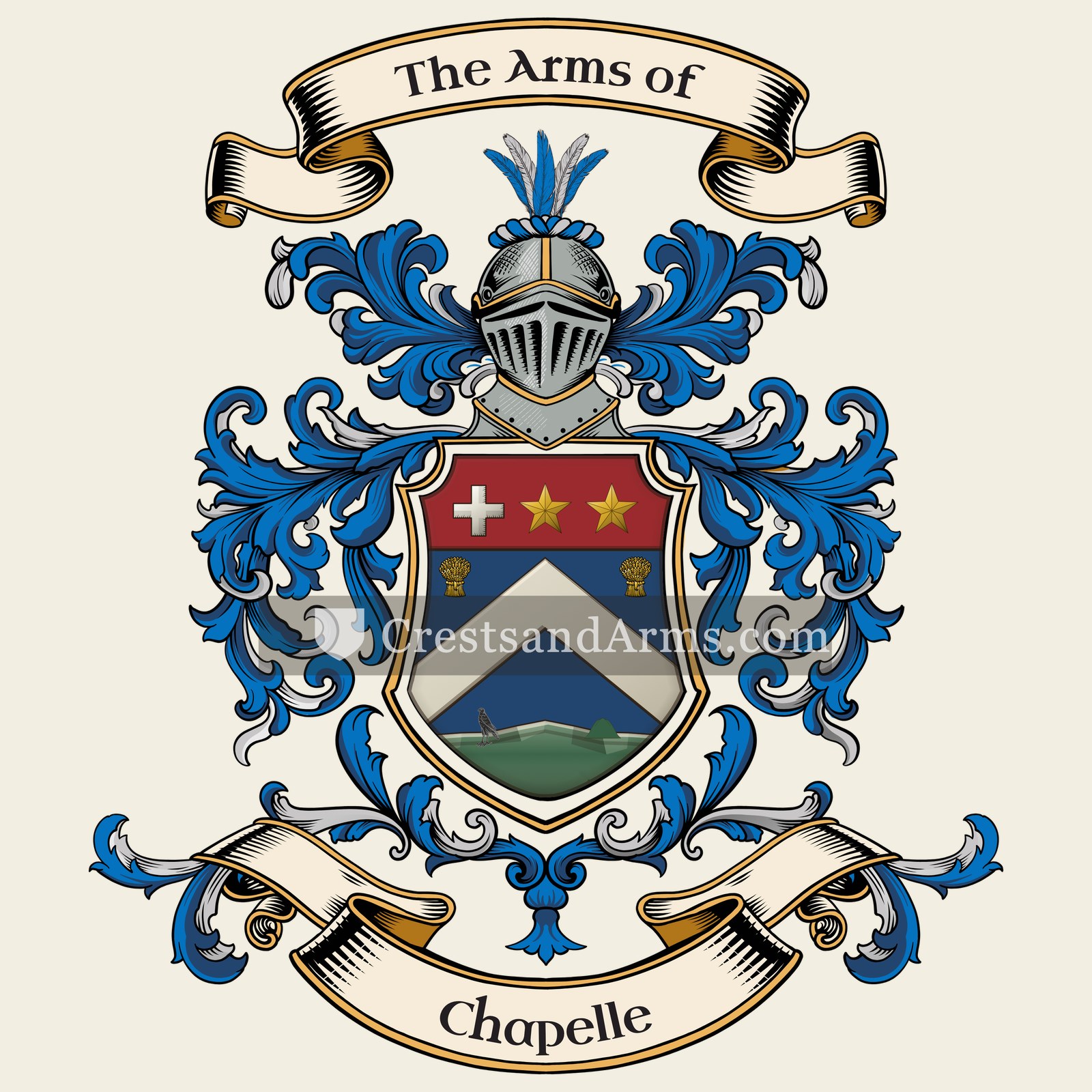
The surname Chapelle originates from the French word for a small church or sanctuary. In the medieval period, families often adopted this name because they lived near a local chapel or served as caretakers for one. By the late sixteenth century, the name was well-established in the Brittany region of France. Records confirm that members of the family were active in this coastal area by 1597. During this era, the family likely navigated the complex social and religious shifts occurring across the French provinces. As people began to move more frequently between rural villages and growing towns, the name became a permanent marker of their geographical and community identity. Over time, the family integrated into the local culture of Brittany, contributing to the agricultural and social development of the region while maintaining their distinct family name.
Coat of Arms & Family Crest Details
Symbols on this shield
chevronProtection, and faithful service completed
mountThe ground held, and steadfastness upon it
chiefAuthority, wisdom and dominion
cross symbolChristian faith and service
wheatsheafPlenty, and the harvest of one's own labour
falconOne eager and quick in pursuit
mulletThe third son, and a divine quality from above
Colours
Blue (Azure)Means: Loyalty and truth
Silver (Argent)Means: Peace and sincerity
Red (Gules)Means: Military strength
Green (Vert)Means: Hope
Gold (Or)Means: Generosity
Historical info
Source
J. B. Rietstap, Armorial Général, Gouda: G. B. van Goor Zonen, 1884–87
Blazon (the actual original written record)
“D'azur au chev. d'arg., côtoyé en chef de deux épis feuillés d'or et acc. en p. d'un épervier au nat., posé sur un tertre de sin.; au chef de gu., ch. d'une croisette pattée d'arg., entre deux étoiles (5) d'or. C.: un bras, arm. d'arg., la main de carn. brandissant une épée d'arg., garnie d'or.”
Finlandc. 1654
Digital archive packCoat of arms PNG, gold border print PDF, vector SVG and the certificate of authenticity. Sent to your email in minutes.
Map of Finland showing where the Chapelle arms are recorded
The Chapelle arms were recorded in Finland, c. 1654.
Arms such as these were typically recorded in Uusimaa.
Uusimaa was the Finnish coast facing Sweden, and the part of the country most closely tied to Stockholm. Its landowners and officers served the Swedish crown, and that service is what put their arms on record.
This is where the arms were entered in the register. Families often moved to other parts of the country, so the same name can turn up in more than one region.
The body that granted and recorded arms in Finland in this period.
How Arms Worked in Finland
Nobility in Finland held the exclusive right to register their coats of arms with the House of Nobility. These symbols were tied to the family name and were inherited by all members of the noble house. If a family branch moved or changed status, they kept their original design to maintain their identity within the official records.
Granting authority
The Finnish House of Nobility served as the official body that managed and protected all noble coats of arms.
How they got arms
Families received their arms through formal letters of nobility or by having their existing ancestral symbols confirmed by the House.
Where arms were recorded
All approved coats of arms were officially recorded in the Finnish House of Nobility Armorial starting in 1818.
The family's standing
Recorded among the armigerous families of Finland.
Origin & History of the Chapelle Family in Finland
The family name Chapelle first appeared in the historical records of the Uusimaa region in 1654. During this period, Finland was part of the Swedish Empire, and the name suggests an origin connected to the French-speaking world or the architectural term for a chapel. Families with this name were often associated with the administrative and military classes that moved throughout the Baltic region during the seventeenth century. By settling in Uusimaa, the early members of this family became part of a small group of outsiders who helped shape the local bureaucracy and social life of the coastal towns. Over time, the name integrated into the local culture as these individuals established roots and participated in the economic development of southern Finland. Their presence serves as a reminder of how European families migrated and adapted to life in the northern reaches of the Swedish realm during the early modern era.
Chapelle Meaning & Related Branches
Root word
capella
Latin term for a small sanctuary or private chapel.
This name
ChapelleRefers to someone who lived near or worked at a small church or shrine.
also spelled
Chappelle
Chapel
Shapel
Related arms
la Serresimilar arms
Chapelvariant spelling
Documented Sources
J. B. Rietstap, Armorial Général, Gouda: G. B. van Goor Zonen, 1884–87
Archives de l'État à Tournai, Registres paroissiaux de la ville de Tournai, 1737
Dion, R., Histoire des levées de la Loire, 1961
Roland, C. G., Histoire généalogique de la famille de Chapelle, 1925
Digital archive packCoat of arms PNG, gold border print PDF, vector SVG and the certificate of authenticity. Sent to your email in minutes.


 chevronProtection, and faithful service completed
 trefoilPerpetuity, and the Trinity
 chevronProtection, and faithful service completed
 trefoilPerpetuity, and the Trinity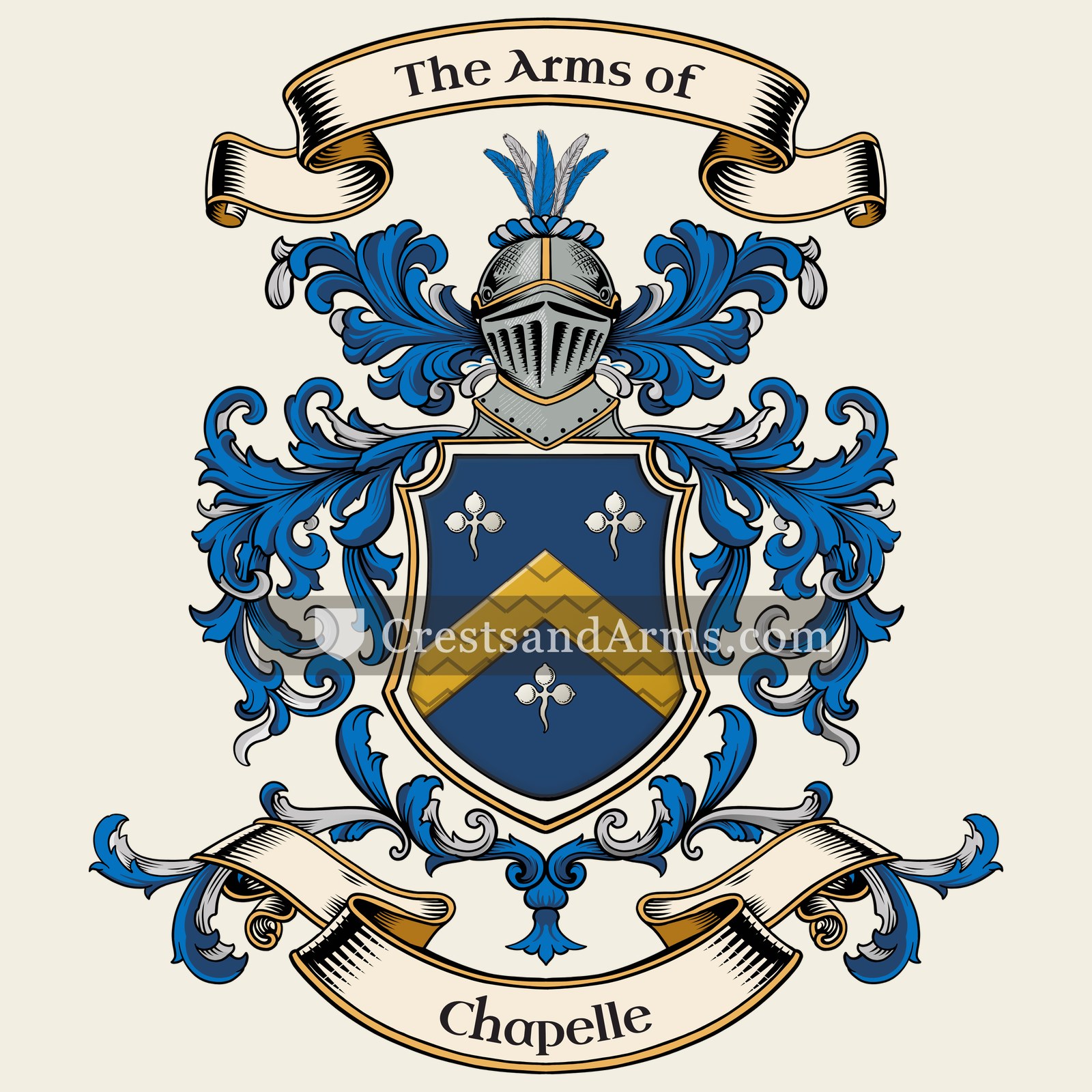


 churchFaith, and the endowment of a house of God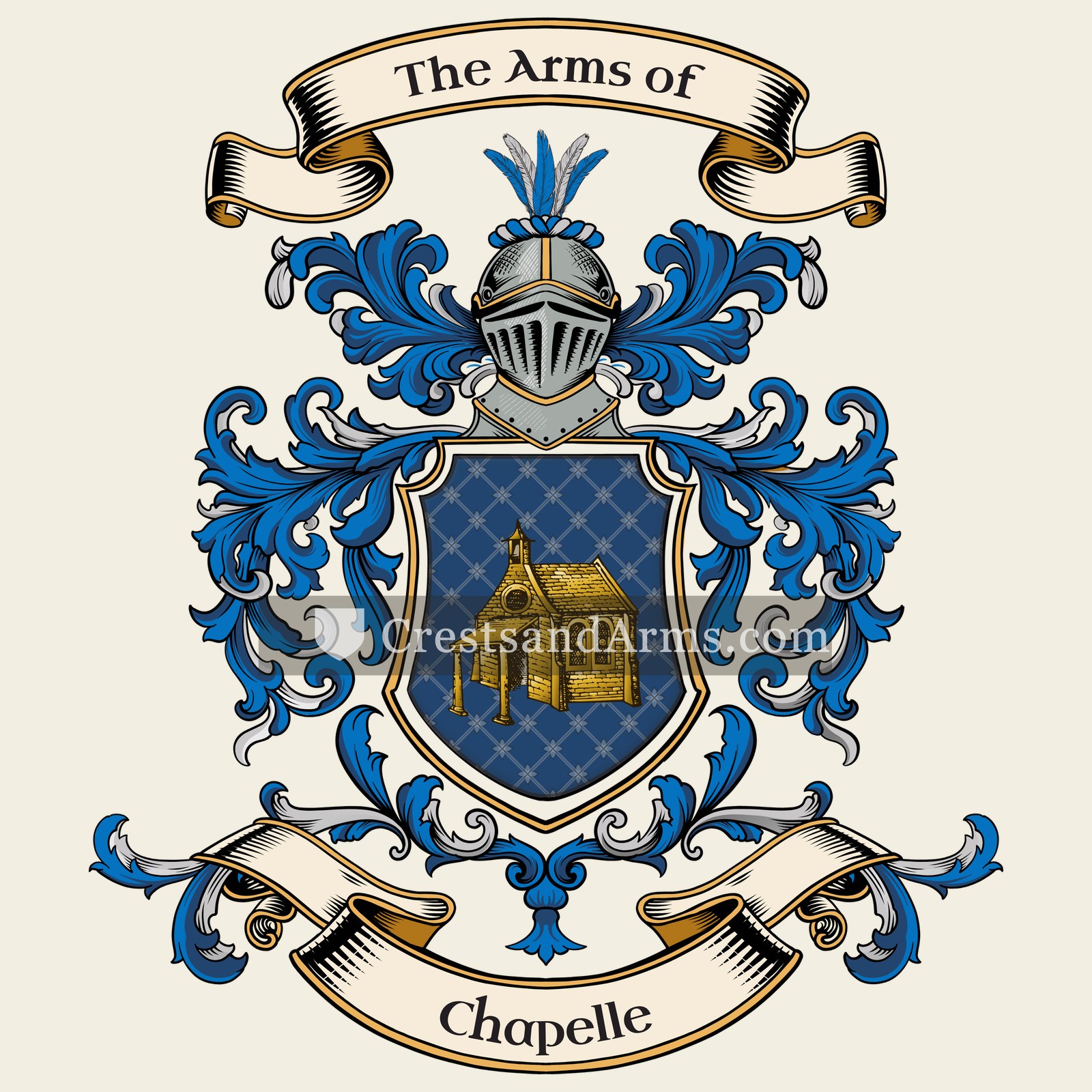


 mountThe ground held, and steadfastness upon it
 chiefAuthority, wisdom and dominion
 cross symbolChristian faith and service
 wheatsheafPlenty, and the harvest of one's own labour
 falconOne eager and quick in pursuit
 mulletThe third son, and a divine quality from above