Map of France showing where the Charenton arms are recorded
The Charenton arms were recorded in Berry, c. 1663.
Berry was central French farming country, quiet and long-settled. Its estates were modest and stayed in the same hands for centuries, and steady landholding of that kind is exactly what puts a name into the heraldic records.
This is where the arms were entered in the register. Families often moved to other parts of the country, so the same name can turn up in more than one region.
The body that granted and recorded arms in France in this period.
Louis XIV of France
Sovereign of the period
Louis XIV of France
1643–1715
Reigning in France when the Charenton arms are first recorded.
How Arms Worked in France
In France, a coat of arms was a mark of honor that passed down through the male line to all legitimate descendants. Families often used the same shield without changes to show their shared heritage. If a branch wanted to stand out, they could add a small mark to their shield to show their specific place in the family tree.
Granting authority
The Juge d'armes de France acted as the official authority that regulated and verified coats of arms across the country.
How they got arms
Families typically inherited their arms from ancestors, though they could also receive them through royal grants or by proving their noble status.
Where arms were recorded
Coats of arms were officially recorded in the Armorial Général de France, which began its main collection in the year 1696.
The family's standing
Recorded among the armigerous families of Berry.
Origin & History of the Charenton Family in France
The name Charenton originates from the historic province of Berry in central France, where the family was firmly established by the year 1663. The name itself is a locative surname, meaning it was likely adopted by individuals who lived in or near a place called Charenton. During the seventeenth century, the region of Berry was a rural landscape defined by agriculture and local trade, which shaped the daily lives of families living there. As the family grew, they became part of the local social fabric, often working as landowners or skilled laborers within the provincial system. By maintaining a presence in this specific region for generations, the Charenton family became deeply connected to the traditions and local history of the Berry area long before the name spread to other parts of France.
Charenton Meaning & Related Branches
Root word
Carantonus
A Gaulish personal name derived from the word for friend or dear.
This name
CharentonRefers to a person originating from the town of Charenton, meaning place of the dear one.
also spelled
Charentonne
Sharonton
Documented Sources
J. B. Rietstap, Armorial Général, Gouda: G. B. van Goor Zonen, 1884–87
Archives départementales du Cher, Registres paroissiaux et d'état civil du Berry
Chérest, Aimé, L'Église et le monastère de Charenton-du-Cher, 1876
Huguenin, Jean-Pierre, Histoire du Berry et de ses familles, 1982
Digital archive packCoat of arms PNG, gold border print PDF, vector SVG and the certificate of authenticity. Sent to your email in minutes.


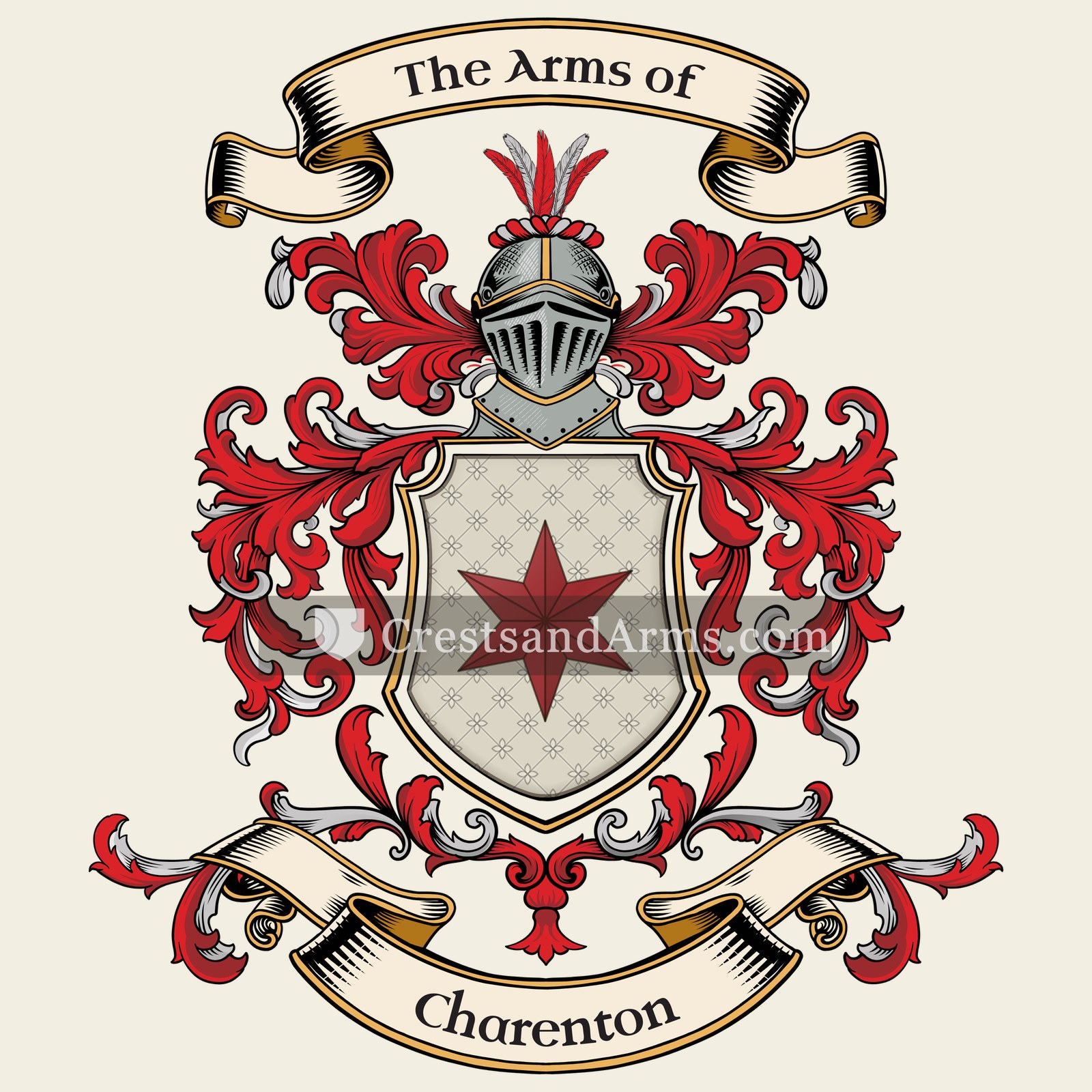
 starThe celestial goddess, and nobility
 starThe celestial goddess, and nobility