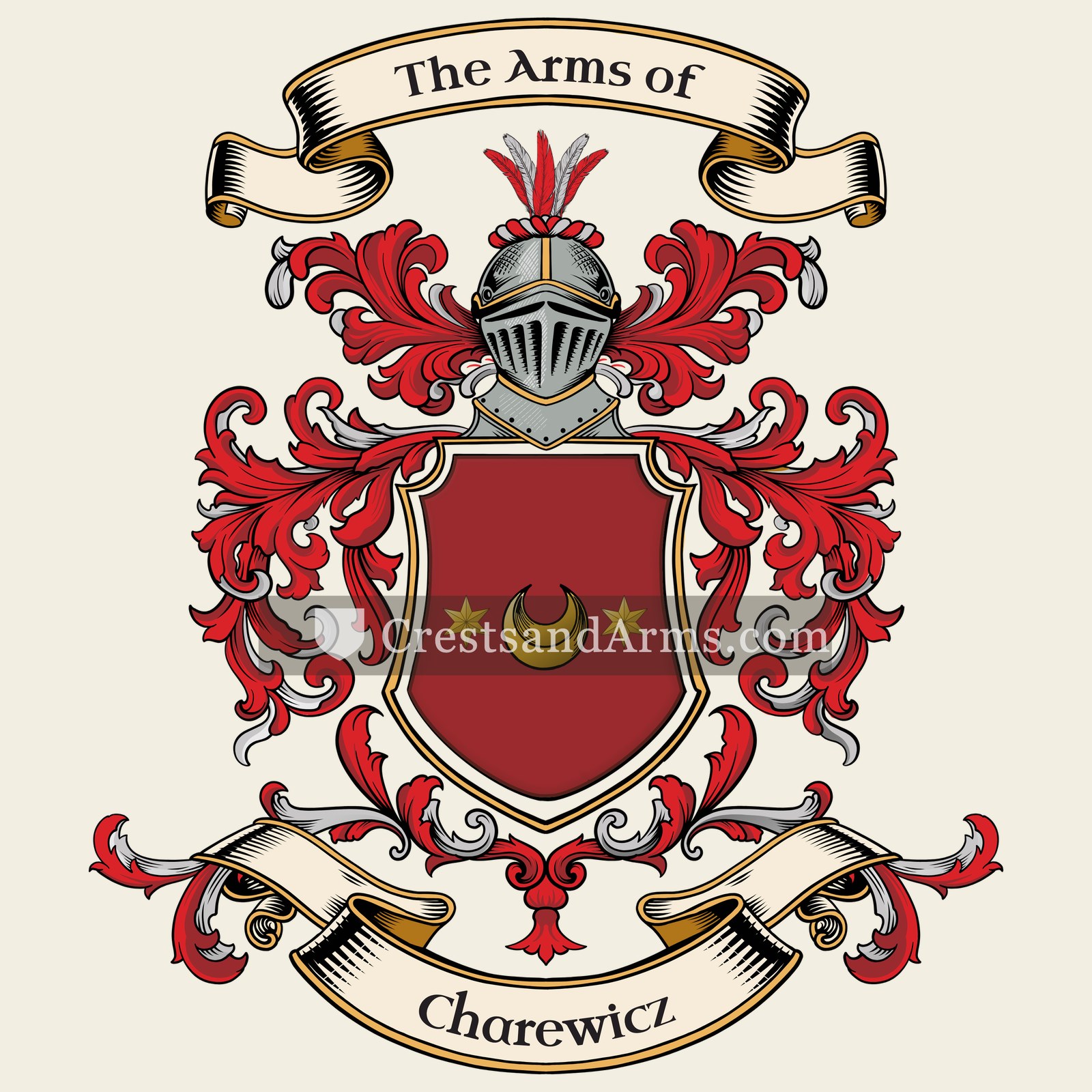
A record of documented arms, meaning and origin, researched for the Charewicz family of Austria.
Reg. 2038 · Austrian, A–C
Coat of Arms & Family Crest Details
Symbols on this shield
crescentHonour by the sovereign, and the second son
starThe celestial goddess, and nobility
Colours
Red (Gules)Means: Military strength
Gold (Or)Means: Generosity
Historical info
Source
J. B. Rietstap, Armorial Général, Gouda: G. B. van Goor Zonen, 1884–87
Blazon (the actual original written record)
“De gu. à un croiss. d'or, en p., surm. d'une flèche d'arg., arm. et empennée du sec., posée en pal; ladite flèche accostée de deux étoiles d'or. Cq. cour. C.: une queue de paon, au nat., transpercée d'une flèche pareille à celle de l'écu, posée en fasce.”
GaliciaGalicia, c. 1772
Digital archive packCoat of arms PNG, gold border print PDF, vector SVG and the certificate of authenticity. Sent to your email in minutes.
Map of Austria showing where the Charewicz arms are recorded
The Charewicz arms were recorded in Galicia, c. 1772.
Galicia was eastern country of large estates and small farming villages, held by families who had been there for a very long time. Land was what entitled a family to arms, and land there rarely changed hands.
This is where the arms were entered in the register. Families often moved to other parts of the country, so the same name can turn up in more than one region.
Region
Galicia
First recorded
1772
Granting Authority for the Charewicz Arms
Imperial and Royal chancery
Sodacan · CC BY-SA 3.0
The body that granted and recorded arms in Austria in this period.
Joseph II, Holy Roman Emperor
Sovereign of the period
Joseph II, Holy Roman Emperor
1765–1790
Reigning in Austria when the Charewicz arms are first recorded.
How Arms Worked in Austria
Austrian coats of arms were often linked directly to noble titles granted by the Emperor. These symbols belonged to the entire family line rather than just one individual. When a family grew, new branches kept the original design without needing to change it. This system allowed all members of a noble house to share the same identity across many generations.
Granting authority
The Imperial and Royal chancery managed all heraldic matters and controlled the official granting of arms throughout the Austrian lands.
How they got arms
Families typically received their arms through a formal imperial decree that often accompanied the elevation of a person to noble status.
Where arms were recorded
Official records of these grants were kept in the Imperial Register of Nobility which began its formal documentation process in 1453.
The family's standing
Recorded among the armigerous families of Galicia.
Origin & History of the Charewicz Family in Austria
The surname Charewicz finds its roots in the historical region of Galicia, which was a territory spanning parts of modern-day Poland and Ukraine. By 1772, when the region was incorporated into the Austrian Empire following the First Partition of Poland, records confirm that families bearing this name were already established residents of the area. The suffix "-wicz" is a patronymic marker common in Slavic naming traditions, indicating that the original bearer was likely the son of a man named Char or a variation of that name. During the late 18th century, the Charewicz family lived within a complex social landscape defined by rural agriculture and the shifting administrative policies of the Habsburg monarchy. As the region underwent significant census taking and land registration under Austrian rule, families like the Charewicz were documented in local parish registers and tax rolls, which helped solidify the name as a permanent fixture in the Galician countryside.
Charewicz Meaning & Related Branches
Root word
Char
Derived from the Slavic word for a sorcerer or magic practitioner.
This name
CharewiczPatronymic surname indicating descent from a person known as a sorcerer or wizard.
also spelled
Charewits
Sharevitch
Documented Sources
J. B. Rietstap, Armorial Général, Gouda: G. B. van Goor Zonen, 1884–87
Gieysztor, Aleksander. Zarys dziejów pisma łacińskiego. 1973
Kuklo, Cezary. Demografia Rzeczypospolitej przedrozbiorowej. 2009
Central State Historical Archives of Ukraine, Lviv. Fond 146: Galicia Viceroyalty (Galicyjskie Namiestnictwo). 1772–1918
Digital archive packCoat of arms PNG, gold border print PDF, vector SVG and the certificate of authenticity. Sent to your email in minutes.


 crescentHonour by the sovereign, and the second son
 starThe celestial goddess, and nobility
 crescentHonour by the sovereign, and the second son
 starThe celestial goddess, and nobility