Map of France showing where the Chargé arms are recorded
The Chargé arms were recorded in Poitou, c. 1663.
Poitou was western French farming country, divided among a large number of small landed families. Its gentry were numerous and modest, and even a small estate was enough to justify a shield.
This is where the arms were entered in the register. Families often moved to other parts of the country, so the same name can turn up in more than one region.
The body that granted and recorded arms in France in this period.
Louis XIV of France
Sovereign of the period
Louis XIV of France
1643–1715
Reigning in France when the Chargé arms are first recorded.
How Arms Worked in France
In France, a coat of arms was a mark of honor that passed down through the male line to all legitimate descendants. Families often used the same shield without changes to show their shared heritage. If a branch wanted to stand out, they could add a small mark to their shield to show their specific place in the family tree.
Granting authority
The Juge d'armes de France acted as the official authority that regulated and verified coats of arms across the country.
How they got arms
Families typically inherited their arms from ancestors, though they could also receive them through royal grants or by proving their noble status.
Where arms were recorded
Coats of arms were officially recorded in the Armorial Général de France, which began its main collection in the year 1696.
The family's standing
Recorded among the armigerous families of Poitou.
Origin & History of the Chargé Family in France
The family name Chargé finds its historical roots in the Poitou region of western France, where members of the family were documented as early as 1663. In the French language, the word *chargé* often relates to the concept of a burden, a responsibility, or someone who has been entrusted with a specific task or office. It is likely that the name originated as a descriptive nickname for an ancestor who held a significant role within their local community or served in a position of administrative duty. During the seventeenth century, families in Poitou were often deeply connected to the land and the local parish structure, which helped preserve these names through generations. As the family grew, they remained part of the social fabric of the region, carrying this name that reflected their historical connection to the duties and roles expected of them in rural French society.
Chargé Meaning & Related Branches
Root word
carricare
Latin verb meaning to load or to carry in a vehicle.
This name
ChargéRefers to someone who worked as a carrier, loader, or freight transporter.
also spelled
Chargey
Chargay
Sharzhay
Documented Sources
J. B. Rietstap, Armorial Général, Gouda: G. B. van Goor Zonen, 1884–87
Archives Départementales de la Vienne, Registres paroissiaux et d'état civil, 1663
Beauchet-Filleau, Henri, Dictionnaire historique et généalogique des familles du Poitou, 1891
Digital archive packCoat of arms PNG, gold border print PDF, vector SVG and the certificate of authenticity. Sent to your email in minutes.


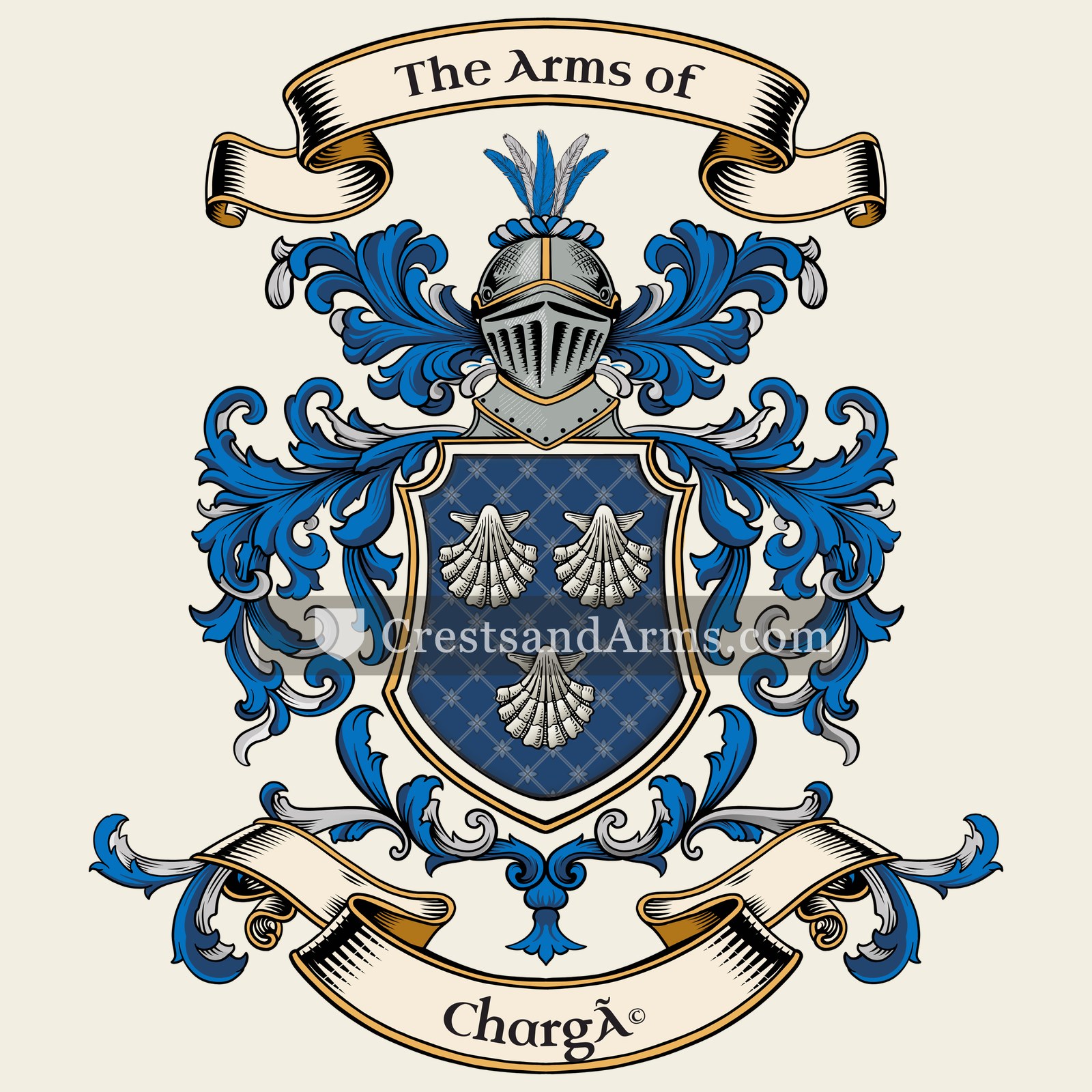
 escallopThe pilgrim's shell, and a long journey made
 escallopThe pilgrim's shell, and a long journey made